



MEPC80 Has Set The Direction Of Travel For The Industry: Ebbinghaus

When Dr Alexandra Ebbinghaus took a few minutes out from her busy schedule to speak with The Motorship, the interview ranged across the themes covered in Shell’s latest All Hands on Deck 2.0 report, but also assessed the likely implications of the MEPC 80 decarbonisation agreements.
The importance of the agreement was that it clearly sent a message to ship owners that they could not take a “wait and see” approach when selecting fuel choices for newbuildings, waiting for the IMO to debate the issue for the next decade.
Encouraging early adoption
Dr Ebbinghaus’ professional background as an engineer with a specialisation in combustion engines, as well as her involvement in high level regulatory discussions as Shell’s representative, ensures that she has a unique perspective on the challenges of reducing the emissions from shipping.
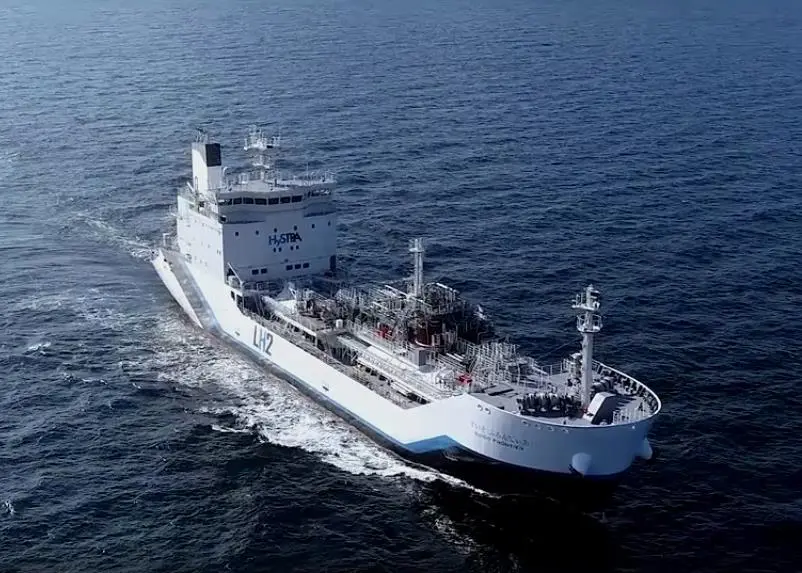
Shell is actively involved in research and development and pilot projects involving a number of alternative fuels, Dr Ebbinghaus noted, citing the company’s participation in a liquid hydrogen transportation pilot project between Japan and Australia, as well as other projects.
However, big-ticket large-scale investments in alternative fuel production projects needs greater clarity about demand for different fuel types. The emergence of voluntary green shipping demand has helped to create a market for alternative fuels, and reforms should make it easier for customers to claim the benefits and use it in their sustainability reporting, but more needs to be done more to expand the market beyond consumer facing sectors where a minority of customers are willing to pay a premium.
Ebbinghaus noted that encouraging wider adoption of alternative fuels would require the creation of a market framework as a necessary precondition for the creation of sustained broader demand for new fuels.
Shipping faces increases in costs
Ebbinghaus was also frank about the future implications of shipping shifting to fuel types used by other modes of transportation, such as aviation or road transportation. Shipping faces direct competition from aviation and road transport for biofuels, and there only a limited prospect of the shipping industry obtaining ring-fenced supplies of fuel feedstock at a discounted price. In other words, there is no scenario in the future where we move to alternative fuels where the cost of fuel doesn’t go up significantly. Ebbinghaus was equally forthright about the economic pressures that introducing electrofuels or green alternative fuels will entail. The conversion of renewable electricity into a liquid fuel or gaseous fuel is going to be an expensive process, requiring electrolysers, and CO2 capture use and storage.
The Motorship previously reported that the production cost of small-scale synthetic natural gas was around 4.5 times that of fossil methane production. Ebbinghaus noted that even if the cost falls with larger scale installations and improved efficiencies, it is likely that the end point is still going to be more expensive. However, unlike biofuel where sustainable feedstocks are limited, synthetic routes do not face the same supply constraint as there is sufficient wind, solar and other renewable sources to meet demand.
Fuel complexity, price differentials and pooling
Ebbinghaus continued that the entry of a number of different fuel types into the fuel market was likely to introduce significantly greater complexity for ship operators. “We saw that the introduction of the 0.5% sulphur limit shifted attention away from managing fuel consumption towards choosing between VLSFO, or HSFO and a scrubber, and looking at LNG.”
The Motorship’s editor notes that the volatility seen in bunker prices since February 2022 has strained historical price differentials between different fuel types, but market participants have noted absolute prices play a lesser role in fuel choices than underlying price differentials between fuels. The Motorship notes that the emergence of regional carbon pricing models, such as the EU’s impending extension of the Emissions Trading System to shipping from April 2024, is likely to complicate the task of managing fuel price models.
Dr Ebbinghaus noted that the introduction of an emissions pooling mechanism to permit shipowners and operators to share carbon emissions offsets across vessels within a company represented a potential solution to ease pressures on shipowners, given the likely emergence of an even greater focus on fuel price differentials as other fuels enter the market. The Motorship notes that similar schemes are under active consideration in other transportation markets.
Biofuel supply to ramp up to meet opportunities
The biofuel market represents an interesting opportunity, and Shell has seen an increase in demand for various types of biofuel, including fatty acid methyl ester (FAME) types. From a technical perspective, biofuels are perfect, Dr Ebbinghaus says, before adding that although the product meets all ship operator requirements, there is still a supply challenge.
The advantages of biofuels are that biofuels would not require signifi cant modifi cations to existing ship engines, and original equipment manufacturers and ship crews have plenty of experience of operating with fuels with variable cold flow properties.
“Energy density is slightly lower than for fuel gas or marine gas oil, but you can just drop it into all the infrastructure, the bunker barges and the fuel tanks.”
However, biofuel supply and potential competition from other industries remain considerable obstacles to increasing biofuel use in shipping.
The global supply of FAME for transportation is under 40 million tonnes, which is equivalent to around 36 million tonnes of fuel oil, if you take into account FAME’s lower energy density.
The majority of FAME is first-generation biofuels, produced by palm oil, soy and rapeseed. The IMO has not yet decided whether to make a decision as to whether fi rst-generation oils were permissible.
With regards to second-generation biofuels, global production is limited to a few million tonnes today, while shipping faces direct competition with the aviation industry which has sustainable aviation fuel (SAF) requirements to meet.
Related Articles
 ALTERNATIVE FUELS & LUBRICANTS
 ALTERNATIVE FUELS & LUBRICANTS
 ALTERNATIVE FUELS & LUBRICANTS