



Joined Up Thinking: MAN’s New NH3 Engine Is On Track
The Motorship: Thomas S. Hansen is Head of Promotion and Customer Support at MAN Energy Solutions and has agreed to discuss the latest progress of MAN ES’ ammonia engine projects. I thought a good place to start might just to get an update on the latest status on your ammonia engine combustion tests, which I believe you’ve just successfully begun at the RCC in Copenhagen.
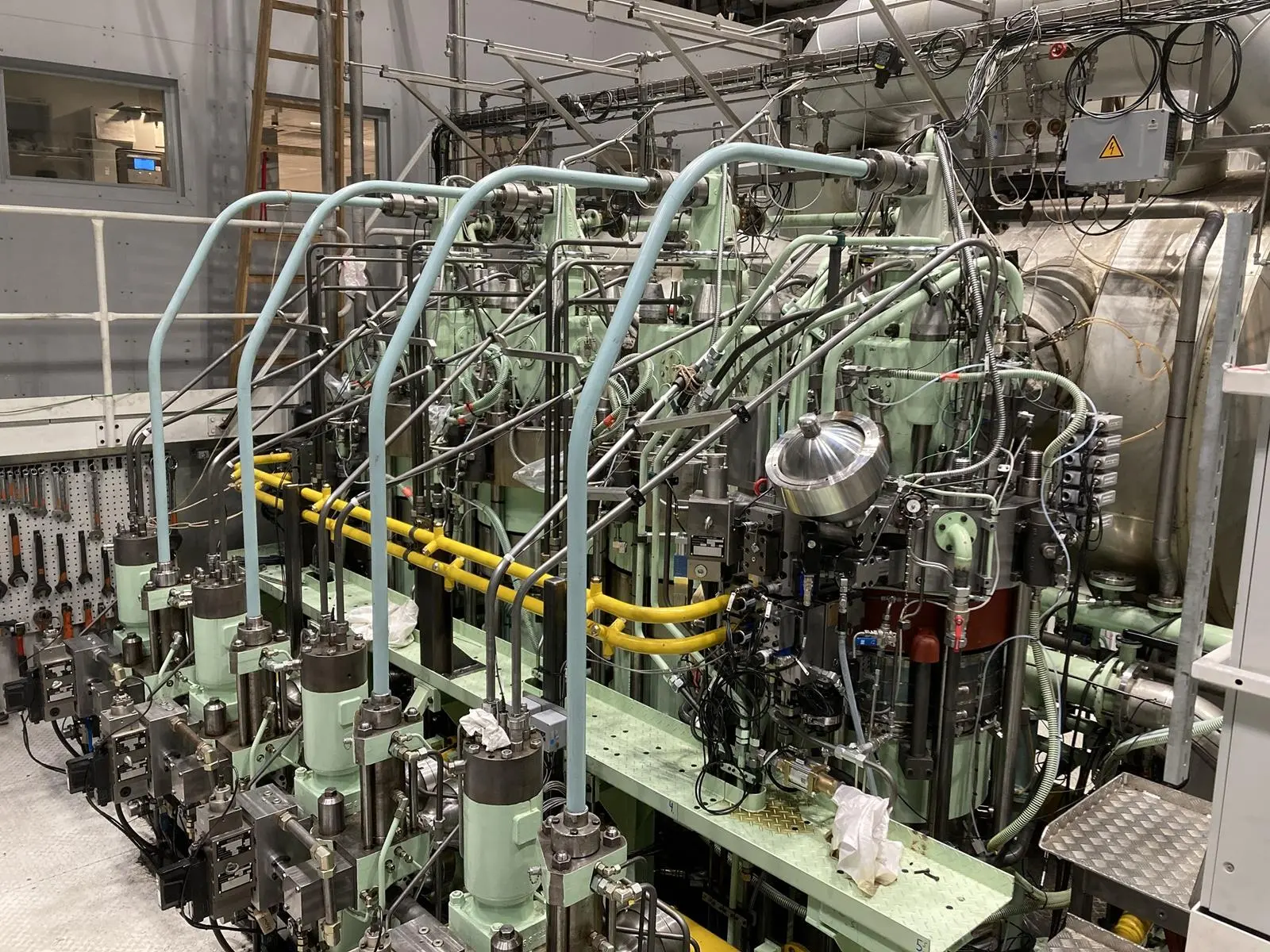
Yes, that was a big moment for us. In July, we started single-cylinder combustion tests on our 4-cylinder 50 bore engine. And it was actually very successful. Within a few hours of [combustion optimisation], we were actually able to run on one cylinder with… a normal combustion… with normal combustion parameters. So, it was a great success
MS: I was wondering if you could give us an update on what how you how you see the development timetable evolving? How long are you expecting to conduct the initial tests for – and I guess the real question that people have is, is when can we expect the fi rst engine to be delivered to a shipyard?
[In terms of the current combustion tests], after the summer break, we will restart the test campaign again. We will continue with that over the remainder of the year. Based on the learnings we will rebuild the engine in preparation for the move from single-cylinder to multi-cylinder running on ammonia. And then in 2024, we will run the whole thing on ammonia. And that will give us you could say the more exact emissions figures and all that also consumption figures and stuff like that to a more exact point. In parallel with that, we are going to be carrying out full scale tests on what we expect will become our first commercial engine at our licensee Mitsui E&S, a 60-bore engine, which will be tested throughout the better part of 2024. And then the plan is that we should finish all of this by the end of 2024. So that the first engine can be delivered to the shipyard by the beginning of March.
We are very interested in the different combustion strategies that you’re evaluating. As I understand it, you’re still assessing which particular route you want to go down [for the wider AEngine development.]
Yes, that is correct. We [initially] chose the Diesel cycle as the basis for the combustion tests and that was also what we started out with now in the tests, and that was very successful. So you can say that this is likely to be the technology which we will pursue.
The very first tests were conducted with 10 to 15 % pilot oil, and we are confident that we can fulfil our target of 5 % The initial results for laughing gas (N2O) are manageable. We are aiming to use our extensive knowledge to eliminate N2O formation as a by-product of combustion, but we are also working on a second path that includes an emission abatement system. So it looks like… we could make a good engine with the Diesel Cycle. But… we also plan to screen the Otto cycle to get exact combustion information firsthand on its [performance and emissions profile]. So we will also carry out a test campaign using an Otto Cycle concept to get those results. But our current thinking is that the Diesel Cycle will prevail for this product. In terms of overall GHG emissions, we’re aiming for a 90% decarbonisation of the ship powertrain in a tank-to-wake sense.
It sounds as if you are a little more definite about when you think you will add the ammonia engine to your engine programme more broadly. Last time we spoke you said you were possibly going to evaluate the first delivery based on a soft launch approach.
[Since] we made that statement about the soft launch… we have further facts, of course, we have gained more confidence and then we will also be able to maybe move a little bit ahead in the decisions in that way. And we are we are looking if we can do more projects, both for the [60-bore] engine size, but all potentially other engine sizes. Nothing has been finalised. I think what the next couple of months will show is whether we can [expand] the number of projects during the initial release phase.
And I guess that leads on to some questions around… commercial interest and an update on how that’s going. Because it sounds as if you are already receiving interest from some interested parties?
Definitely. There’s interest for container ship applications, as well as for bulk carrier applications. And, and even for other ship types as well. I think we will be able [announce] some good projects for… the commercial release, if you will. The interest is [by no means limited to] European companies. For instance, the interest from the bulk carrier segment is being driven by certain charterers who would like to have green propulsion. They’re seeking shipowners who would like to buy ships with which they could then enter into charter contracts.
If we can just follow up on that a little bit. There have been some recent announcements, obviously, including some of the decisions at MEPC80. Do you see that affecting interest, or would you say it simply confirms the interest from some people you’re already speaking with?
You’re right. If we look back at the decision to develop the Ammonia engine back in 2018, we believed that a strong market for ammonia solutions [would emerge]. What is happening now, at MEPC 80, and elsewhere confirms this direction in shipping propulsion. At MAN ES, we are seeing a strong increase in interest in alternative fuel engines. Looking at our orders, dual-fuel engines accounted for 56% of all orders in 2022. And we have seen a huge increase in orders for methanol dual-fuel engines, which has continued into this year. I would say that the customers who are evaluating methanol, they would also be evaluating ammonia, if was available with the same deadline for the ships on order. Which would bring the choice down to choices about which fuel would be the most beneficial for them to use, comparing fuel supply chain considerations and equipment costs.
That leads us on to other areas, relating to upstream supply, and broader developments in the ammonia supply market, which are very interesting. We’ve been following some of the large scale investments being driven by the hydrogen economy developments in Europe. And it looks like the ammonia engine will become commercially available, roughly, on a similar timescale to the beginning of production for some of these large scale green, ammonia export projects.
Yes, exactly. And this just shows that our decision in 2018, to begin development of the ammonia engine, and simultaneously announce it to the market, was the right one. From the beginning, we recognised that there was a chicken and egg problem, and the engine development was reliant upon expansion of fuel supply. And we have liaised closely with interested parties about our development schedule. So I think it’s no coincidence that the development of the engine and the development of the supply chain are in parallel.
Really interesting. And I was wondering if we could conclude by just looking at some of the most recent safety developments.
Safety is often cited as one of the obstacles that need to be overcome for the introduction of the ammonia engine. I would say that the safety is maybe twofold, right, because there’s both the say the emissions part of it, which is you would say environmental safety, and then there’s also even say, the personal safety to the people working with the onboard the ship, for instance, or working with bunkering. Our investment at our RCC centre in Copenhagen, both in terms of time and money, has worked as it should. We believe that our full-scale facility has proven a kind of a concept as to how you can devise safety measures, and that it has acted as a starting point for classification societies and regulators. In the end, I think that we have established that the [combustion of ammonia] is like any other engineering problem, and it is just a matter of making designs and rules, regulations and procedures. And we have also seen that our [thorough] safety design has worked exactly as intended. And that gives us confidence that the engines can be constructed in a safe manner.
Thank you, thank you so much for taking the time to update us on the progress and it sounds like there will be a lot to talk about in the in the months and years to come.
Thank you. My pleasure
Related Articles
 2-STROKE & 4-STROKE
 2-STROKE & 4-STROKE
 2-STROKE & 4-STROKE