



BV Study Quantifies CCS CII Benefit For Bulker Vessels

BV delivered an Approval in Principle (AiP) to Wah Kwong Maritime Transport Holdings, a Hong Kong shipowner, and Shanghai Marine Diesel Engine Research Institute (SMDERI), a subsidiary of China State Shipbuilding Corporation, for a carbon capture and storage (CCS) project in June. The AiP was delivered following a joint study that validated the technical feasibility of using CCS technology on two existing Wah Kwong bulk carriers.
SMDERI developed a customised design of a CCS unit for the two vessels based on their specific design parameters. The CCS unit has passed laboratory tests, achieving over 85% CO2 capture from the exhaust gas flow, and it is now being continuously optimised and upgraded. The system is based on an organic amine solution that extracts CO2 from exhaust gas before it is liquified and stored.
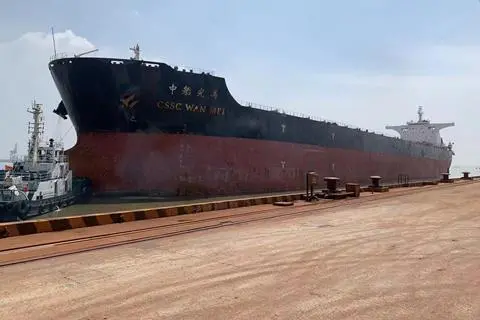
BV provided comprehensive support throughout the project, from vessel selection in the early stages to the design layout of the CCS system on board, certification, and cost analysis. The two vessels selected were the 53,000 dwt Supramax bulk carrier Tianjin Venture and the 176,000 dwt Capesize bulk carrier CSSC Wan Mei. The study showed that in the case that CCS is recognised in the official CII calculations going forward, CCS would enable the two vessels to maintain a CII rating of C until at least 2030. It confirmed the technical viability of retrofitting CCS technology on existing ships to reduce their GHG emissions at the levels required to ensure compliance with the new CII regulation.
Tianjin Venture
The first vessel in the study was the 53k dwt. Supramax Tianjin Venture, which has a MAN 6S50MC-C main engine, three Daihatsu diesel generator engines (not connected to the CCS scrubber) and one composite type steam boiler. An evaluation of the vessel’s operational data (DCS 2021) indicated that if it is to continue operating until 2030, measures will need to be taken to maintain its annual CII rating to an acceptable level (at least a C rating).
A CCS system with a CO2 capture rate of 1 ton per hour would enable the Supramax vessel to extend its C ratings until at least 2030. The system operates with power from the generator engines and with steam generated from the oil-fired composite boiler. The generator engine exhausts and the boiler’s burner exhausts are not connected to the CCS. The CCS captures CO2 emitted from the main engine exhausts in the seagoing condition, therefore, an iterative computation was applied to determine the net CO2 capture rates to attain the desired CII rating. According to the CCS system designed by QIYAO ENVIRON TEC for Tianjin Venture, capturing one ton of CO2 will consume 268 kWh of electrical power and 70 kg of fuel oil for the boiler to produce the extra steam. To attain a C rating in 2023, the CCS would need to capture a total of 1,442 m3 of CO2 which is compressed and liquefied for storage at 7 barg and –46°C. This corresponds to a CO2 capture rate of 10.2% in 2023. As the CII requirements get stricter, the CCS capture rate will need to increase each year, with the capture rate reaching 29.5% (or 4,528 m3) in 2030.
The study examined whether the power and steam available were sufficient to run the system and satisfy all the consumers onboard under all operating conditions. The amount of steam required by the system is 1 t/h at 0.7MPa. Based on the steam balance, with the system in operation during seagoing condition and hotel load at the winter condition, this criterion is met with the existing boiler.
For the supramax Tianin Venture, the smaller of the two ships, the limited space available was one of the biggest challenges to overcome. Additional considerations were the weight of the system and the weight of the captured/stored LCO2 which come at the expense of cargo (except for cases of light cargoes). The LCO2 storage tanks also needed to be adequately sized to retain a satisfactory amount of CO2 considering the ship’s cruising range. For the Tianjin Venture, due to the space limitations, the optimal location for the CCS was found to be around the engine casing aft of the funnel.
Instead of a single large tank, four smaller LCO2 storage tanks were preferred since these were easier to position on the limited deck space. The four tanks would each have a capacity of 100m3 and be installed on deck in way of the No. 5 cargo hatch. Alternatively, the cross decks were also an option to place the tanks. The dry weight of CCS equipment, including the LCO2 tanks, is about 289.3 tons.
The ship’s stability was also considered by the study. The newly added lightweight after the retrofit would have a vertical centre of gravity (VCG) of 21,800mm:
• Intact stability: the intact stability based on the new VCG after retrofit would be approved on the revised loading manual.
• Damage stability: The study highlighted that the damage stability in accordance with the International loadline convention requirement ICLL Reg. 27(11) would be marginal. If this project were to proceed to the detail design stage, the designer should perform a detailed calculation considering heights of openings such as hatch coaming corner tops, vent heads and air pipes, as necessary.
CSSC Wan Mei
The second vessel in the study is the 176k dwt Capesize bulk carrier the CSSC Wan Mei, which has a MAN 6S70MC-C main engine, three Yanmar diesel generators (not connected to the CCS) and one composite type steam boiler (oil-fired burner exhausts not connected to the CCS). Like the Tianjin Venture, the CII ratings of CSSC Wan Mei were estimated and the target CII values calculated for applying CCS technology.
The study showed that a system with a CO2 capture rate of 1.6 tons per hour would enable the Capesize vessel to attain C ratings until at least 2030. The capture of 1.6 tons of CO2 will consume 538kWh of electric power and 112 kg of fuel oil for the boiler to produce the extra steam. The CCS capture rate would need to be 5.8% in 2023 and increase gradually every year to 26.3% in 2030 to maintain a CII rating of C.
The dry weight of the CCS system for the CSSC Wan Mei would be about 364.9 tons, which would result in inevitable loss of cargo carriage. The total capacity of the existing boiler is 4.2 t/h, and with the CCS system in operation, the steam consumption at sea in the winter condition would be 4,498 kg/h. In principle, the capacity of the existing boiler is marginal, so the actual winter operational steam consumption at sea could be re-checked to verify whether the ‘as-built’ ship has this margin or whether the steam consumption should be supplemented by installing additional electric heating in the air handling unit.
As with the Tianjin Venture, from previous experience with scrubber retrofits, there would not be a need to repeat the shaft alignment calculation. As the Cape is a much larger ship than the Supramax, the pre-engineering calculations showed that stability would not be an issue on the Cape.
Cost analysis
A high-level CAPEX and OPEX estimation was carried out, along with a preliminary analysis of the savings from EU ETS allowances for the period from 2023 to 2030. In addition to EU ETS savings, the study also calculated the value of the captured LCO2 assuming it could be potentially traded as a commodity for re-utilization within an LCO2 circular economy. Assuming the ships sail between EU and non-EU ports, and that the legislation accepts CCS as a countermeasure to reduce CO2 emissions, for Tianjin Venture, the EU ETS savings would be $1,375,600 between 2023 to 2030, with the value of the captured LCO2 amounting to $6,767,952. For CSSC Wan Mei, the cost savings from EU ETS would be $2,254,500, with the value of the captured LCO2 amounting to $11,092,140.
This analysis therefore illustrates that the application of CCS technology in ships is feasible and economical under the increasingly strict regulations taking effect. However, there are still uncertainties to be considered, such as whether CCS will be formally recognised under those regulations, how to handle the collected CO2, the potential for a carbon tax to be introduced, and whether non-EU countries will propose similar ETS regulations. These factors will require careful consideration, but there is no doubt that CCS is already an effective technical solution to reduce carbon emissions from ships, and a customised design for specific ships will ensure the best savings while meeting regulations.
Related Articles
 CARBON CAPTURE
 CARBON CAPTURE
 ALTERNATIVE FUELS & LUBRICANTS