



AiP for NH3-fuelled SCR design using ammonia as reductant
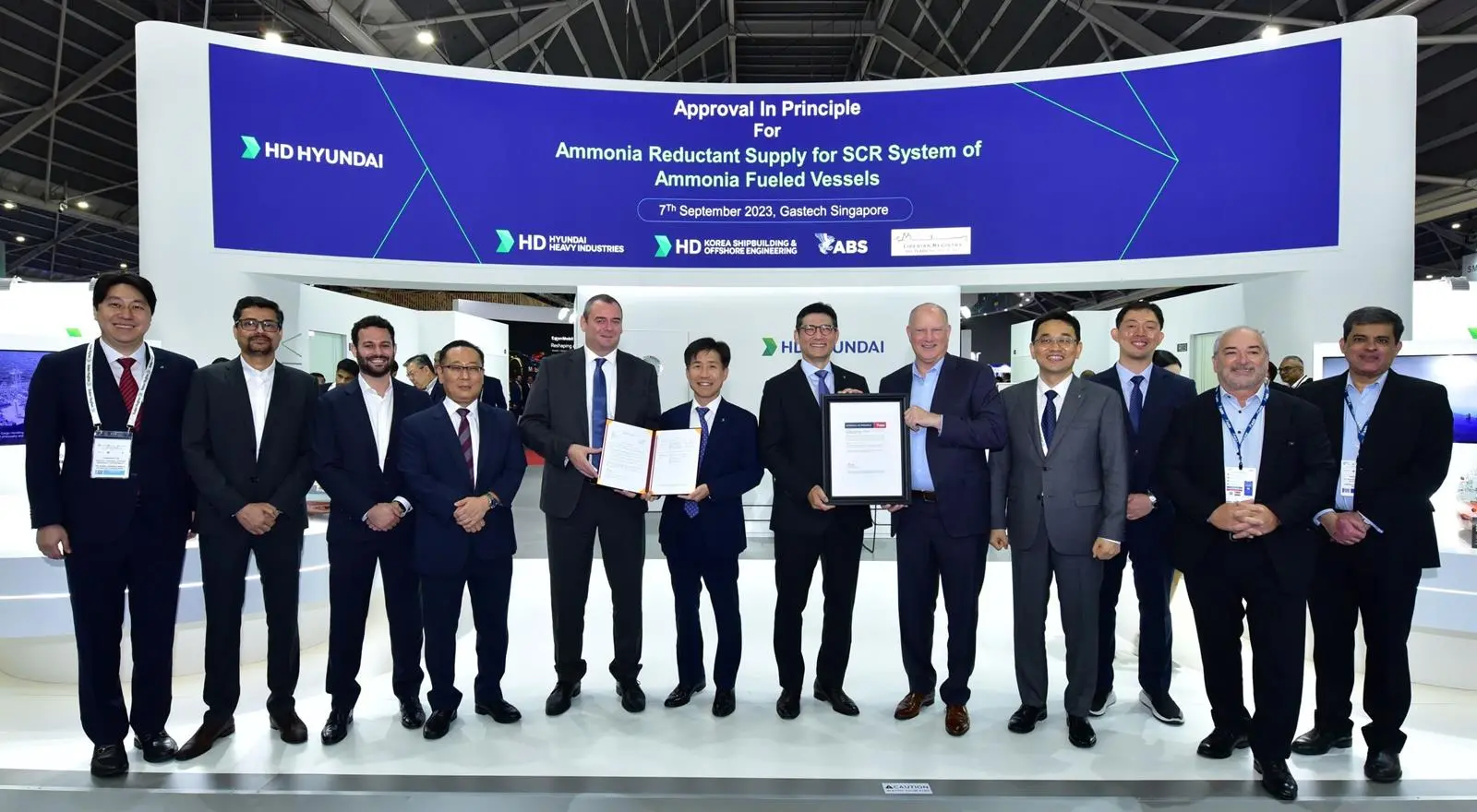
The AIP was presented at Gastech 2023 in Singapore, in a ceremony attended by representatives from both companies and the Liberian International Ship & Corporate Registry (LISCR).
The system utilises the ammonia carried on board as the SCR reductant to remove NOx from emissions as opposed to the urea used in traditional diesel propulsion.
The Motorship notes that using ammonia rather than urea in the catalytic reaction in the SCR results in the conversion of NH3 and NOX to diatomic nitrogen (N2) and water (H2O). This minimises emissions of unburned NH3 (ammonia slip) and the potential formation of nitrous oxide (N2O), a more potent GHG gas.
In addition, the AIP includes a plan to safely treat toxic ammonia gas generated during operation, including a configuration that can use ammonia Boil-Off Gas (BOG) and purge gas generated from an ammonia fuel supply system as an SCR reductant.
“ABS has always been a safety pioneer, so we are well placed to tackle the challenges on board and ashore presented by ammonia’s toxicity and flammability. ABS is committed to leading the industry in supporting ammonia’s safe adoption at sea,” said John McDonald, ABS President and COO.
“After the 80th MEPC, there is a lot of interest in zero-emission ships that use ammonia as fuel. We are pleased to have received the world’s first approval in principle (AIP) from ABS and LISCR for our technology, which aims to improve the safety of ammonia-fueled ships and reduce the operating costs for shipowners. We will continue to develop ammonia-fueled ships that are the best for our customers and look forward to working with ABS and LISCR,” said Sung-Joon Kim, Senior Executive Vice President and CTO at HD KSOE.
“Considering the recent tightening of environmental regulations, ammonia is expected to become a mainstream alternative fuel in the future. Accordingly, the development of ammonia-related technology will be actively developed, and HHI and KSOE are also working on the development of ammonia-related technology. The newly developed ammonia-reducing agent supply system is one of the results of these technological development efforts and is expected to contribute to the efficient operation of ammonia carriers,” said Seung-Ho Jeon, Senior Executive Vice President and CTO at HD HHI.
“As a leader in innovation and decarbonization, we at the Liberian Registry are very proud to join our partners in supporting this pioneering technology. This AIP is a significant step forward in the implementation of zero-carbon fueled vessels,” said Alfonso Castillero, CEO of the Liberian International Ship and Corporate Registry (LISCR).
Related Articles
 2-STROKE & 4-STROKE
 2-STROKE & 4-STROKE
 2-STROKE & 4-STROKE