



WinGD to add more bore sizes to X-DF-M platform

The engine designer has already confirmed orders from customers in China for 10X92DF-M-1.0 engines for a series of 16,000 teu container vessels, and 6X82DF-M-1.0 engines for a series of 8,000 teu container vessels, Marcel Ott, General Manager of Application Engineering at WinGD told the webinar.
The shop test of the first of the series 920mm-bore engines for COSCO is expected to occur in mid Q1 2025, with the shop test of the first of the 820mm-bore X-DF-M engines expected in mid-Q3 2025. The first deliveries of the 920mm-bore and 820mm-bore engines are expected no earlier than Q2 2025 and Q3 2025, respectively.
The Motorship previously reported that WinGD was planning to deliver the first 92-bore engine to market as part of a project for the Chinese liner operator and ship owner COSCO by June 2025.
In addition, WinGD has received an order for a first retrofit project for X52DF-M-S1.0 engines, Ott noted, without adding more details about the customer or the vessels.
Before the first delivery of the new 520mm-bore X-DF-M engine, WinGD plans to develop a 620mm-bore variant, although the final choice of whether to develop a short-bore X62DF-M-S1.0 version or a X62DF-M-1.0 version will depend upon customer demand. The earliest delivery date of the first bore size would be Q1 2026, while the remaining 620mm-bore variant would be delivered by Q4 2027 to complete the engine portfolio between 52-bore and 92-bore.
Ott added that WinGD was also planning to launch a 720mm-bore variant of the X-DF-M engine by Q2 2027, as the penultimate addition to the methanol engine programme.
WinGD previously told The Motorship that the decision to extend the methanol portfolio to smaller engine bore sizes would be likely to reflect commercial interest from smaller vessel sizes, including small and medium sized container feeders as well as other vessel classes.
Design concept
WinGD has finalised the design concept for the X-DF-M, Ott added, noting that the engine designer planned to use a Diesel Cycle combustion concept, coupled with an SCR aftertreatment solution to ensure Tier III compliance.
The decision on the concept had been helped by the modelled results produced by WinGD’s in-house spray combustion chamber in Winterthur. The data from the specific combustion tests has been used to refine simulations of the combustion of methanol in the test engine, which has helped WinGD to calibrate its own simulation models.
Leif Knipström, Product Manager, added that in parallel with the testing of methanol on the RTX-6 test engine in Winterthur, the development team would make use of the RTX-7 and RTX-8 test engines at WinGD’s Global Research Centre in Shanghai.
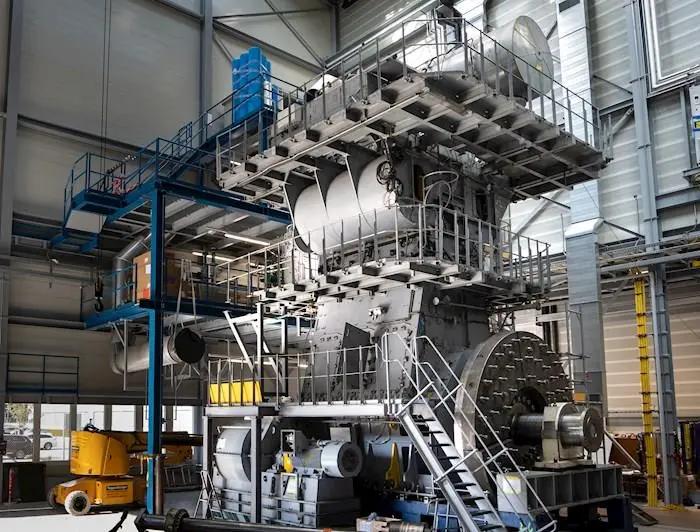
WinGD is also likely to make use of single cylinder combustion tests on WinGD’s new dedicated SCE 920 test engine. The dedicated single cylinder engine (SCE) tests are expected to be used for methanol base technology validation from the second half of 2024.
Related Articles
 2-STROKE & 4-STROKE
 2-STROKE & 4-STROKE
 2-STROKE & 4-STROKE