



PODCAST: MAN ES’ Foldager expects demand for ME-LGIM engine to soar
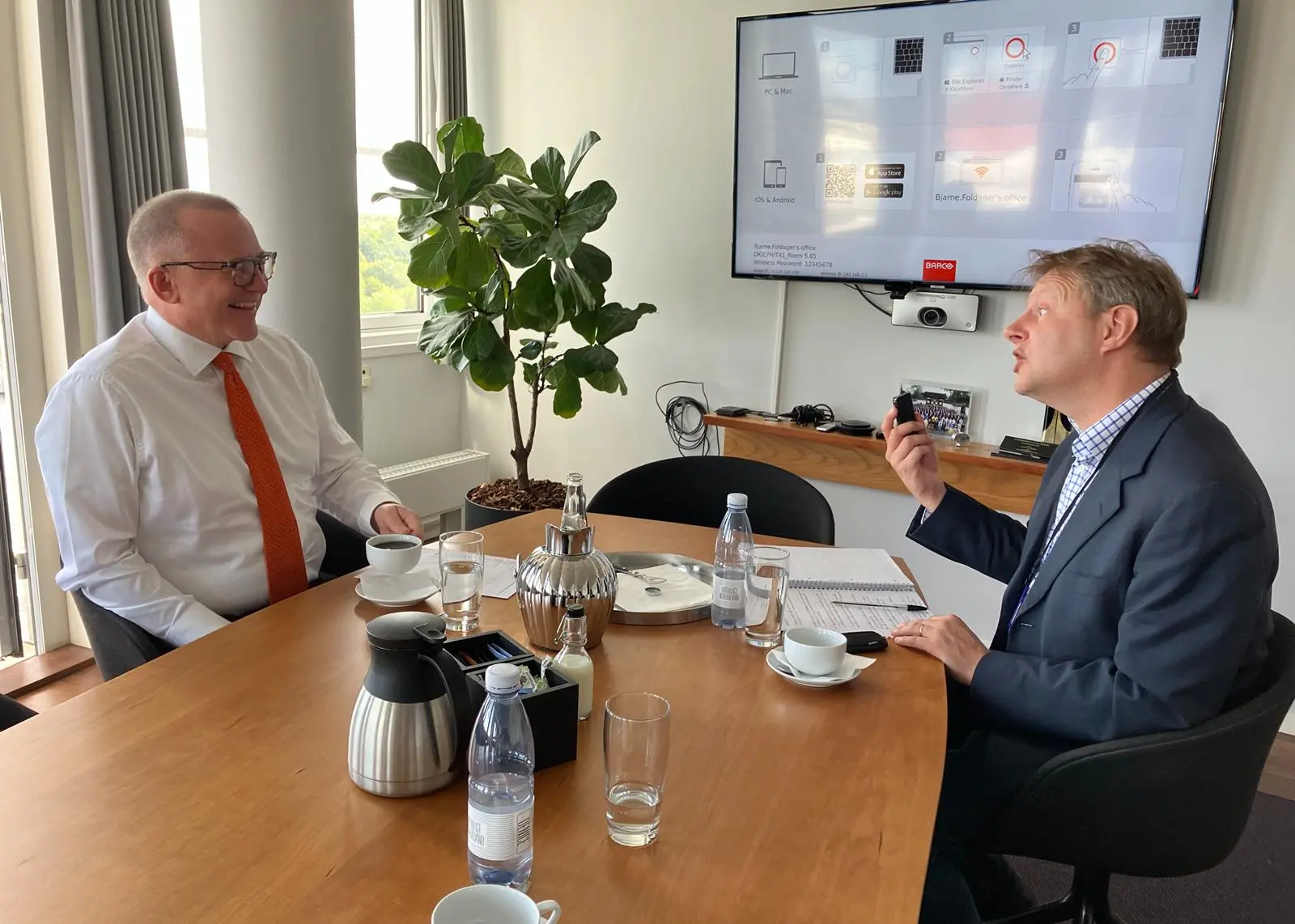
Bjarne Foldager was in ebullient mood in mid-September, when he discussed the status of MAN ES’ methanol-fuelled engine programme with The Motorship. The interview followed with the christening of A.P. Moller Maersk’s first green methanol-fuelled container feeder a short distance away, in what a striking confirmation of the successful growth of the methanol-fuelled engine programme since the reference entered service in 2016.
The ME-LGIM engine programme was evolved since its beginnings, when it was initiated in response to consumer demand for a methanol-burning engine from the methanol carrier market, before the Green Transition. Since then, MAN ES has expanded its entire programme, moving from the initial 50-bore engines specified in methanol carriers to cover almost the entire range.
“We have developed a 45 bore engine for smaller ships, such as Handysize bulkers or smaller tankers, where we have seen an interest, but also a 60 bore engine, which has been applied for bulker projects, as well as the car carrier market.” Foldager noted MAN ES has now received orders for the first car carriers.
Project pipeline supports further growth
Foldager noted that the sharp rise in methanol-fuelled engine orders has been driven by car manufacturers interest in transporting electric vehicles (EVs) in an environmentally friendly manner, while the increasing weight of car loads (reflecting the heavier weight of individual EVs compared with conventional vehicles), and larger designs has led to an increase in engine sizes for PCTCs.
Foldager also noted that the increase in interest in methanol-fuelled propulsion has been seen in the container ship market, with orders for 8,000 teu vessels with a G80 engine, and in the larger 12,000 to 24,000 teu segment of the container market, where MAN has received 70 orders for its G95 engine. While the large proportion of large bore ME-LGIM engine orders explains the rise in methanol-fuelled engine orders by engine capacity, the number of engine orders has also grown rapidly, reflecting the growth of interest in the methanol-fuelled engine from diverse segments. As of mid September, over 150 ME-LGIM engines have been ordered or delivered.
“If you look at the pipeline of potential projects, where we know the ship owner is in discussion with the shipyard potentially to construct a ship or a ship, we are aware of close to 200 projects where the shipowner is considering using methanol as a fuel.” The interest is not concentrated in any one segment, but includes the tanker, container, bulker and car carrier segments.
The interest from the tanker market has recently led to MAN ES’ first reference for its methanol-fuelled engines for a pair of VLCCs for an Asian shipowner. “We think the methanol-fuelled technology is ready now, and should be available for all the major segments… This [order sends] a very strong signal that [the ME-LGIM] is now also in the VLCC market.”
While Foldager is careful to recognise that not all the projects in the project pipeline will convert into orders, previous experience suggests that further orders can be expected in the future.
Part of the growth has been driven by increasing shipowner familiarity with methanol as a fuel, as well as the operational service history of MAN’s ME-LGIM engines. The engine has now accumulated more than 500,000 hours of service history operating in methanol mode since 2016, Foldager noted.
When asked why methanol has attracted so much attention recently, Foldager responded that is seem as a pathway for shipowners looking to decarbonise their fleet that is commercially available, while beneficial cargo owners note that it will help them to decarbonise their Scope 3 emissions.
Foldager also referred to the importance of the pooling of emissions, as included in the FuelEU Maritime regulations affecting shipping operating within the waters of the European Union’s member states, and also apply to a lesser extent to vessels calling in the EU. “One of the clever things… is the pooling concept, which allows shipowners to [count] CO2 reductions from across their fleet towards overall annual reduction targets. Rather than having to reduce emissions by 10% for 10 ships, you will be able to fully decarbonise one vessel and be fully compliant.”
Fleet growth will ratchet effect of IMO targets
Widening the focus beyond the EU and European regional regulations, Foldager also noted that the agreement of a net zero decarbonisation objective for 2050 at the MEPC meeting in July was of fundamental importance for the shipping sector. While recognising that translating aspirations and commitments into actions will be hard work, Foldager noted that the IMO’s targets are more ambitious in scope than the EU’s, because of the impact of the likely growth of the fleet in the coming years will increase the scale of the reduction in absolute emissions. “We need to the immediate target is to reduce co2 emissions by 20%, striving for 30%, by 2030… compared to the baseline. But when you take into account the growth in the fleet gross since 2008, that has actually eaten up the co2 savings we have made since 2008 already.”
“Although the absolute increase in CO2 emissions will depend upon a variety of factors… we expect that to reach the IMO target by 2030 will require each individual ship to reduce its CO2 emissions by close to 40%, because of the fleet growth, especially if we strive to meet the 30% CO2 reduction goal.”
Foldager notes that such a scale of reduction is likely to exceed the scope of energy saving devices, and is likely to lead to increase in the use of alternative fuels in both newbuildings and in retrofits for existing tonnage.
He added that given the rate with which the fleet is being renewed, “[it is highly probably] we will have to retrofit a big part of the existing fleet also.”
Retrofit orders mount
MAN ES has a successful track record of delivering alt fuel retrofits, and has already delivered 20 conversions to new fuels already. MAN ES has seen a sharp rise in enquiries about methanol retrofits, with a particular focus linked to large container ships. “We have signed a contract with Seaspan to retrofit between 15 and 60 of its big container ships to methanol over the coming years, and we have also signed a contract with Maersk to retrofit 11 of their large container ships to methanol.”
There were several other contracts where MAN ES has either signed or is close to signing contracts where the names of the operator and ship owner are not yet public. The big advantage for larger container vessels is that the existing fuel tanks can be repurposed to be used for methanol also, which means you don’t lose a significant number of container slots when you have actually retrofit to methanol.
Alt fuels supply remains bottleneck
Expanding on the alternative fuel theme, Foldager noted that cost differentials between alternative e-fuels were likely to remain, even as some of the underlying conversion technologies, such as electrolysers, mature and the cost of production begins to decline.
“Eventually, we will need some kind of scheme [to distribute] some of the savings between people who are using [fuel oil] and users of new fuels, whether in terms of an emission trading scheme, like the one the EU is setting up, a green levy or a global CO2 tax.”
The technology for the use of the fuels on the ship has been developed, and the technology for the fuel production is also in place. “The key issue is the scaling and ramping up of the production, the supply, the logistics, and the port to deliver these fuels, that will be the key issue. Our hope and our prayer is that the decisionmakers will also consider this.”
The proceeds from whatever scheme is eventually introduced will need to be invested in the production, infrastructure and logistics of the alternative fuels because the supply of the fuel will be the bottleneck.
The importance of early adopters
One of the interesting aspects of the Laura Maersk christening, (as well as subsequent announcements by other large container liner operators about their commitment to methanol), is that it allows early adopters to promote the development of demand for alternative fuels.
“I’m sure we will see the final investment decisions being taken on the production of [alternative] fuels… because… the demand from the market players and the customers [will act as an initial driver]. Some of the ship owners that have ordered container ships… have clearly [said] they will deploy these ships on the Europe trade between Asia and Europe.”
Foldager noted that Direct Air Capture (DAC) has also begun to emerge as a potentially interesting technology, and MAN ES has become involved in a project in Chile.
MeOH genset range to expand
Returning to the engine development programme, Foldager is pleased to note that MAN ES has developed a dual-fuel genset, the MAN 21/31, capable of operating on methanol. The first orders for MAN’s methanol gensets have been received from a shipyard in China, where the engines will be installed in a series of car carriers that are under construction. “The series will feature our [ME-LGIM] main engine as well as the methanol-fuelled gensets.”
While MAN expected to receive further orders for the MAN 21/31 engine, it was also expanding the programme and was seeking to develop larger-bore methanol-fuelled gensets suitable for installation on larger containerships.
While discussing the dual-fuel G95 engine, he added that MAN had lowered its guaranteed fuel consumption data for the G95 in methanol mode as a result of encouraging test results from the test bed in Korea.
Related Articles
 2-STROKE & 4-STROKE
 2-STROKE & 4-STROKE
 2-STROKE & 4-STROKE