



LR JDP with NACKS yields efficient MeOH-ready bulker design
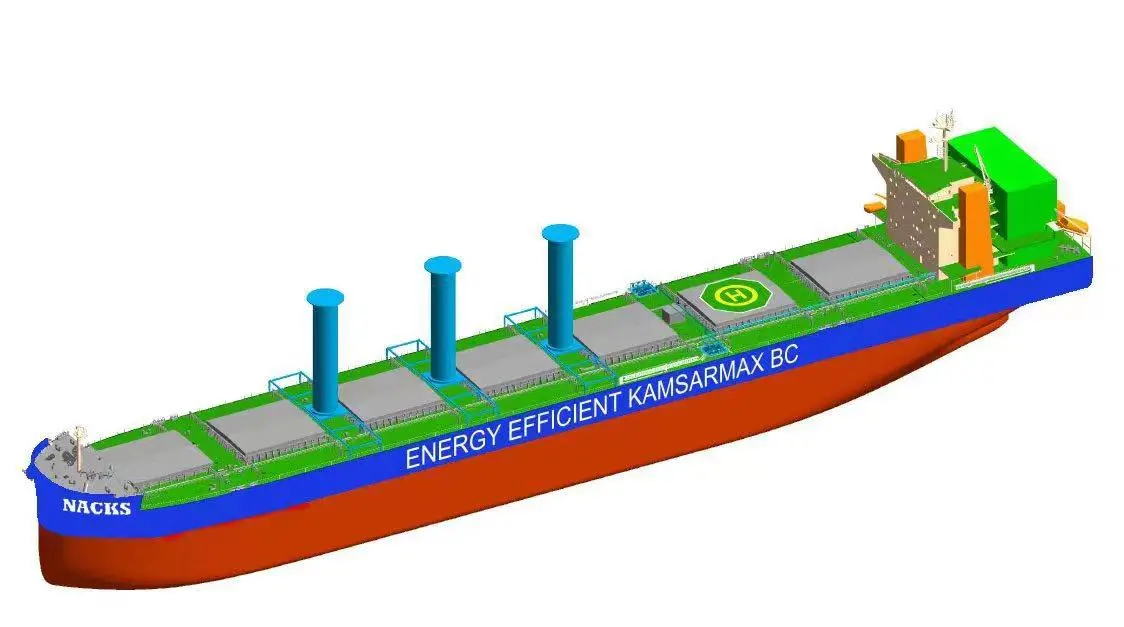
The JDP included input on user requirements from one of the largest dry bulk operators, Cargill, and brings together the operational experience of ship owner Minerva Dry with the design expertise of leading Chinese shipyard NACKS. LR acted as a trusted adviser throughout the joint development project as the sole classification society for the design of this unique vessel.
The Kamsarmax bulk carrier design includes the potential operation on methanol as a fuel, as well as rotor sail capabilities. By optimising the hull form and implementing energy saving devices, the vessel provides significant improvement in energy efficiency comparing with the last generation of Kamsarmax bulk carriers. It can satisfy the requirement of EEDI Phase 3 by using conventional fuel, with the potential for greater improvement in it following the utilisation of wind propulsion and methanol fuel in the future.
The design will provide a new energy efficient bulk carrier at a time when ship owners and operators must consider their environmental, social and governance (ESG) strategies in line with new and upcoming environmental regulations which mandate the limiting of greenhouse gas (GHG) emissions.
Nikos Kakalis, Global Bulk Carriers Segment Director, Lloyd’s Register said: “Lloyd’s Register is proud to have collaborated on this JDP with Cargill, Minerva Dry and NACKS to design an energy efficient and future fuel ready Kamsarmax bulk carrier, bringing innovation to practice.”
“And it is absolutely vital that stakeholders across the maritime value chain continue to work together to provide commercially viable bulk carriers to meet the sector’s demands whilst prioritising designs that comply with tightening GHG emission regulations, as evidenced by this JDP.”
Chris Hughes, Decarbonisation Specialist, Cargill International said: “It’s been great to work closely with NACKS, Minerva Dry and LR on this project; they all brought a lot of knowledge and experience to the project; plus a willingness to challenge the status quo, and to consider new ideas and technologies. Rather than starting with a conventional fuelled design and adding on some limited “readiness” we essentially designed a methanol fuelled ship first, and worked backwards from there for the methanol-ready version. The result is a design that is truly ready and feasible for conversion”.
The research included comprehensive research by NACKS into the optimal arrangement of methanol storage tanks, fuel supply and refuelling systems on the design.
Kostas Papadodimas, Technical Manager, Minerva Dry said: “Minerva Dry is committed to working with industry stakeholders and business partners in developing solutions that will enable the Decarbonisation of shipping transportation. We are very glad that we were given the opportunity to provide our insights and operational experience in this JDP that has resulted in the development of an optimised and energy efficient design of a Kamsarmax bulk carrier with futureproofing capabilities and sustainability elements, being at the same time commercially relevant today”.
Related Articles
 METHANOL
 METHANOL
 2-STROKE & 4-STROKE