



Propeller Trimming: Meeting EEXI Criteria

The entry into force of the Energy Efficiency Existing Ship Index (EEXI) in November 2022 has led to a considerable reduction in power, in many cases exceeding 25%. This measure has resulted in a noticeable decrease in propeller efficiency, as propellers are called upon to abide at a rating often as much as 30-40% less than the original MCR, for which they were designed.
Consequently, the propeller, which was optimised for the old design MCR/RPM/ship-speed before EEXI is now not able to compensate for the new operational difference as effectively as before, resulting in reduced efficiency and fuel wastage. There are a variety of factors ultimately affecting a vessel’s performance and the efficiency of its fuel consumption.
The hull factor and the rotational factor play a crucial role; the ability to intervene in these areas, however, is limited. Hence, an effective strategy is to focus on the efficiency of the propeller factor; by modifying the propeller system, the fuel consumption issue arising from Engine Power Limitation (EPL) implementation, can be mitigated.
While a new propeller designed according to EEDI would be the optimal solution to absorb the operational difference, in practice this involves extended lead times. The process of designing, producing and taking delivery of a new propeller can exceed a full calendar year, as most reputable manufacturers are currently operating at full capacity. The business case for a new propeller can also be problematic, given the cost of a new propeller, notwithstanding the potential scrap value of older propellers.
A comparatively faster and more economical approach is to trim the original propeller of the vessel. While propeller trimming is known to be an effective method of relieving a propeller from overload, it can also be used to bring a propeller in line with EEXI regulations. This alternative method of intervening on the propeller system has delivered very satisfactory results for our customers. We have recently performed propeller trimming for 6 cargo vessels (ranging in size from 30,000 to close to 80,000 dwt). The vessels have all seen significant improvements in their performance, with individual improvements reflecting the degree to which the existing propeller can –when trimmed – absorb the fuel oil consumption difference.
The trimming of a propeller can be carried out in two ways: either by trimming the Diameter, or by trimming the Trailing Edge (TE). Both methods have their advantages and disadvantages, and they are used based on a variety of factors which differ from case to case.
Compared to the production of a new propeller, propeller trimming has many advantages; both the cost and time requirements are significantly lower. The technical study needed to determine the new propeller characteristics and decide how the original propeller will be trimmed, can be completed in less than a month; a properly trained team of technicians can perform the trimming process within Dry Dock period when the ship is dry, and the propeller is removed under strict supervision.
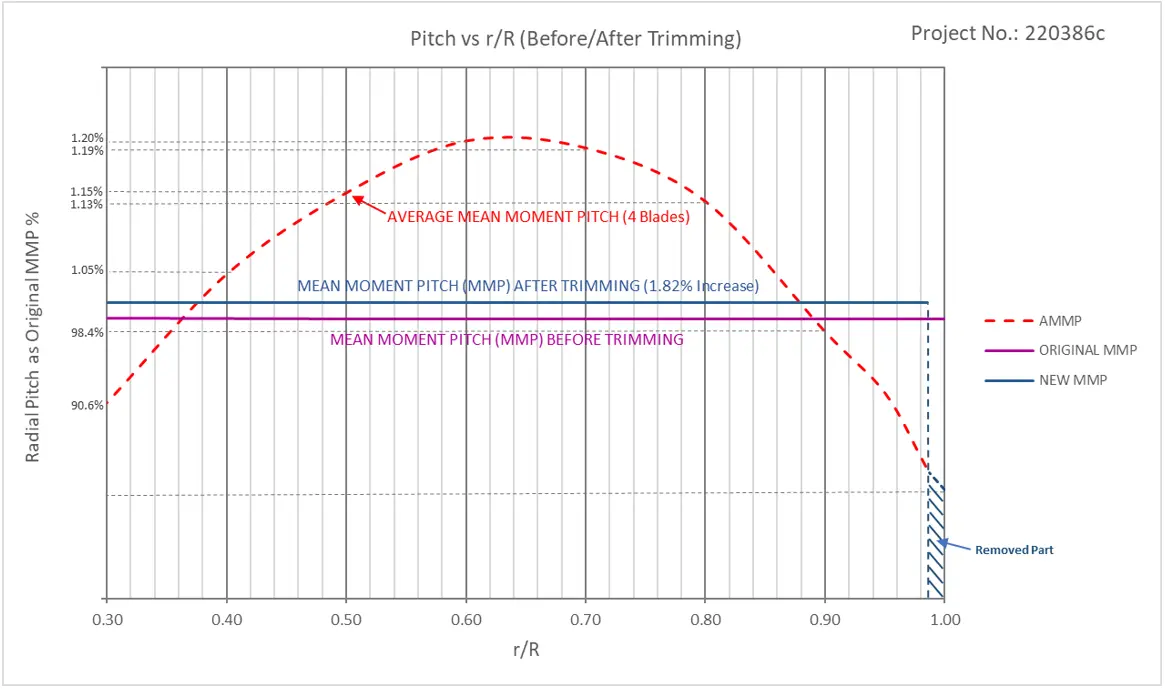
Another important factor to consider is that since the original propeller was designed for greater power usage (which now, due to EPL=Energy Power Limit), the propeller diameter ends up being greater than needed. As a result, unnecessary inertial shaft loads are being produced and power losses occur, while overall efficiency is reduced. Trimming the propeller results in both power transmission and fuel consumption improvements. Mechanical stress is also reduced, extending the lifespan of the machinery components, while overall safety and comfort is enhanced since there is a reduction in both vibrations and noise levels.
In addition, propeller trimming has a unique advantage; as the vessel maintains its original propeller, which is then trimmed, the radial blade thickness increases. This allows the propeller to operate at higher speeds in case of emergency. This option is not available for new propellers, since they are designed with smaller thickness and radius necessary to satisfy the new power rating of the Main Engine.
The fuel quantity between higher (design) and lower (EPL) values may not be totally recoverable due to the fact that propeller was optimized at design and not at EPL. By trimming the propeller, we try to eliminate this efficiency defect and recover the full fuel difference between the two points (design and EPL).
Case Study (Trimming project for Handymax Sisters)
Intership Maritime recently carried out propeller trimming on a series of three Handymax bulk carriers. The results of the operation, presented below, demonstrate the effectiveness of propeller trimming. Since pitch ratio (P/D) is greater after trimming, propeller efficiency increases as the Expanded Area Ratio is being kept near the original value. This results in:
- Less fuel consumption
- Better acceleration
- Faster transient through criticals
- Better manoeuvring response
All three sister vessels have similar performance improvements after trimming. Although additional information cannot be released due to client confidentiality, it can be understood that propeller trimming can indeed be a good alternative for existing vessels of reduced commercial value and time.
Related Articles
 LNG
LNG
 LNG
LNG
 SHAFTS AND PROPELLERS