



HHI-EMD targets oxicat prototype test by Q3 2024
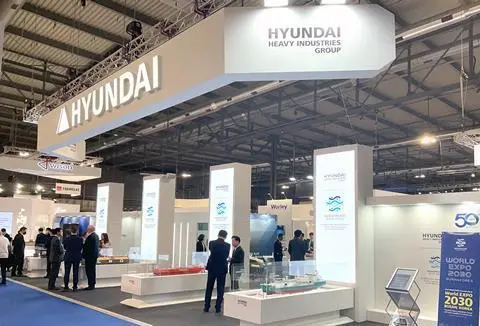
Speaking at the webinar, senior engineer Yoonyong Kim noted that the Methane Oxidation Catalyst System (MOCS) formed part of the company’s efforts to reduce methane slip from its dual-fuel 4-stroke engines..
Kim noted that HiMSEN had retained a market leading position in the dual-fuel LNG newbuilding segment, where the proportion of orders received by HHI-EMD reached 66% in 2022, in a market where over 100 LNGC newbuildings were ordered. HHI-EMD had achieved market shares of 78% in 2020 and 2021, albeit in markets with lower ordering activity.
Kim clarified that the revised product development schedule will see a prototype test occur in Q3 2024.
The next step in the timeline was a system test with an engine to ensure that the system functions and performs as expected. The development team have already verified the performance of the catalyst with an engine during a scaled test in Q2 2023. Following the scaled test, further optimisation and improvement work was being undertaken. Kim noted that the oxicat solution under development was expected to be able to reduce emissions by up to 80%, which represents a slight reduction on the 90% reduction potential originally anticipated in 2021.
HHI has various solutions for methane slip including in-cylinder technology that can reduce emissions by up to 47%. The so-called Methane Slip Solution (MSS) uses software to improve combustion performance, and employs multiple pilot fuel injection and cyclinder cut off strategies.
The solution, in tandem with refinements to the design of the combustion chamber by minimising crevice volumes, has been installed on 176 vessels and 628 engines. Kim noted that the MSS solution offers even greater methane slip reduction possibilities when dual-fuel engines are operating at lower loads, citing savings of 52.7% at 50% load, and 83.7% at 25% load.
Related Articles
 2-STROKE & 4-STROKE
 2-STROKE & 4-STROKE
 2-STROKE & 4-STROKE