



MAN Adds SCR Options For ME-LGIM Engines For Tier III Compliance
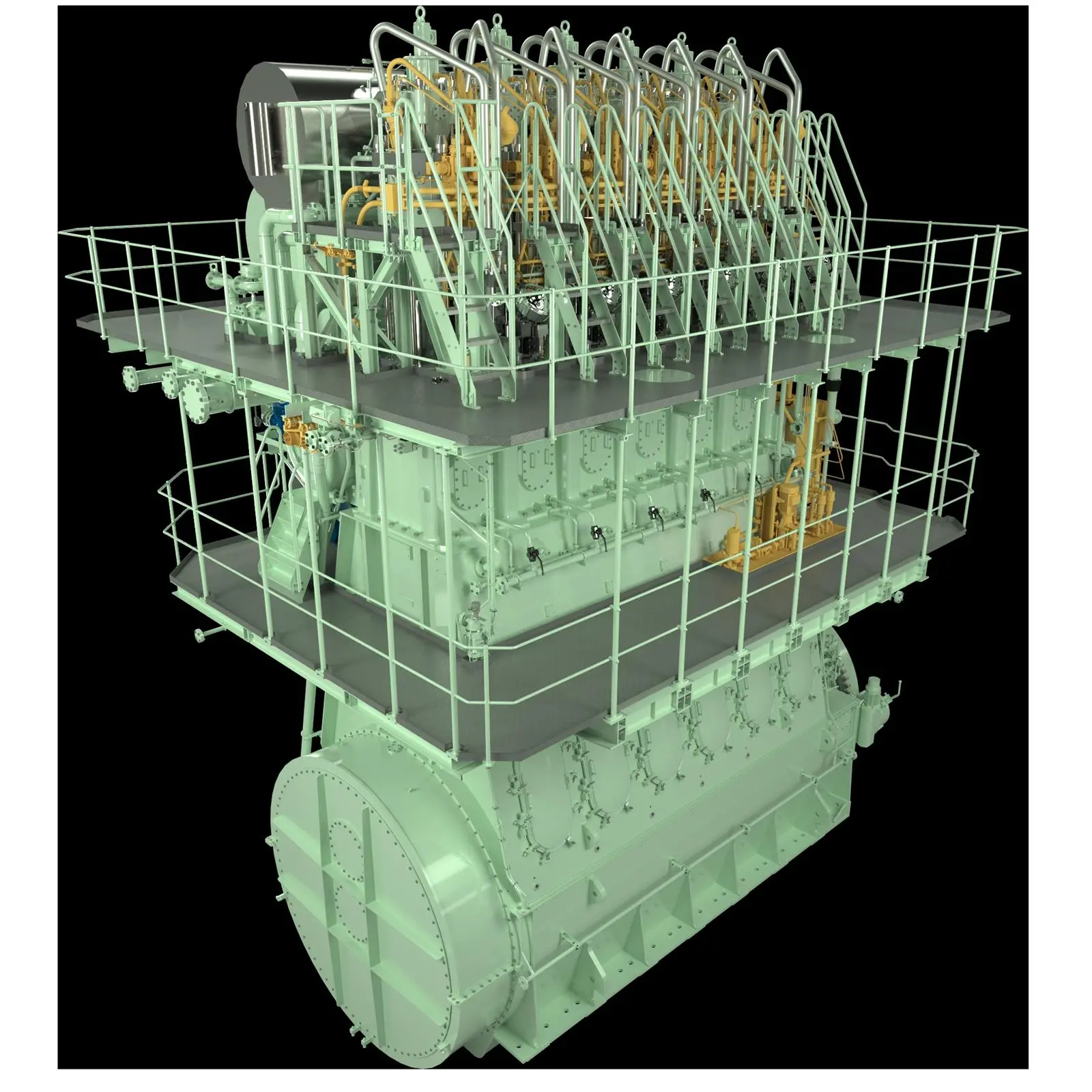
Emission abatement using SCR will be made available alongside exhaust gas recirculation (EGR), the existing method of driving down NOx to Tier III criteria for all engines in the ME-LGIM programme.
The delivery of a broader choice is intended to suit owner or shipyard preferences, and individual considerations of operational expenses and capital expenditure.
Low-pressure SCR (LPSCR) is being introduced in application to the most potent, large-bore designs, the G95ME-C10.5-LGIM and G80ME-C10.5-LGIM types, while the high-pressure variant (HPSCR) is also an option for the latter, 800mm-bore series. HPSCR is otherwise the system that can be specified for the 600mm-, 500mm- and 450mm-bore engines of the S60ME-/G60ME-C10.5-LGIM, S50ME/G50ME-C9.6-LGIM and G45ME-C9.7-LGIM classes, respectively.
In general, NOx emissions decrease about 30% when using methanol instead of diesel oil, on the basis of the same thermodynamic operating parameters. This is an effect of the intrinsically colder methanol flame. Accordingly, there is a substantial headroom for specific fuel oil consumption(SFOC) optimisation of the methanol process while still maintaining NOx emission compliance to the Tier II standard.
However, realising Tier III requires a further step and associated investment. In 2020, MAN augmented its ME-LGIM range with a version capable of running on a mixture of methanol and water, meeting performance requirements while keeping within the Tier III limits. The ME-LGIM-W (emulsion) solution, whereby the addition of water to the methanol reduces combustion temperature, has the fundamental merit of obviating the need for, and expense of, EGR or SCR.
In the latest initiative, the Tier III abatement offering with SCR for ME-LGIM engines allows for ease of integration in all relevant vessel designs.
The company has extensive service experience with both EGR and SCR, and particularly so in the case of the latter, with more than 900 SCR systems at sea to date across its two-stroke portfolio.
Related Articles
 2-STROKE & 4-STROKE
 2-STROKE & 4-STROKE
 2-STROKE & 4-STROKE