



Azipod propulsion to play a greater role in next generation vessel designs

What vessel types are suited to Azipod propulsion?
Today, more than 25 vessel types rely on the Azipod technology. Azipod propulsion is available in power ranges from 1MW to 22MW, making it suitable for smaller crafts, ferries, cruise ships, cargo carriers, and icebreakers capable of independently operating in the harshest conditions.
ABB is continuously widening its portfolio to cover even more vessel types. One example is the large order we announced in June 2023 with one of the largest offshore shipbuilders in China, Yantai CIMC Raffles Offshore Ltd. ABB is to deliver an integrated bridge-to-propeller technology for Havfram Wind’s two new NG20000X-HF wind turbine installation vessels. The vessels, incorporating the latest battery-hybrid drivetrain technology, will be among the most energy-efficient designs to operate in the offshore wind industry.
ABB scope comprises four Azipod electric main propulsion units with a total propulsion power of 17MW; the Onboard DC Grid™ power distribution system; a 4.1MWh energy storage installation; ABB Ability™ Marine Pilot Control with Dynamic Positioning System for advanced vessel control, as well as a comprehensive package of automation and digital technology. Once in operation, the vessels will be able to leverage the benefits of connecting digitally to the ABB Ability Collaborative Operations network for remote support and predictive maintenance.
Do you expect Azipod propulsors to feature on larger cargo vessels?
Yes, we do expect that. The benefits of having Azipod propulsion, such as improved propulsion efficiency and manoeuvrability, have been proven on various vessel types already over three decades. These proven benefits can be adapted basically in any vessel type, which is well demonstrated by, for example, our recent orders of supplying Azipod propulsion for dry bulk carriers. Dry cargo vessels benefit from Azipod propulsion in operations where vessel must perform reliably over an extended period at maximum efficiency, and need to be especially manoeuvrable in shallow waters.
Embarking on a new chapter in Azipod propulsion history, in 2019 ABB entered this new market segment with an order to install Azipod electric propulsion on two dry bulk carriers from Germany’s largest bulk carrier company, Oldendorff Carriers. Two 1.9MW Azipod units were installed on each of the 21,500dwt transshipment bulkers as part of a package of electric, digital and connected solutions from ABB in 2021.
What are the benefits for cargo vessels?
The choice of an Azipod electric propulsion system has the potential to significantly reduce investment costs. In addition, the yard benefits from reduced construction complexity, as the simple design of the Azipod propulsion system limits the number of interfaces required during vessel construction. Operational benefits of Azipod propulsion include enhanced vessel efficiency and increased manoeuvrability resulting in significant fuel savings.
The Azipod propulsion system consists of an electric drive motor located in a submerged pod mounted outside the ship’s hull. The propeller is attached directly to the motor, enabling it to rotate 360 degrees, providing enhanced manoeuvrability and operating efficiency compared to shaftline propulsion systems. The design also frees up cargo space on board, presenting an opportunity to boost vessel profitability.
Both Azipod propulsion and diesel-electric power management are highly responsive to load variations, making self-serving cargo ships more manoeuvrable in shallow waters, better able to hold station, and more power-efficient during frequent loading and unloading operations.
Bulk carrier vessels can benefit from Azipod propulsion in operations demanding reliable performance at maximum efficiency over extended periods. With the added advantage of enhanced manoeuvrability in shallow harbours with limited space, Azipod propulsion is equipped to meet the future needs of the dry bulk trade.
What impact does Azipod propulsion have on hullform?
Azipod propulsion is located outside ship’s hull and therefore there is no need for regular stern tube configuration. With the pulling type Azipod propulsion, this enables undisturbed water flow to propeller, i.e. ship hullform can be optimised to maximise the free water flow to propeller. It is also to be noted that with increased propulsion efficiency delivered by Azipod propulsion, less installed power is needed and the location of the energy sources (generator / batteries, etc.) inside the ship can be selected freely, enabling better weight balancing of the ship and therefore decreasing the resistance of the hull.
Azipod thrusters are also available with pushing ducted propeller (DZ). Azipod DZ, launched in 2015, is the latest thruster with a nozzle in the Azipod portfolio. It is available with up to 7.5MW power. Based on its gearless and simple construction and high thrust performance, Azipod DZ provides a cost efficient and reliable underwater mountable solution for DP vessels and other ships that require high thrust.
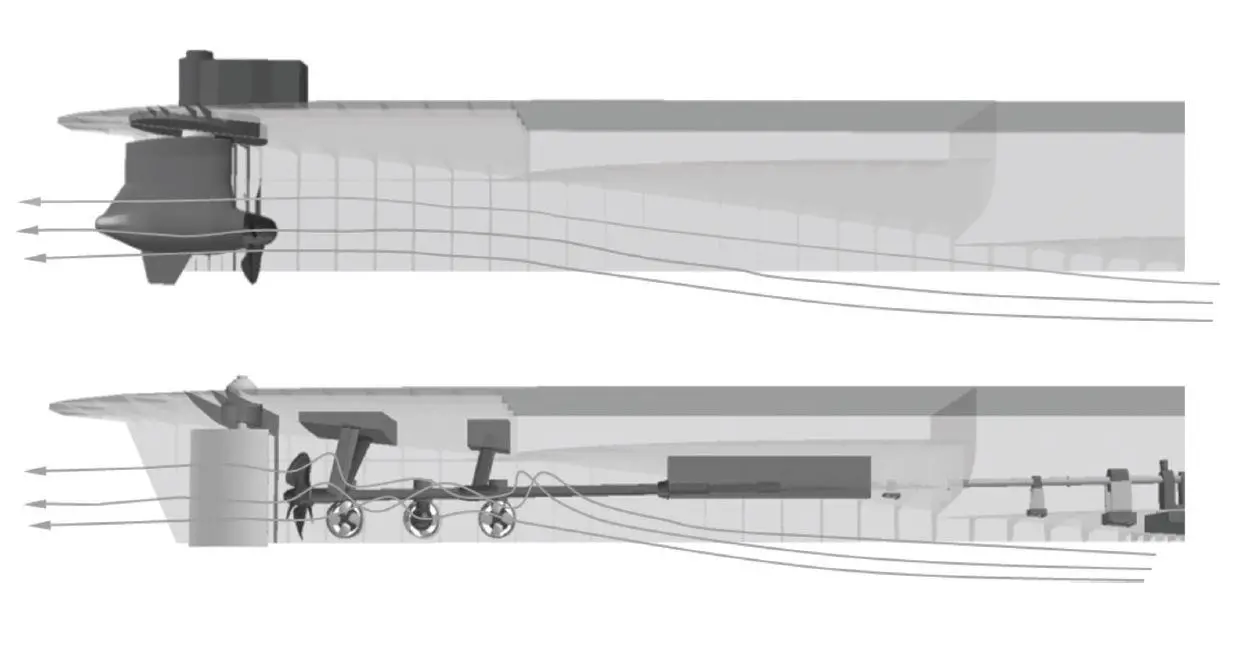
Pushing Azipod propulsion can also be adopted to basically any kind of hull-form with no limitations regarding the number of installed units, providing ship designers freedom to utilise it in any application seeking higher propulsion efficiency. An example of this is a barrel shaped vessel called Arendal Spirit which features six pushing Azipod units. The cylinder-shaped vessel has a displacement of about 40,000 tonnes and capacity to accommodate 490 persons.
What benefits does Azipod propulsion offer for passenger vessels?
The story of the Azipod in the cruise segment began by replacing an existing traditional shaft line configuration with two Azipod units. It enabled fuel savings of up to 10%. Since then, the hydrodynamic development of both the Azipod units and hullforms independently and combined has moved forward, and customers in various segments have reported even higher efficiency improvements and fuel savings.
It is also to be noted that the reported fuel savings, up to 20% in comparison to a traditional shaftline propulsion configuration, are not only generated by the increased hydrodynamic and propulsion efficiency but also the fact that with better manoeuvrability, for example, time used in manoeuvring is decreased and therefore less time spent with propulsion power on (as demonstrated in a recent study made for a ferry application by an independent source).
What benefits does ABB’s fourth generation permanent magnet technology bring?
The third generation refers to the revolutionary hybrid cooled permanent magnet electric motor introduced first in Azipod D and named Innovation of the Year back in 2015. In the fourth generation, the power density of the hybrid cooled permanent magnet motor is increased by further optimization utilizing ABB in house developed evolutionary algorithms. Higher power density enables more sustainable and cost efficient Azipod propulsion.
ABB has secured a contract with Fincantieri, one of the world’s leading shipbuilding groups, to deliver Azipod propulsion systems featuring this development for four forthcoming medium-sized cruise vessels. The passenger ships will be equipped with two 7.7MW Azipod propulsion units per vessel.
The Azipod system, featuring ABB’s fourth-generation permanent magnet motors, has been refined for added power and efficiency, while a simple but robust design offers ease of maintenance and reliability. The system’s compatibility with alternative energy sources makes it a future-proof solution that is ready to work with new, cleaner fuels as soon as these become available.
What future do you see for the retrofit market?
ABB’s leading Azipod electric propulsion system has become a commercially attractive retrofit option for existing vessels as shipowners seek ways to comply with new emissions regulations such as the EEXI and CII. These regulations have sparked a surge of inquiries from shipowners looking at ABB Azipod electric propulsion as a potential cost-effective retrofitting solution to keep aging ships on the right side of compliance and to potentially add a further 10 to 20 years to a ship’s lifetime.
Shipyards have a long backlog of newbuilding projects, so retrofitting an older vessel with a new propulsion system is a much quicker solution than having to wait for a production slot for a new ship.
Is ABB designing your Azipod propulsors for longer operational lives?
We have seen more interest from our customers in extending the lifetime of their current installations. Today, ships are built for more sustainable maritime operations, with the target to make them last longer, and certain special vessels such as icebreakers to be able to operate even for 50 years.
We are increasingly focusing on total cost of ownership, taking into account the operational profile of each vessel and based on that, optimising the design of key components and the service and maintenance program.
What final thought would you like to share?
As the maritime industry is waiting for a silver bullet re energy sources (alternative fuels, batteries, fuel cells), electric propulsion is already available today for almost all types of vessels and can be adapted to utilise any energy source.
Related Articles
 INTERVIEWS
 CONVENTIONAL FUELS & OILS
 GENERAL NEWS