



UK Backs Methanol Retrofit Project
Produced by the US group at the Daventry plant in the English Midlands, the 16-cylinder, four-stroke diesel in its marine version covers applications broadly in the 1,500-2,000kW range. Under the R&D endeavour, an adapted dual-fuel unit will be tested in an offshore service vessel.
The initiative is being underwritten to the tune of £4.4m($5.5m) as part of the Zero Emission Vessels and Infrastructure(ZEVI) competition financed by the UK government and delivered through the agency Innovate UK. Cummins’ collaborators in the project are Aberdeen Harbour Board, Scotland’s largest berthage port, marine robotics company and support vessel operator Ocean Infinity, and methanol producer Proman AG.
The line of funding is predicated on providing the UK with a home-grown, UK-built ‘clean’ maritime technology solution as part of the industry’s energy transition.
With initial application to the country’s vibrant offshore energy sector, and endorsement of the solution by way of demonstration on one of Ocean Infinity’s new fleet of multi-purpose offshore vessels, the project targets a 50% reduction in CO2 emissions plus NOx, SOx and PM at levels “considerably below those emitted by conventional fuel,” according to Cummins. All retrofitted, dual-fuel engines will achieve compliance with IMO Tier III criteria.
Given its focus on conversion of existing engine installations, the concept is one of obviating the need for a major vessel overhaul, rendering an immediate positive effect on carbon emission limitation in all operating conditions.
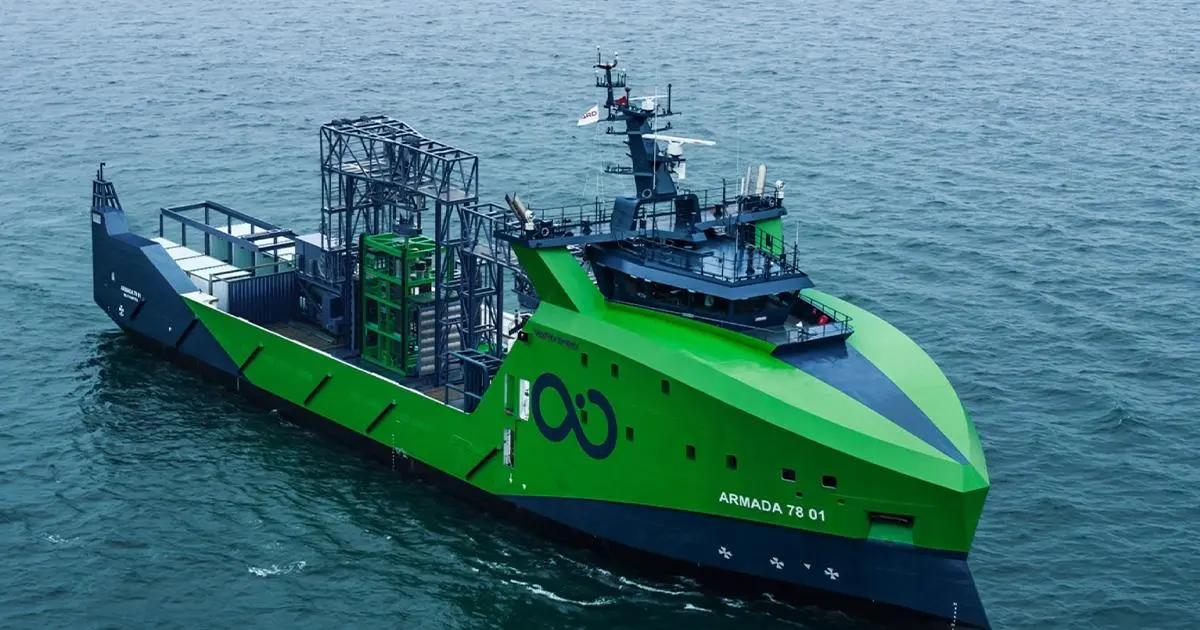
Southampton-based Ocean Infinity is providing one of its Armada 78-series, multi-role offshore service ships as the platform for Cummins to design, develop and test the dual-fuel methanol and HVO(hydrotreated vegetable oil) technology. Cummins recently announced the approval of unblended paraffinic fuels—often referred to as renewable diesel including HVO—in all the high horsepower engines in its portfolio.
Ocean Infinity’s 78m newbuild class, eight of which have been ordered from VARD, is a highly-advanced generation designed to allow for onshore remote-controlled, lean-crewed and ultimately robotic-functioning operations in a various types of offshore work. The vessels incorporate hybrid solutions conceived to evolve through various stages of future fuels implementation.
The port of Aberdeen, which is intent on becoming Scotland’s premier net-zero port, is putting its facilities and services at the disposal of the test campaign. Proman AG’s industrial know-how, including its development of ultra low carbon methanol production, gives further practical dimension to the project.
Related Articles
 2-STROKE & 4-STROKE
 2-STROKE & 4-STROKE
 2-STROKE & 4-STROKE