



LNG-Fuelled Coal Carriers Make Debut
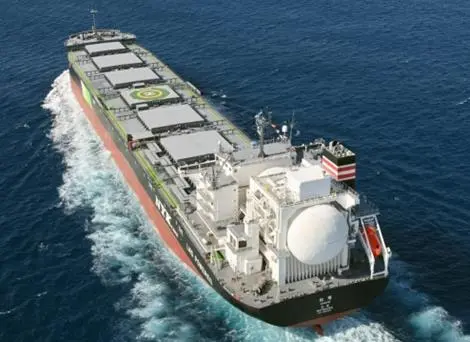
Built to Japanese account at domestic yards to similar dimensions and cargo capacities, the 95,233dwt Shoyo was delivered on October 2, followed in mid-November by the 95,792dwt Reimei. Chartered in each case by Kyushu Electric Power Co, the 235m bulkers will be employed transporting coal to thermal power stations on Kyushu, the southwesternmost of Japan’s main islands.
Shoyo was constructed to the account of NYK Line by Oshima Shipbuilding at its Koyagi plant in Nagasaki, formerly owned by Mitsubishi Heavy Industries, while Reimei has augmented the fleet controlled by the Mitsui SK Lines (MOL) Group after completion by Namura Zosensho’s Imari yard. Both shipbuilders are among the most productive worldwide in the bulker category.
The high volume-to-deadweight relationship characteristic of bulkships dedicated to carrying coal is implicit in the 110,291m3 and 109,185m3 cargo capacity ratings of Shoyo and Reimei, respectively, each embodying a seven-hold arrangement.
The main engine choice for both ships settled on a WinGD X62DF-2.1 dual-fuel two-stroke, in six-cylinder configuration, manufactured under licence by the Diesel United factory at Aioi, now part of the Mitsui organisation. The installation in Shoyo was specified for an output of 9,400kW at 81rpm, to give a service speed of 14 knots, while the machinery in Reimei is rated for 9,240kW at 80rpm.
Earlier this year, Mitsui E&S (MES) acquired the large-bore marine engine business of IHI Power Systems, encompassing Diesel United’s activities as licensee maker of WinGD low-speed models and MAN’s four-stroke Pielstick marque. The production lines at Aioi now operate as Mitsui E&S DU.
The LNG tank on each of the new bulkers is mounted above deck right aft, immediately abaft the bridge and accommodation block.
While the national economy is well embarked on the energy transition, coal remains a substantial contributor to Japan’s energy mix. The adoption of LNG by ships supplying the coal-fired power generating stations constitutes a drive to reduce environmental impact in the logistic chain. Running on LNG rather than burning conventional HFO is forecast to cut CO2 by 30% as well as virtually eliminating SOx and slashing NOx by 80%.
Shoyo has LNG dual-fuel auxiliaries, in the shape of Daihatsu 6DE20DF-based gensets, and incorporates a raft of energy-saving design elements, including Oshima’s proprietary Seaworthy Bow, Advanced Flipper Fins, and Rudder Fin. Overall, the vessel achieved a 40%-plus lower figure than the EEDI reference value.
Her entry into trade was preceded by an initial LNG bunkering alongside at Kitakyushu LNG’s Tobata terminal. This was reported to have been the first shore-to-ship bunkering for an ocean-going, LNG-fuelled vessel in Japanese waters. Kitakyushu LNG is majority owned by Kyushu Electric Power. Shoyo is also fitted for ship-to-ship bunkering. Significantly, a newbuild LNG bunker tanker is scheduled to be ready to effect such deliveries in the Setouchi and Kyushu areas from March 2024 onwards.
Following handover at Imari, Reimei similarly took on LNG fuel from the Tobata terminal. LNG procured by Kyushi Electric for power generation elsewhere in its network is expected to be the continuing source of bunkers for the coal bulkers.
NYK Line has concluded a contract with Oshima for second and third coal carriers of the Shoyo class, using WinGD LNG dual-fuel propulsion. The vessels are due in 2025, and will serve electric power utilities. The newbuilds will be among the first to adopt WinGD’s variable compression ratio (VCR) technology in application to X62DF-series engines.
MAIN PARTICULARS
Shoyo/Reimei
| SHOYO | REIMEI | |
|---|---|---|
|
Builder |
Oshima |
Namura |
|
Length overall |
234.98m |
234.92m |
|
Length bp |
231.00m |
231.35m |
|
Breadth, moulded |
38.00m |
38.00m |
|
Depth, moulded |
20.16m |
20.05m |
|
Draught, summer |
14.37m |
14.43m |
|
Gross tonnage |
54,633t |
54,684t |
|
Deadweight |
95,233t |
95,792t |
|
Cargo capacity |
110,291m3 |
109,185m3 |
|
Main engine |
WinGD dual-fuel |
WinGD dual-fuel |
|
Main engine power |
9,400kW |
9,240kW |
|
Generators/total power |
4/3,463kVA |
4/2,975kVA |
|
Class |
ClassNK |
ClassNK |
|
Flag |
Japan |
Liberia |
Related Articles
 2-STROKE & 4-STROKE
 2-STROKE & 4-STROKE
 2-STROKE & 4-STROKE