



First hydrogen-powered CTV enters service in German offshore market
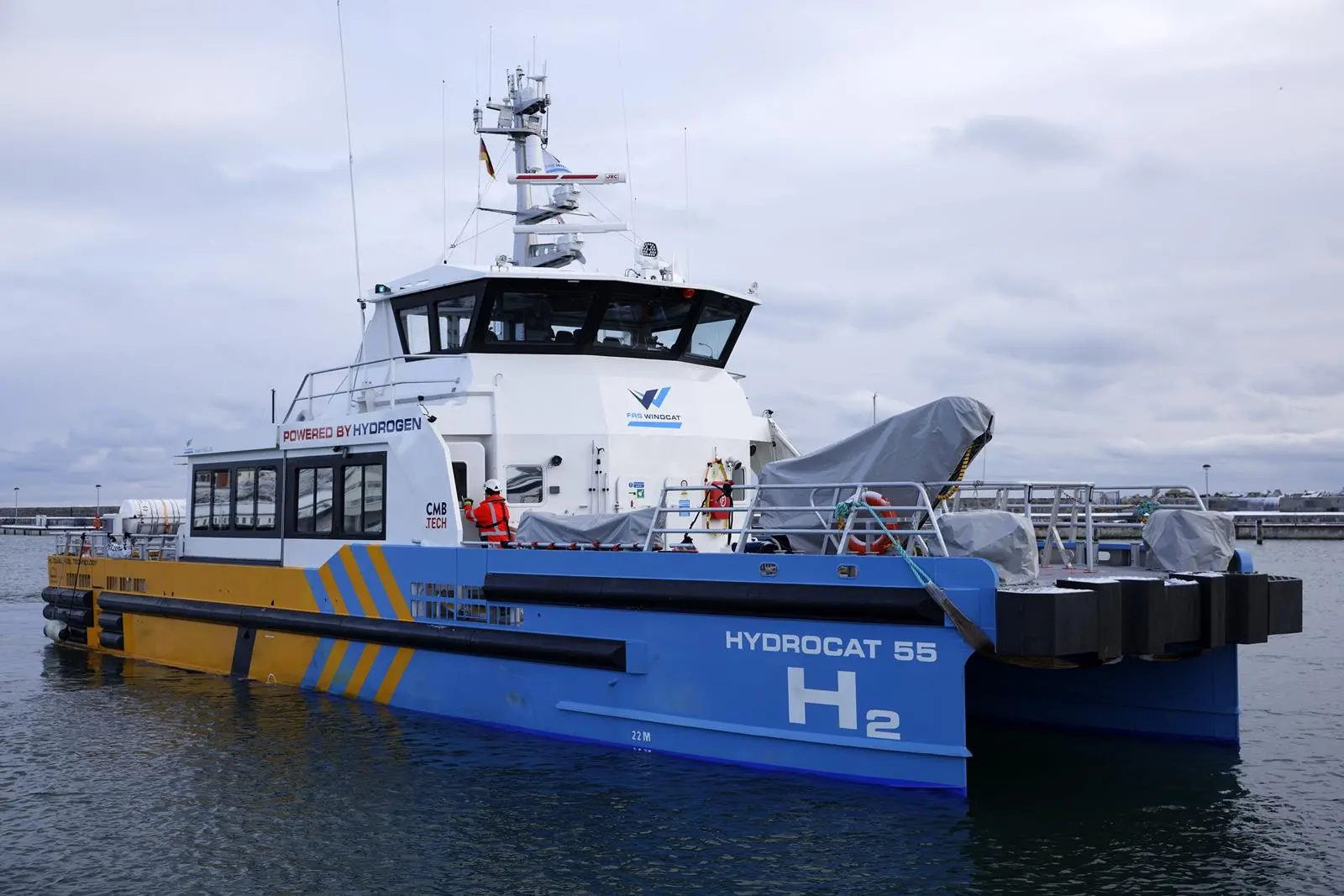
The 25m-long Crew Transfer Vessel (CTV) forms part of a fleet of six ships currently operated by the Germany-based FWOL in the German and Danish North and Baltic Sea. The vessel is conducting operations on behalf of 50Hertz, the transmission system operator (TSO) responsible for connecting the wind farms in the German Baltic Sea to the German electricity grid.
Hydrocat 55
The dual fuel hydrogen system of the Hydrocat 55 allows a significant reduction in CO2 emissions during operation and a substantial decrease in NOₓ emissions. The CTV has a tank capacity of 207 kg of hydrogen in 27 cylinders. The engine is manufactured by MAN Engines for dual fuel use and retrofitted by CMB.TECH with a hydrogen injection system, drawing hydrogen from compressed hydrogen storage tanks.
By using hydrogen, the Hydrocat 55 can significantly reduce diesel consumption and CO2 emissions. At the same time maximum flexibility and safety are ensured. The Hydrocat 55 is built the same way as the Hydrocat 48, which was launched as the first hydrogen powered CTV in 2022 for operations in Belgium.
In collaboration with the Dutch joint venture partner Windcat, five more CTVs of this type are under construction. Work is ongoing to further optimise the ship’s technology and reduce CO2 emission even more in future. A trial period is set to start in January 2024 and will run for a year with regular use of green hydrogen.
Tim Kunstmann of FWOL states: “Looking to the future, FWOL is committed making a significant contribution to the decarbonisation of offshore logistics and supporting a green production of renewable energy with the Hydrocat 55 and the further vessels of this type.”
Dual fuel hydrogen combustion engines
No fundamental changes to the vessel’s main engine are required, which not only means that maintenance and repair remain simple, but also that the engine can easily be switched back to diesel fuel without any modifications. Even if hydrogen is not available, the vessel can continue to run on traditional fuel, making it a very robust and reliable solution for the offshore wind industry.
Willem Van Der Wel of Windcat says: “With this announcement, we are showing that our group strategy is becoming a reality with the focus on decarbonization and optimisation. We are reducing the carbon emissions of our customers in the offshore wind industry, today. We’re grateful to have such great customers and local partners who help drive this strategy.”
Related Articles
 2-STROKE & 4-STROKE
 2-STROKE & 4-STROKE
 2-STROKE & 4-STROKE