



Successful onboard carbon looping CCS pilot
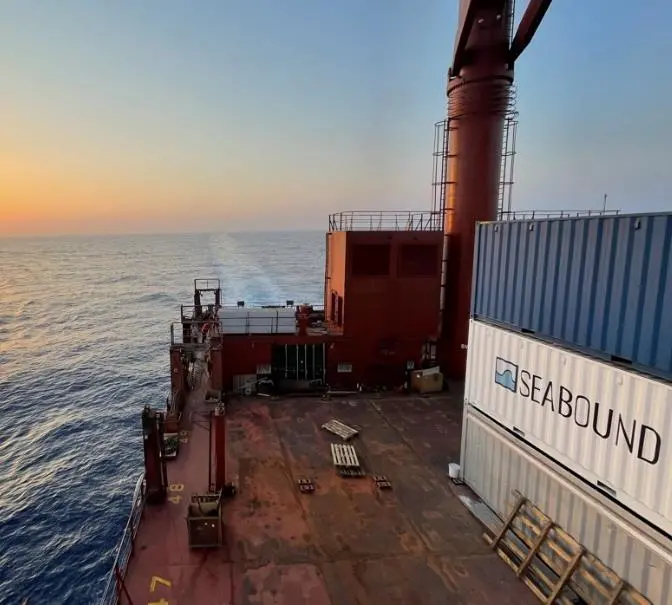
The pilot was conducted in collaboration with Lomar, the international ship owner, and its corporate venture lab, lomarlabs. During the two-month long project, Seabound’s carbon capture technology was used with one of the engines on the 240m long, 3,200 teu container feeder, Sounion Trader. The ship was chartered by Hapag-Lloyd, which also supported the project.
The project demonstrated Seabound’s second-generation calcium looping carbon capture technology. The innovative system has the potential to capture up to 95% of CO2 emissions from a ship’s exhaust, transforming it into solid calcium carbonate pebbles. The solid calcium carbonate pebbles can be easily offloaded at port for reuse or sale. The Motorship notes that limestone has a range of established manufacturing and industrial applications, but does not typically command a high market price.
The Seabound team completed the installation at a shipyard in Turkey and sailed onboard the ship for two months to gain hands-on operating experience. A series of tests were completed onboard the ship, which increased the carbon capture rate over time and culminated in a carbon capture efficiency of 78% and sulphur capture efficiency of over 90%.
The test successfully demonstrated the viability of the system for maritime installations. The small-scale pilot captured roughly 1 tonne of CO2 per day in a prototype system, but Seabound expects that the technology can be scaled up for much larger-scale installations in the future.
Seabound’s system was approved for onboard testing by the American Bureau of Shipping (ABS), with an additional risk assessment completed by Lloyd’s Register. Seabound and Lomar secured £1.2 million in grant funding from the UK Government as a part of the Clean Maritime Demonstration Competition Round 3 to fund part of the pilot.
“Our pilot project demonstrates that we can capture carbon emissions directly onboard ships in a simple and cost-effective way, said Alisha Fredriksson, CEO and Co-Founder of Seabound. “This breakthrough demonstrates that the shipping industry doesn’t have to wait for new fuels or solutions to reduce its emissions in the future – we can start to capture carbon from the existing fleet today.”
“Shipping sustainability has a defining role in the clean energy transition. Working with Seabound underscores our commitment to supporting shipowners and operators and the wider industry to move towards a cleaner future, shaping the industry for the better. Seabound’s work is crucial at this time and we are proud to be working alongside them to make it a reality,” said Panos Koutsourakis, Vice President of Global Sustainability, at ABS.
“Supporting this project by Seabound and Lomar underpins our dedication to reducing our climate impact. Our company’s ambitious aim is to be net-zero by 2045. Thus, we are looking forward to the opportunities this foresighted project will bring in the future.” said Georg Eljardt, Senior Director Fleet Innovation & Technology
With the pilot successfully completed, Seabound is now focused on developing its first full-scale carbon capture systems for commercial deliveries from 2025 onwards.
Related Articles
 2-STROKE & 4-STROKE
 2-STROKE & 4-STROKE
 2-STROKE & 4-STROKE