



Japanese Pact Advances LPG Carrier Design
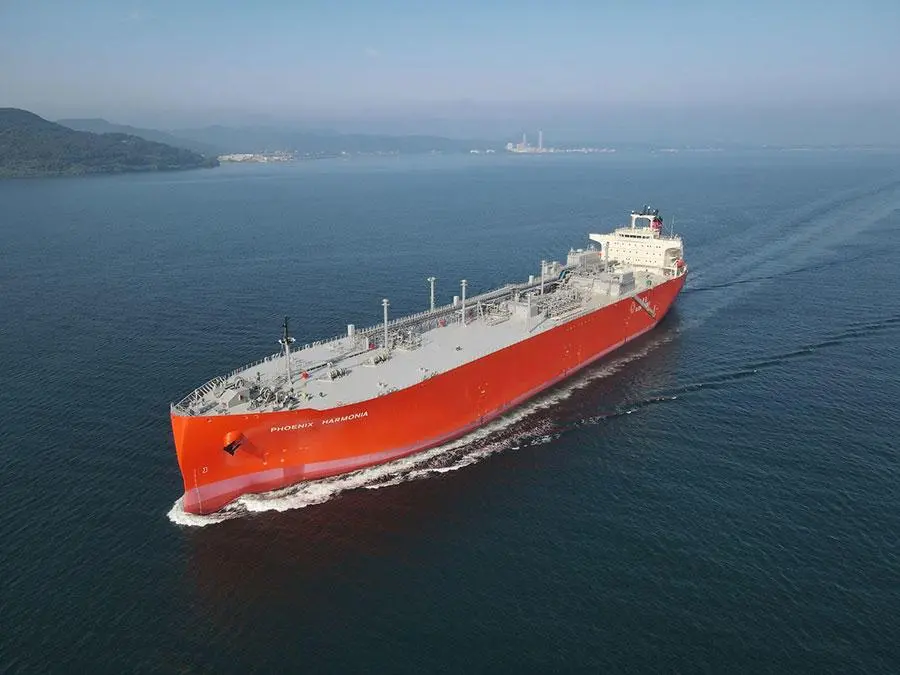
Constructed by Namura Shipbuilding’s Imari yard with input from Mitsubishi Shipbuilding embracing development of the hull form and detail design, equipment procurement, and newbuild support, the Panamanian-registered gas carrier has entered service for MOL Energia of Singapore, under the operation and stewardship of MOL Tankship Management.
Mitsubishi’s considerable track record in producing very large LPG (VLGC) tankers and mid-size LPG/ammonia carriers has been brought to bear in realising an 87,000m3 cargo capacity compared to the 83,000m3 volume of preceding vessels. This represents the biggest ship size that can be received at major Japanese LPG terminals.
Phoenix Harmonia also ranks among the largest worldwide suited to the transportation of ammonia, a potential point of advantage given rising demand for the fuel on environmental grounds. While ammonia is currently used in fertilisers and as a feedstock for the chemical industry, Japanese electric utilities are forging ahead with efforts to reduce CO2 emissions by switching to ammonia as a fuel for thermal power plants.
The primary power installation is a six-cylinder model of the MAN G60ME-C10.5-LGIP dual-fuel engine, specifically developed to allow operation on LPG as a low-flashpoint fuel. The specified maximum continuous output rating in the Phoenix Harmonia application is 12,400kW, running at 94rpm, well within the 17,000kW design scope of a six-cylinder version. In fact, and besides offering a large layout area, the G60ME-LGIP series provides for power deratings up to 56%.
LPG fuel gives rise to virtually zero-sulphur emissions and has a lower carbon content than fuel oil, pertinent to achieving compliance with IMO 2020 SOx regulations, while also giving credit towards EEDI requirements. Firing on LPG can reduce CO2 emissions by 20%.
Mitsubishi Shipbuilding lent its know-how in gas handling to the development of a system to draw on the LPG cargo as the main or supplementary fuel source, offering cost and logistic benefits for the owner and charterers, as well as reducing deck equipment.
The liquid gas injection, two-stroke engine is off the Tamano production line of Mitsui E&S Machinery. The design allows switching between LPG, very low sulphur fuel oil (VLSFO) and marine gas oil without loss of performance, and the incorporation of exhaust gas recirculation (using bypass matching) ensures IMO Tier III compatibility in all modes.
The three main generator engines are also of dual-fuel type, and feature selective catalytic reduction (SCR) systems.
MAIN PARTICULARS
Phoenix Harmonia
| Length overall | 230.0m |
|---|---|
|
Length bp |
226.5m |
|
Breadth |
36.6m |
|
Depth |
22.9m |
|
Draught |
12.0m |
|
Gross tonnage |
50,849t |
|
Deadweight |
56,711t |
|
Cargo capacity |
87,123m3 |
|
Main engine power |
12,400kW |
|
Generators |
4 = 5,050kVA |
|
Complement |
29 |
|
Class |
ClassNK |
|
Registry |
Panama |
Related Articles
 2-STROKE & 4-STROKE
 2-STROKE & 4-STROKE
 2-STROKE & 4-STROKE