



GAS HYBRID POWER FOR JAPANESE COASTAL BULKER
The 94m bulker is to be phased into shuttle-type service transporting limestone across the Tsugaru Strait in northern Japan, between Shiriyazaki, on Honshu, and Muroran, on Hokkaido.
Construction of the 5,550dwt newbuild was entrusted to Tsuneishi Shipbuilding Co by the NS United subsidiary Naiko Kaiun Kaisha (NS Naiko). The vessel will also provide the first reference for the LNG fuel tank type designed by Nippon Steel Corporation using 7% nickel steel.
The project represents an investment in new, home-grown technology directed at markedly reducing the environmental impact of short-sea bulk commodity transportation. The scheme has involved a consortium of Japanese companies, wherein NS United partnered with charterers Nippon Steel Corporation and Nippon Steel Cement, prospective fuel supplier Japan Petroleum Exploration(JAPEX), and engine maker Kawasaki Heavy Industries.
The newbuild will replace the similar-sized, 30 year-old Shimokita Maru, which has a load capacity of 5,200t and special handling equipment for limestone, used as a raw material in cement production and steelmaking.
The gas engine is expected to realise a reduction of approximately 24% in CO2 emissions relative to operation on heavy fuel oil in a conventionally diesel-powered vessel of equivalent size, along with much lower NOx and near-elimination of SOx. Consuming only natural gas fuel, transits will be made with the engine driving a controllable pitch propeller through a reduction gear, while port entry and departure will be effected in electric propulsion mode using the battery installation.
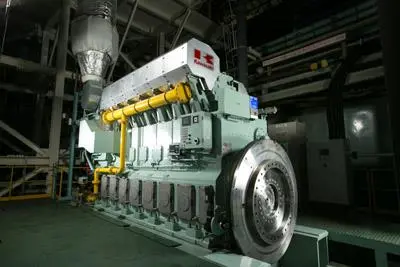
The Kawasaki L30KG engine is based on a model developed for the distributed power generation market, and is claimed as to offer exceptional electrical efficiency of 49.0% and NOx emissions less than 1.0g/kWh, well below IMO Tier III limits.
Adapted to the needs of marine duty cycles, and suited to either direct-coupled mechanical drive or gas-electric propulsion as well as a hybrid arrangement, the design has a bore of 300m and stroke of 480mm. The series encompasses in-line formats of six, eight and nine cylinders, spanning a maximum power range from 2,670kW to 4,005kW.
The L30KG was the first Japanese gas engine to obtain DNV type approval. Kawasaki has subsequently proceeded to acquire type certification for the control system.
Related Articles
 2-STROKE & 4-STROKE
 2-STROKE & 4-STROKE
 2-STROKE & 4-STROKE