



LOW-EMISSION CAR CARRIERS FOR VW TRADE
Deliveries of the 7,000CEU sisters Emden and Wolfsburg from Guangzhou Shipyard International (GSI) signify a further stage in China’s emergence as a premier global force in PCTC design and construction. An earlier VW-backed contract had given rise to the completion by Xiamen in 2020 of the pioneering, LNG-fuelled vessels Siem Confucius and Siem Aristotle.
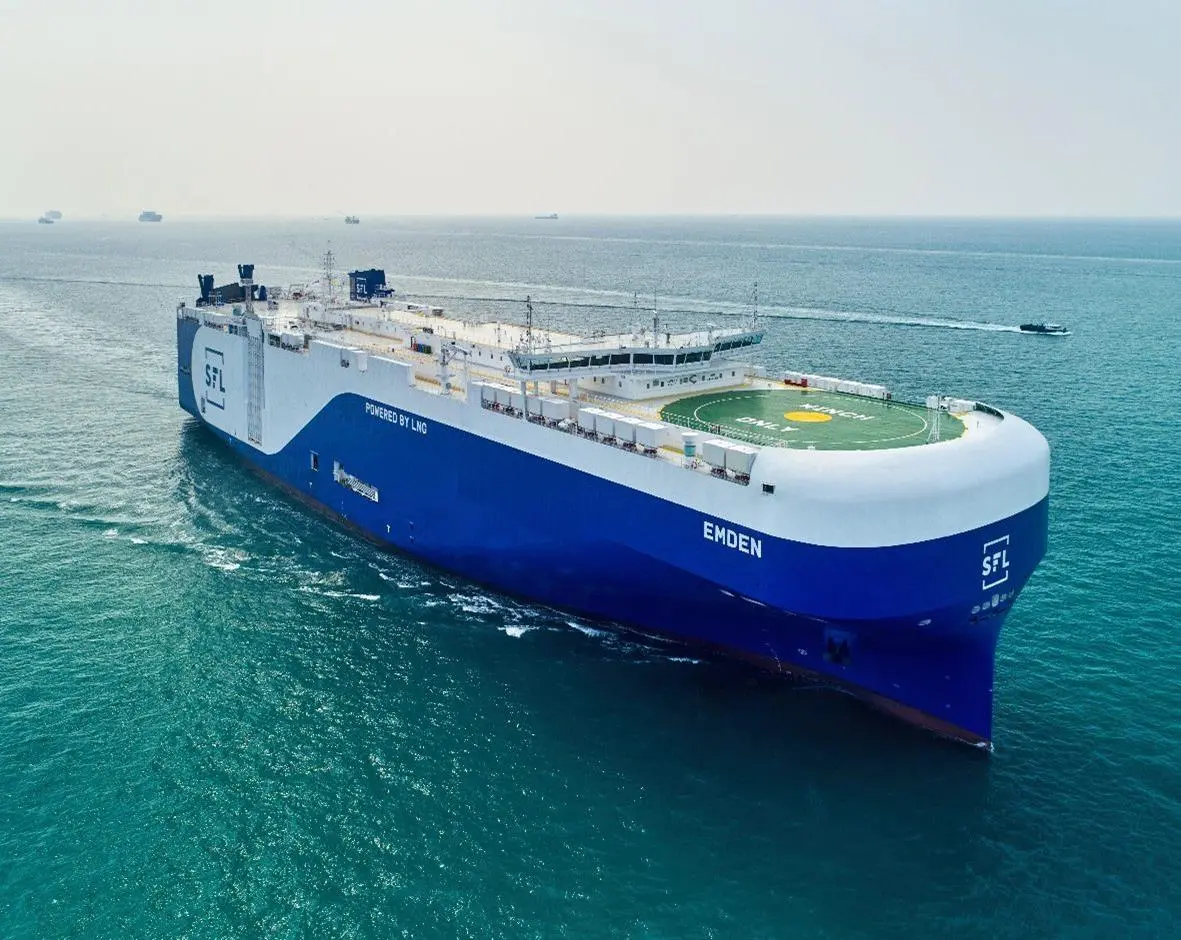
Ordered by Bermuda-headquartered, New York Stock Exchange-listed SFL Corporation, the two latest newbuilds incorporate LNG dual-fuel propulsion and auxiliary machinery and a versatile loading capability optimised within a 38m-wide hull envelope conforming to the 200m length restriction imposed by Japanese loading ports.
Emden was handed over during September 2023, followed by Wolfsburg in November, and Volkswagen Logistics has secured both ships on 10-year charters, with options to extend the engagements by a further two years. The vessels will play a major role in the VW traffic linking the organisation’s hub port of Emden, in northwest Germany, with the US eastern seaboard and Mexico.
Such is the automotive group’s manufacturing network, range of brands and market position, that the ships will be loaded in both directions across the North Atlantic. The deck configuration and structures allow for a degree of heavy cargo, but with the headroom and requisite axle and wheel loading provision throughout for the heavier sports utility vehicle (SUV) and electric car models that continue to gain market ground.
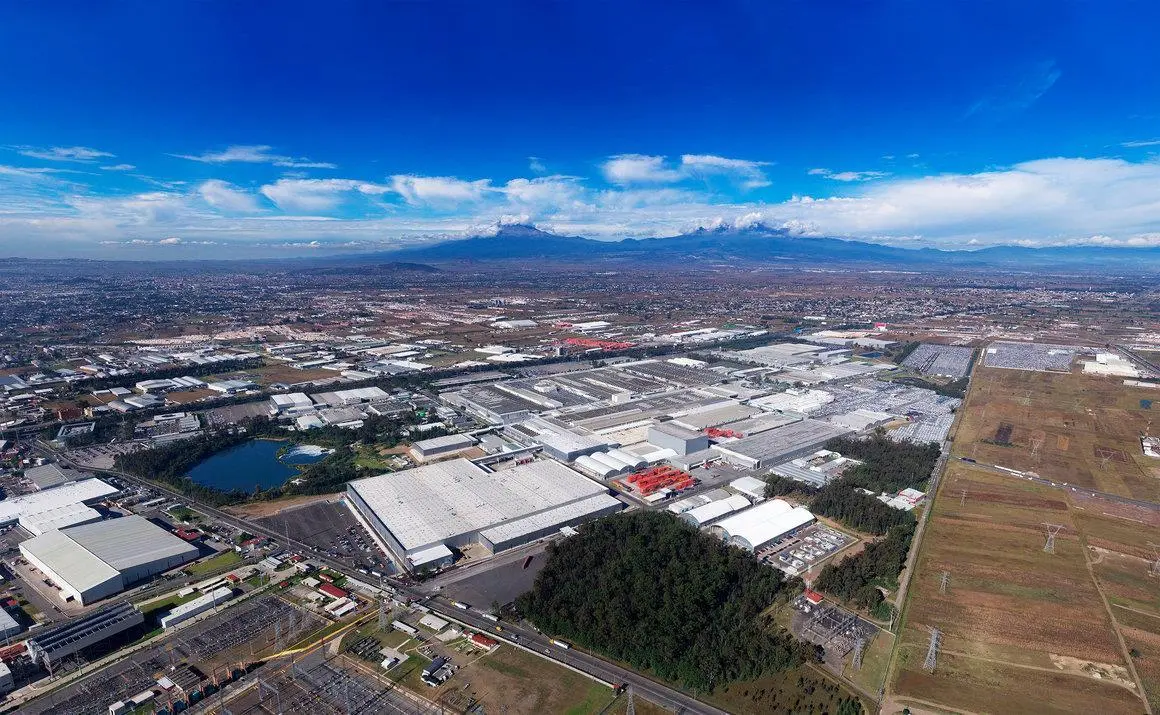
While westbound shipments to the North American market encompass Volkswagen, Audi, Porsche and other brands in the extensive VW portfolio, the output of the group’s Mexican factories, and its huge Puebla plant in particular, generates substantial demand for eastbound shipping space to Europe. Located southeast of Mexico City, the Puebla complex produces Beetle, Jetta, Cabriolet, Golf, Sportwagon and long-wheelbase Tiguan models. It is understood that two of the decks have been fitted so as to permit future transportation of hydrogen-fuelled vehicles.
Cargo access and egress is by way of a jumbo quarter ramp, designed by MacGregor and incorporating the proprietary Load Monitor System, affording more scope for heavier project cargo, potentially up to 300t. Expeditious cargo handling when starboard side to the quay is also facilitated by a side ramp in the aftship section for lighter vehicles.
The 7,000CEU vessel blueprint, customised to the requirements of both owner and charterer, was developed by Shanghai Merchant Ship Design & Research Institute (SDARI) in compliance with DNV class rules. While characteristically slab-sided, a feature of the Emden is the vertical bow with accentuated flare, contributing to the maximisation of internal volume for revenue-earning.
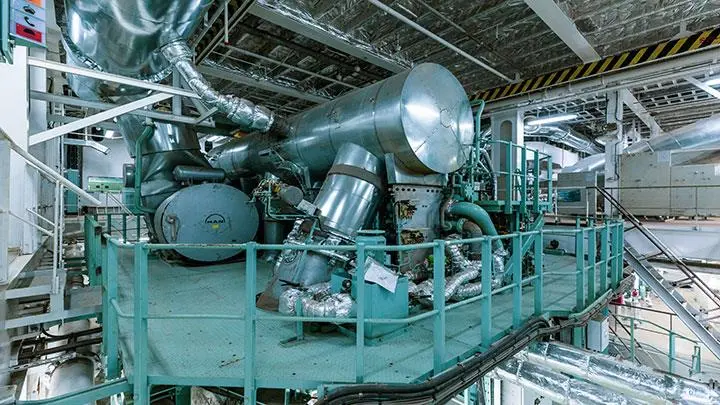
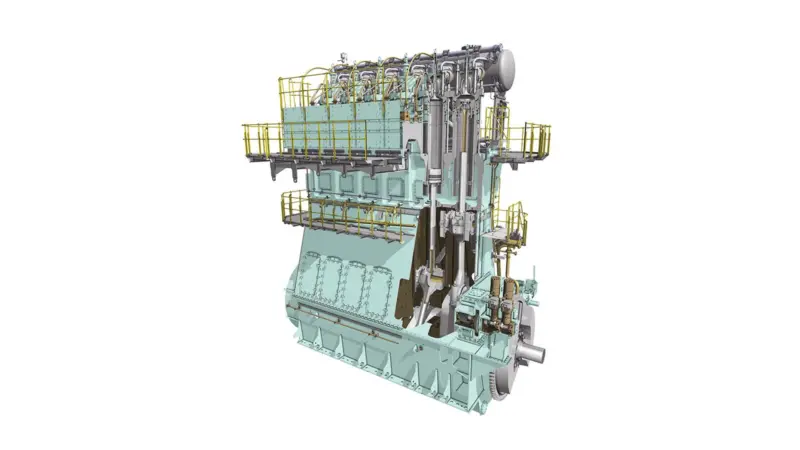
Emden is powered by a single MAN two-stroke engine of the gas-injected(GI) type, enabling primary operation on LNG with the capability to revert to fuel oil. The six-cylinder S60ME-C10.5-GI low-speed unit has been specified at an output of 13,300kW at 105rpm, giving a service speed of 19 knots.
The engine type is attributed with a very small methane slip factor due to the high injection pressure, and offers a design reserve for a maximum rating of 14,940kW. The S60ME-GI plant includes EGR and SCR technology to ensure Tier III NOx compliance in all modes.
The auxiliary installation is also founded on dual-fuel prime movers, such that the vessel can be run wholly on LNG. Each of the MAN 8L28/32DF four-stroke engines driving the three main gensets can deliver 1,600kW at 720rpm.
The adoption of LNG fuel promises a 25% reduction in tank-to-wake CO2 emissions, plus up to 30% lower NOx, virtual elimination of SOx and a cut in soot particles by as much as 60%.
LNG fuel is stored in two vacuum-insulated tanks of 1,675m3 capacity supplied by MAN Cryo and located immediately forward of the main engine room. The scope of the Swedish-based cryogenic specialist’s contract included the high-pressure and low-pressure gas handling equipment for the main and auxiliary engines, respectively, the boil-off gas (BOG) management system, with two low-pressure compressors, port and starboard side LNG bunkering stations and nitrogen generation plant.
Manoeuvring in close-quarter port and terminal environments is assisted by a 2,000kW tunnel thruster in the bow, made in China to a Kawasaki Heavy Industries design.
Formed in 2003 as a wholly-owned subsidiary of crude oil carrier specialist Frontline, part of the John Fredriksen-headed organisation, SFL Corporation has developed from a pure tanker company into the owner of a diversified fleet, embracing investments in the bulker, containership and offshore sectors as well as the tanker business.
The expansion of the asset base into the vehicle carrier market has, as in the other spheres of interest, been underpinned by charter agreements with major shipowning groups and cargo generators. Two of the existing fleet of PCTCs, the 6,500CEU SFL Composer and SFL Conductor, have provided SFL with its initial VW long-term contracts. Following on from the Emden and Wolfsburg, two further 7,000CEU newbuilds booked from GSI are due in 2024 as the Odin Highway and Thor Highway and have each been committed to K Line for 10 years.
Responsibility for crewing and technical oversight of the Emden and Wolfsburg, plus the two further newbuilds chartered to K Line, has been placed with Emden-based Lauterjung Shipmanagement, which already husbanded the SFL Composer and SFL Conductor. The new vessels are registered in Monrovia under the Liberian flag.
Besides SFL’s Odin Highway and Thor Highway, shipbuilding contractor GSI, a subsidiary of China State Shipbuilding Corporation, has a considerable forward workload of vehicle carrier orders, spanning tonnage for South Korean owners as well as various Chinese companies.
Although GSI is well-versed in the sector, Emden ranked as the first LNG-capable, large PCTC from southern China, and the Guangzhou yard faced and overcame the challenges presented in the construction process as regards core technologies such as thin plate deformation control, hull structure accuracy control, installation and commissioning of heavy ro-ro access equipment, besides the LNG dual-fuel propulsion system.
MAIN PARTICULARS – Emden
| Length overall | 199.9m |
|---|---|
|
Length bp |
195.6m |
|
Breadth |
38.0m |
|
Depth |
14.8m |
|
Draught |
10.0m |
|
Gross tonnage |
69,470t |
|
Deadweight |
19,243t |
|
Vehicle capacity |
7,000CEU |
|
Cargo decks |
12 |
|
Main engine power |
13,300kW |
|
Service speed |
19kn |
|
Auxiliaries |
3 x 1,600kW |
|
LNG fuel tanks |
2 x 1,675m3 |
|
Bow thruster |
2,000kW |
|
Class |
DNV |
|
Class notations |
+1A Car carrier, BIS, BWM(T), CLEAN, COAT-PSPC(B), E0, Gas fuelled LNG, LCS, MCDK, NAUT(OC), Recyclable, TMON(oil lubricated), ER(EGR, SCR, Tier III) |
|
Flag/registry |
Liberia/Monrovia |
Related Articles
 2-STROKE & 4-STROKE
 2-STROKE & 4-STROKE
 2-STROKE & 4-STROKE