



JERA begins world-first NH3 co-firing demonstration at Japanese thermal plant
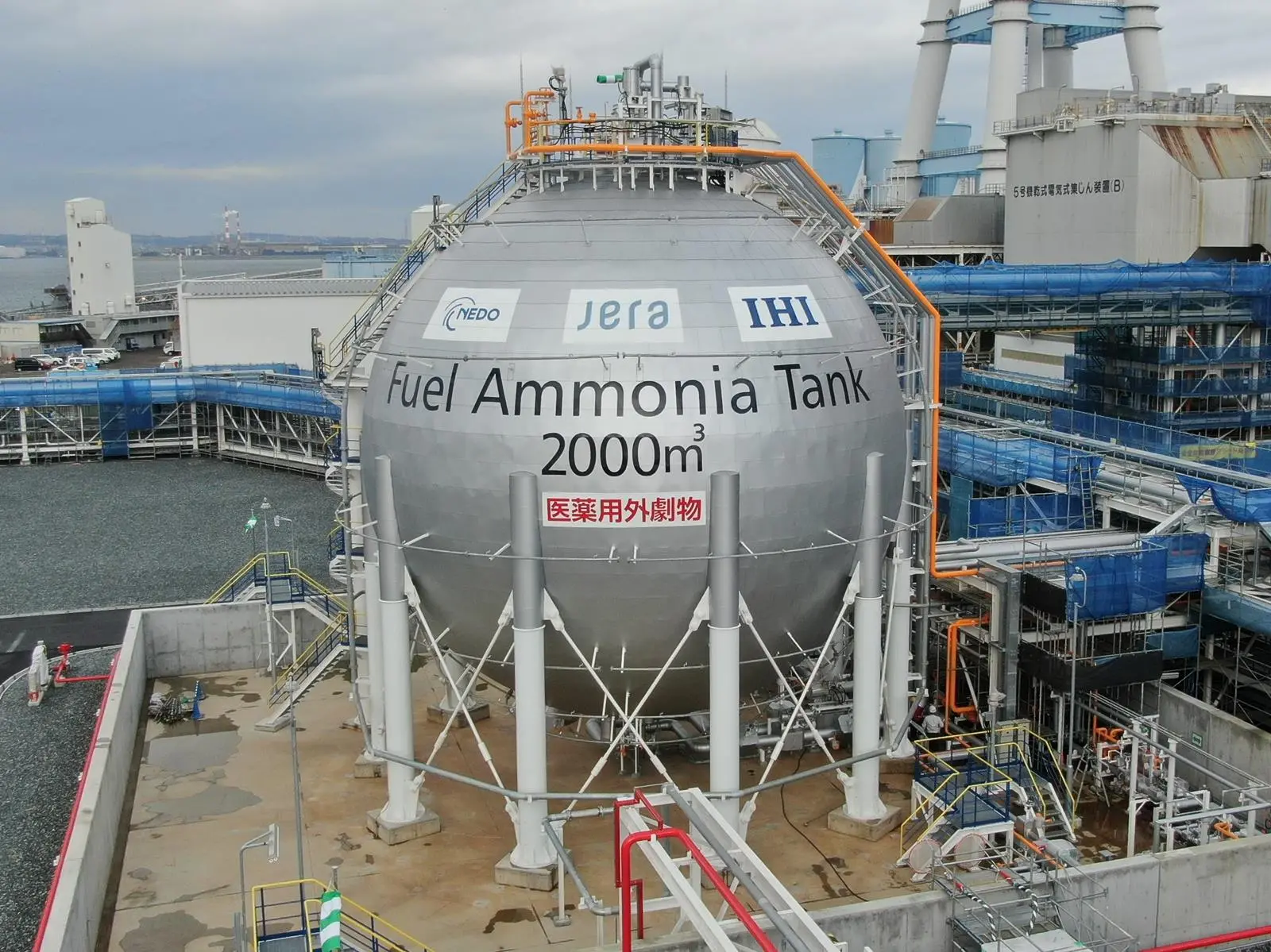
The demonstration tests began at JERA’s Hekinan Thermal Power Station in Hekinan City, Aichi Prefecture in Japan on 1 April. The demonstration testing is planned to be carried out through June 2024.
The demonstration testing will look at characteristics of the plant overall, monitoring nitrogen oxide (NOx) emissions and confirming factors such as operability and the impact on boilers and ancillary equipment.
By March 2025, JERA plans to begin commercial operation of large-volume fuel ammonia substitution (20% of heating value) at Unit 4 of JERA’s Hekinan Thermal Power Station.
JERA noted that it will seek establish for higher-ratio combustion (of 50% ammonia or more) at thermal power plants and to develop burners for 100% ammonia combustion.
Significance
The demonstration test is significant as it may offer a technologically feasible route to permit countries with significant coal-fired generation capacity to reduce emissions from installed generation capacity without the need to replace existing coal-fired plants.
The potential solution is likely to create additional demand for ammonia, and is likely to be closely followed by market participants in the Asia-focused thermal coal seaborne market. The Asia Pacific region has become the most important thermal coal trading region in recent years, supplying 63% of seaborne thermal coal exports, and receiving 82% of all imports in 2021.
The ammonia co-firing technology may also attract interest from China and India, which maintain sizeable domestic coal mining industries and are continuing to invest in new coal-fired generation capacity.
Ammonia Co-firing
Japanese researchers have been active developing solutions to permit supercritical coal plants to reduce their CO2 emissions by co-firing with ammonia. A 2019 study by IHI Corporation found that in some cases, an injection of 20% ammonia into coal boilers could also reduce their output of nitrous oxide (NOx), a gas that has significantly global warming potential than CO2.
IHI expects that coal co-firing with green ammonia could reduce carbon emissions, enough to bring those from an ultra supercritical coal powerplant down to 636g-CO2/kWh – below the level of an oil-fired plant – and would provide a cheap way of cutting emissions without completely rebuilding infrastructure, or increasing Japan’s reliance on nuclear power.
Related Articles
 AMMONIA
 AMMONIA
 AMMONIA