



Methanol bunkering first at Antwerp-Bruges
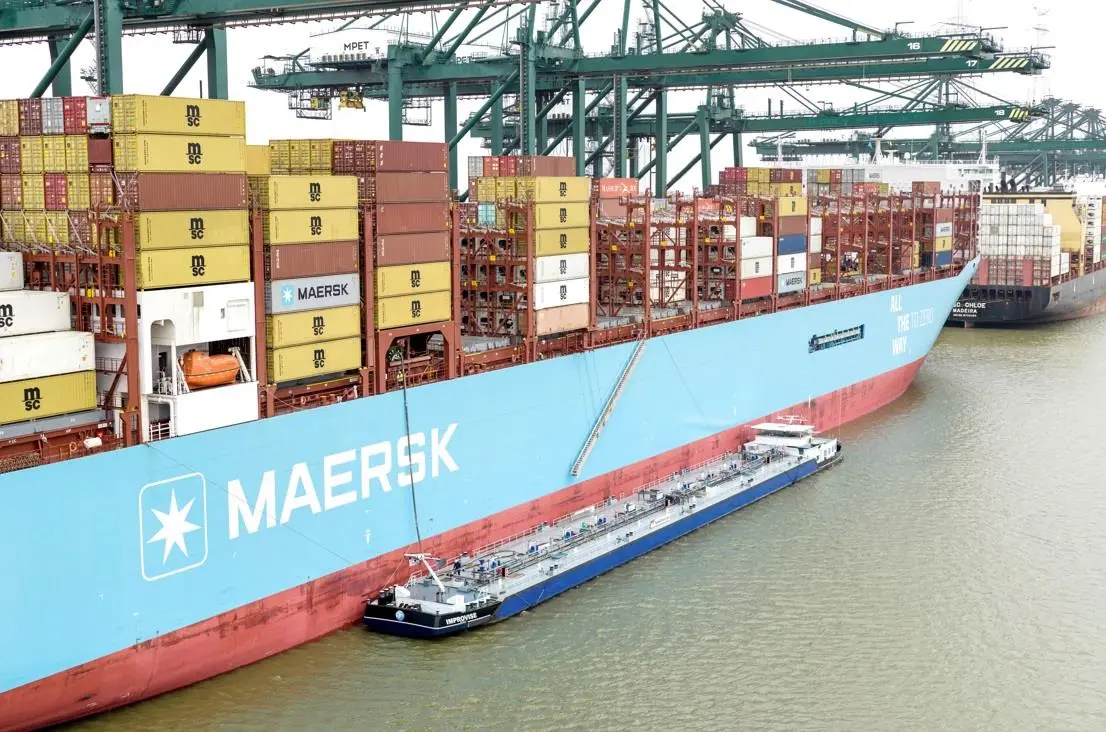
‘Ane Maersk’ bunkered 4.300 tonnes of green methanol and 1.375 tonnes of biodiesel (B100) during the port stay at the MSC PSA European Terminal (MPET).
“As the fifth largest bunkering port in the world, we are committed to playing a pioneering role in the integration of climate neutral fuels to the bunker market,” said Jacques Vandermeiren, CEO Port of Antwerp-Bruges.
”Port of Antwerp-Bruges will provide facilities where possible, make both platforms multifuel ready and is itself committed to making its fleet greener by using alternative fuels.”
Methanol move
During the bunkering operation, TankMatch dispatched two barges to transfer 4.300 tonnes of green methanol onto the Ane Maersk. Subsequently, a barge from VT Group delivered 1.375 tonnes of biodiesel (B100) .
The bunkering process was integrated into the vessel’s port stay, combining bunkering simultaneously with on and off-loading of cargo. The so called ‘simultaneous operations’ (SIMOPS) increased the efficiency of the port stay by lowering additional time allocation for refuelling.
For Port of Antwerp-Bruges, this is also a milestone in its ambition to become a multifuel port, where a multitude of different climate neutral fuels such as hydrogen, ammonia, methane and methanol are available for bunkering, in addition to the range of bio and conventional bunker fuels already available.
In June 2023, the very first methanol bunkering operation took place at Port of Antwerp-Bruges, when 475 metric tonnes of methanol were bunkered onto the tanker Stena Pro Marine.
Port of Antwerp-Bruges already has the capacity to store climate neutral fuels for use within its industrial cluster and distribution to the hinterland.
In the context of the broad energy transition, where hydrogen carriers like methanol, ammonia, and methane are set to play pivotal roles, Antwerp-Bruges is one of many tank storage terminals that have invested in extra capacity or are planning to do so.
The call at Antwerp is part of Ane Maersk’s maiden voyage from South Korea to China, fuelled by green methanol. It’s the first of Maersk’s 18 large methanol-enabled vessels that will be delivered between 2024 and 2025 and world’s second methanol-enabled container vessel.
Related Articles
 METHANOL
 METHANOL
 2-STROKE & 4-STROKE