



Dutch know-how for US cableship project
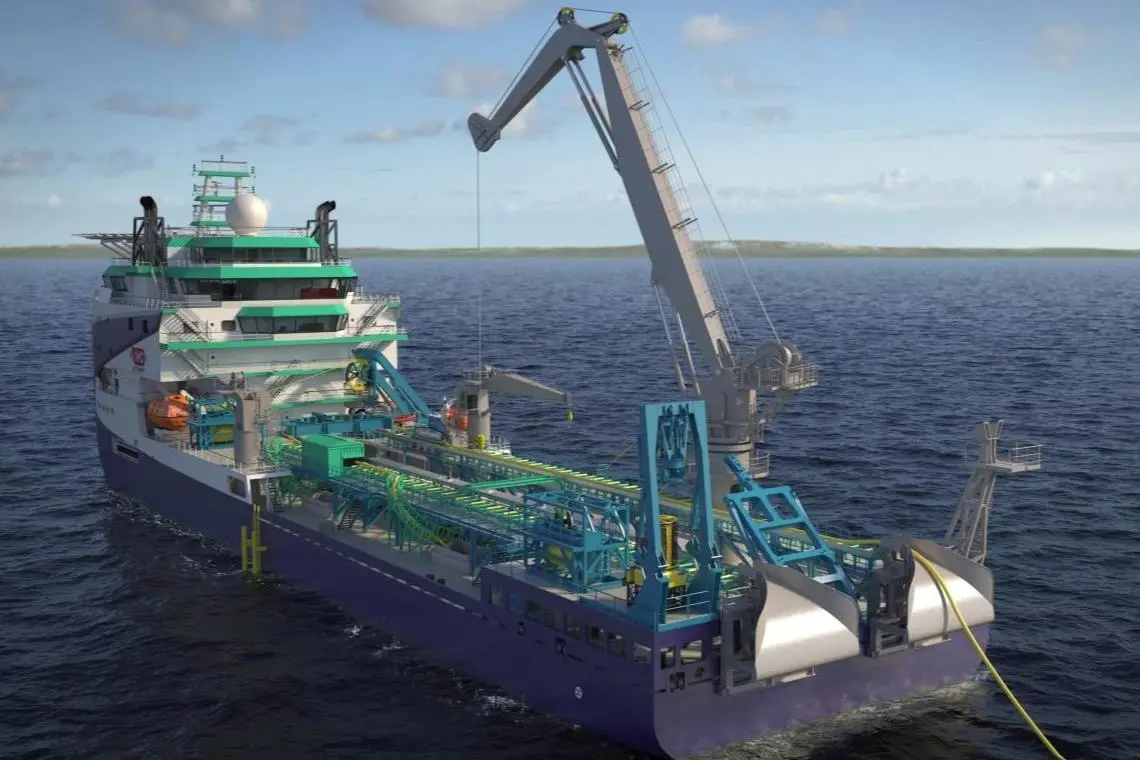
Under Jones Act requirements, construction will be undertaken in the USA, leveraging Royal IHC’s design, engineering and shipbuilding know-how as a leading light in vessels and technology for the offshore energy and dredging sectors.
The envisaged newbuild, to be delivered in 2028, is of some 115m length overall and features a dual-lane cable installation system and a 5,000t cable transportation capacity in two carousels. The turntables are dimensioned to load up to 100km of cable for wind farm arrays and connections to the onshore network.
The vessel will fill a gap in US fleet capabilities. Besides installation work in the emergent US offshore renewables business, the diesel-electric cableship is also to be equipped for repair and maintenance tasks.
The preliminary agreement signals the first step in a partnership between Kalypso and Royal IHC, which will collaborate to finalise the contractual, engineering and construction details for the project. The initiative indicates significant maturation of the domestic supply chain, elemental to shipbuilding orders governed by the Jones Act.
The proposed vessel employs a forward bridge and accommodation arrangement, with all offshore operations effected from the aft working deck. The two lay lines over the stern sheaves will be fed from the two below-deck carousels, offering identical 2,500t storage capacities. The design includes a dedicated, enclosed cable splicing area for cable joints and repairs.
Handling wherewithal includes an active heave compensated, 100t knuckle boom crane offset on the starboard quarter for installation and construction assignments, and a jet trencher. There will also be provision for a work-class remote operated vehicle(ROV) with a 1,000m umbilical and associated launch and retrieval gear.
The newbuild is to be of DP2 dynamic positioning standard, and powered to ensure transits at 10 knots’ cruising speed, up to a maximum 12 knots. Four primary gensets, each rated at approximately 2,300ekW, supplemented by an energy storage system of some 1,500ekW equivalence, will feed all shipboard consumers.
The main propulsion units in the draft specification are two nozzled, azimuthing thrusters of 2,500kW apiece, complemented in position holding, track keeping and otherwise precision handling mode by two 1,400kW bow tunnel thrusters and a 1,500kW retractable azimuthing thruster in the foreship. Consideration has been given in the design and engineering for optional or future use of methanol fuel in the prime movers.
The accommodation layout provides for a total complement of 94 personnel.
The announcement of the partnership on the cable layer scheme came at the same time as the launch in Texas of the first dedicated wind turbine installation vessel to be built in the USA.
Ordered by Dominion Energy from the Seatrium AmFELS yard at Brownsville, the 472ft(144m) Charybdis is of the jack-up type and designed to handle turbine sizes of 12MW or larger. Implemented under the auspices of the Jones Act, the project is testament to the scope afforded the US shipbuilding industry and supply chain by the ramp-up of the offshore wind sector.
Related Articles
 PROPULSION
 GENERAL NEWS
 HYDROGEN