



Japanese group target first ammonia-powered gas carrier
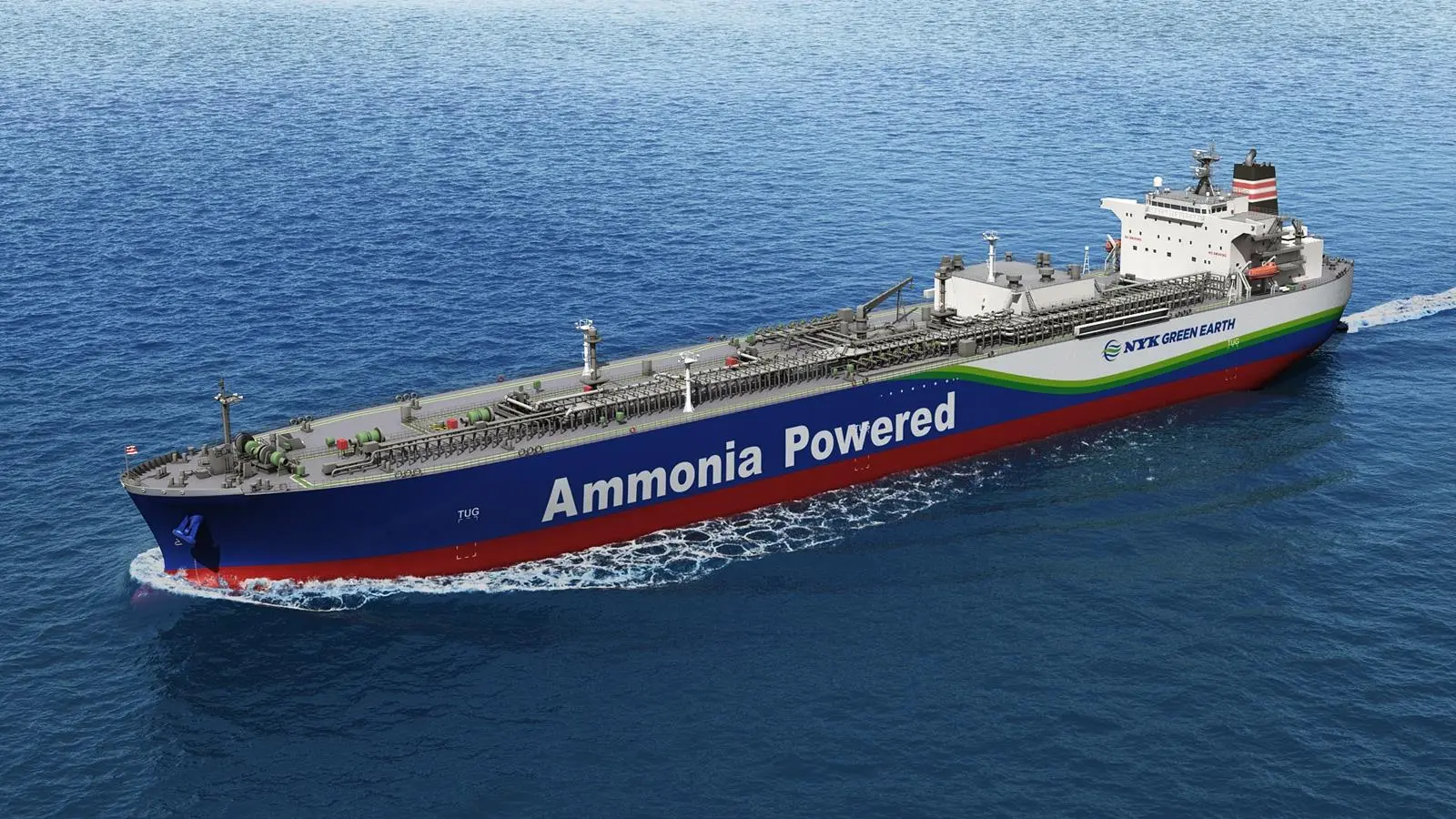
Japan Engine Corporation (J-ENG), IHI Power Systems, NYK, ClassNK and Nihon Shipyard are cooperating on the construction of an ammonia-fuelled gas carrier equipped with Japan-made engines.
The carrier is part of on-going development supported by Japan’s New Energy and Industrial Technology Development Organization (NEDO), and the team aims to have a vessel operational in November 2026. The idea is to promote the concept, further the development of other ammonia-fuelled ammonia carriers, and progress regulations for ammonia as fuel at the IMO.
The prototype 40,000cbm vessel design obtained an Approval in Principle (AiP) from ClassNK in September 2022. This process involved risk assessments that included NYK’s engineers and led to ClassNK subsequently publishing safety guidelines for ammonia-fuelled ships.
Engine design specifications
The carrier will be fitted with a dual-fuel two-stroke engine produced by J-ENG and a 250mm bore four-stroke auxiliary engine produced by IHI Power Systems. The developers aim to minimise pilot fuel use to reduce GHG emissions by having an ammonia fuel mixed combustion rate of up to 95% in the main engine and at least 80% in the auxiliary.
The engine developers are faced with the challenge of managing the impact of ammonia’s flame retardant characteristics on combustion whilst minimising the production of nitrous oxide (N2O), a greenhouse effect of approximately 265 times that of CO2.
In May 2023, IHI Power Systems achieved the world’s first stable combustion of ammonia at an 80% co-firing rate with fuel oil in a bore 4-stroke engine. The testing confirmed that ammonia slip and emissions of N2O were virtually zero and that there was no ammonia leakage during operation or after shutdown.
Also in May 2023, J-ENG began mixed firing operations on a large, low-speed, two-stroke engine to optimize engine performance and verify safety. This marked the start of development of the ammonia-fuelled UEC60LSJA type engine that will be used in the new carrier. J-ENG is also working on a NEDO-supported project for a 50cm bore ammonia-fuelled model expected to be completed in 2025.
J-ENG has since ordered an ammonia fuel supply system and an ammonia gas abatement system from Mitsubishi Shipbuilding. The systems are remotely controlled automatically by an integrated control system. Mitsubishi Shipbuilding will deliver the modules in 2025.
Earlier this year, Hitachi Zosen Corporation and NYK announced a plan to develop a catalytic N2O removal system for ammonia-fuelled 2-stroke engines, again with support from NEDO. The solution will be installed on the new vessel, and ClassNK will conduct a safety verification of the system. ClassNK is also researching the development of international guidelines.
Safety first
This adds to the guidance already developed. The society’s “Guidelines for Ships Using Alternative Fuels” have been updated to include the use of ammonia as fuel. They now cover high-pressure dual-fuel 2-stroke engines and low-pressure dual-fuel 4-stroke engines. Specific requirements, including isolation distances from areas where there is a risk of ammonia release to areas that should be protected, and safety design concepts to design engines and boilers using ammonia fuel, are included.
ClassNK has issued a range of other ammonia-related AiPs including one for a large ammonia-fuelled 210,000dwt bulk carrier jointly developed by Mitsui O.S.K. Lines (MOL) and Mitsui & Co. and one for an ammonia fuel supply system for oil tanker and container ship developed by Samsung Heavy Industries (SHI). ClassNK has evaluated the ammonia-ready ammonia carrier Gas Innovator owned by IINO Kaiun Kaisha as part of the Zero-Emission Accelerating Ship Finance program, which is jointly operated by ClassNK and the Development Bank of Japan.
ClassNK has also awarded an AiP for the design of a prismatic ammonia fuel tank (IMO Type B independent tank) for container ships developed by Planning and Design Center for Greener Ships (GSC). While Type B tanks require a refined fatigue analysis, it is possible to use ordinary steel as the material for the structure of fuel storage hold space, except for the bottom which is intended to be a partial secondary barrier. This results in a reduction in the amount of steel needed for low temperature service. Additionally, prismatic tanks offer superior volume efficiency compared to cylindrical tanks as they can be designed to fit the ship’s hold. The Type B tank developed by GSC has been designed to ensure safe storage of ammonia and to minimise the reduction in the number of cargo containers.
Related Articles
 AMMONIA
 AMMONIA
 AMMONIA