



A future in the making
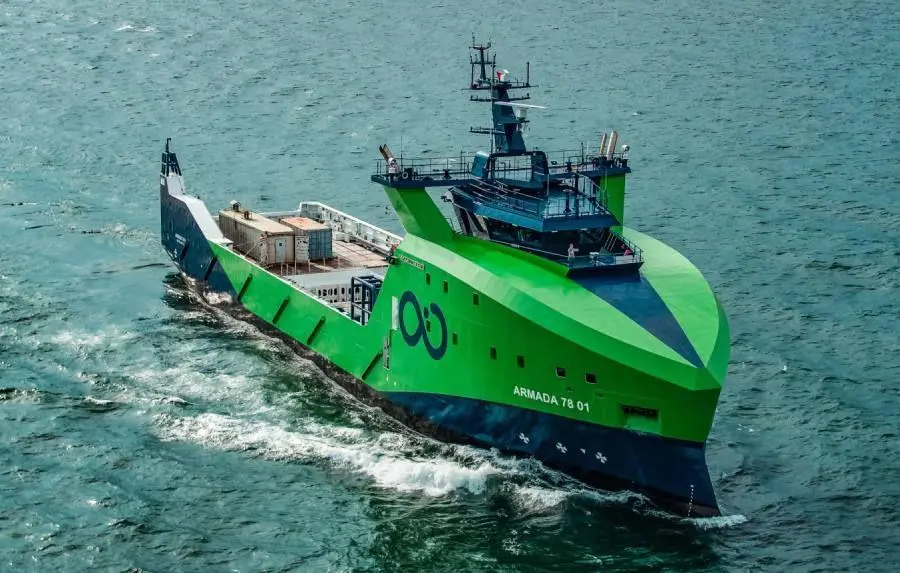
The new 78m Armada series offers a multi-role capability, with the accent on geophysical survey, geotechnical sampling, and inspection, maintenance and repair(IMR) services.
The investment in the eight-ship class, as with the other strands of the Armada fleet development programme encompassing 21m, 35m and 85m designs, is complemented by the creation of a remote control centre(RCC) network and proprietary remote communications system.
Thus, while each vessel has a relatively small crew complement, the ground is being laid for a future wherein all operations and navigation will be handled by the onshore establishment of mariners and specialised personnel at workstations. Clearly, the project is long-term not only in vision but also in expectation of profitable returns, given the premium entailed in initially coupling crewed vessels with an infrastructure conceived for ultimate, fully remote control. Furthermore, the diesel-electric newbuilds have been engineered to facilitate adaptation over time to new fuels and lessened environmental impact.
Ocean Infinity’s strategic objectives expressed in the Armada programme at large have a potentially broader industrial benefit, in testing the mettle of shipyards, engineering companies, equipment suppliers and designers in providing solutions to visionary requirements. A degree of public funding support in the UK has enabled certain facets to be realised or progressed.
The eight Armada 78 vessels were contracted from Norwegian international shipbuilder VARD, and specified with diesel-electric battery hybrid power and propulsion. Vessel construction was assigned to the group’s Vung Tau yard in Vietnam, with certain installation work undertaken at VARD’s Soviknes premises in western Norway. Production at Vung Tau of the last of the series, the Armada 78 08, was completed towards the end of January this year.
Developed in conjunction with Ocean Infinity’s US and UK technical personnel, the VARD 9 60 design is a multi-purpose platform distinguished not only by its provision for ‘lean’ crewing and remote control, but also by the preparation for alternative fuels such as ‘green’ ammonia and fuel cell and battery technologies.
VARD’s standing as an integrated shipbuilder was a significant factor in attracting the ground-breaking Ocean Infinity contract. Besides the capability of its international shipyard network for marrying lower-cost construction in Vietnam with a high-technology specification, the group’s VARD Design brought its extensive know-how in high-grade offshore vessels to bear on the project, while VARD Electro supplied the shipsets of SeaQ advanced marine electronics. VARD Accommodation provided the accommodation solution, and VARD’s daughter company Seonics delivered the moonpool launch and recovery system.
The dialogue between Ocean Infinity and VARD had first centred on three larger ships. However, over time, the project changed in form to one entailing eight smaller vessels, resulting in the 78m class. Because of the vessels’ planned long lifespan, the contractual owner was predisposed to investing more in each ship, and the ultimate design was arrived at through many iterations by VARD.
The Armada 78 series supports operations with the owner’s remote-operated vehicles(ROVs), seabed drills and cone penetration test(CPT) systems. The aft bulwark is removable so as to permit deployment of the Ocean Infinity autonomous underwater vehicle(AUV) fleet. Each vessel incorporates two 9m x 4m moonpools fitted with modular launch and recovery systems(LARS), fully automated and remotely-operable from the company’s present remote control centres in Austin, Texas, and Southampton, UK.
The robotic undersea equipment carried by the Armada 78 vessels can include Hugin 3000/6000 AUVs rated to 3,000m and 6,000m depths, Saab Seaeye Leopard ROV, and Saab eWROV and Schilling HD WROVs.
The ships thereby have the wherewithal to undertake a range of services including detailed mapping and survey tasks, analysis and inspection of seabed assets, and seabed search, salvage and subsea security. In addition, given the spacious open deck area for payloads of up to 1,000t of equipment or containers, the vessels can provide a logistic function, and carry out asset maintenance operations.
The power and propulsion system is of diesel-electric battery hybrid type. While the two Cummins QSK60-M engines and two Scania Dl16M units that drive the four main generators run on diesel fuel, the vessels’ design and engineering arrangements have been conceived to evolve through various stages of future fuels implementation.
The QSK60-M high-speed engine, manufactured at Cummins’ Daventry plant in the English Midlands, is a 16-cylinder vee-form four-stroke offering power ratings from 1,491 to 2,013kW. The Scania Dl16M eight-cylinder vee-type covers a power band up to 846kW.
Classed to DP2 dynamic positioning standard, each vessel has two Kongsberg US205 main propulsion thrusters and a troika of Kongsberg TT1650 bow tunnel thrusters. The current propulsion configuration can deliver a maximum speed of 14 knots and a cruising speed of some 8-10 knots, and the power arrangements include 1,130kWh of energy storage capacity by way of two banks of 565kWh Corvus Orca lithium-ion batteries.
Preparation for fuel upgrades is reflected in the provision of two large tank spaces and fuel cell rooms, and in the DNV Ammonia Ready notation. In fact, Ocean Infinity is leading a project that secured UK government innovation funding for building a marine propulsion test facility with an integrated ammonia marine propulsion system. The test facility will demonstrate clean-fuelled technology eventually capable of powering Armada vessels using an ammonia-based fuel cell system. The company’s partners in the undertaking include Oxford Green Innotech(OXGRIN), University of Oxford, and the University of Southampton’s Marine & Maritime Institute.
Cummins’ UK arm has subsequently won UK research funding for a collaborative project addressing the development and deployment of a methanol conversion kit for the QSK60 engine series. Under the R&D endeavour, Ocean Infinity is to provide one of the Armada 78 vessels as the platform for Cummins to design, develop and test the dual-fuel methanol and hydrotreated vegetable oil(HVO) technology.
While construction of the 78m series was under way, Ocean Infinity augmented the VARD orderbook in February 2022 through a contract for six newbuilds of an 85m version. Embodying the VARD 9 80 design, the vessels will be optimised for inspection, maintenance and repair(IMR) and light construction work in the offshore energy market. Provision will be made for the integration of fuel cell and battery technology in keeping with the company’s low-carbon service mantra.
The company’s establishment of RCCs in Southampton and Austin represents the start of a network that will include stations in Singapore, Tasmania and elsewhere.
| Main Particulars – Armada 78 01 | |
|---|---|
| Length overall | 78.0m |
| Length bp | 72.3m |
| Breadth | 15.0m |
| Depth | 7.0m |
| Draught | 5.3m |
| Gross tonnage | 2,373t |
| Deadweight | 1,490t |
| Deck cargo capacity | 1,000t+ |
| Propulsion system | Diesel-electric battery hybrid |
| Main generator engines | 2 x Cummins QSK60-M + 2 x Scania Dl16M |
| Battery packs | 2 x 565kWh |
| Main propulsion thrusters | 2 x Kongsberg US205 |
| Speed, maximum/cruising | 14kn/10kn |
| Manoeuvring thrusters(bow) | 3 x Kongsberg TT1650FP |
| Class | DNV |
| Class notations | +1A, Battery(Power), CLEAN, COMF(C-3, V-3), DK(+), DYNPOS(AUTR), E0, Fuel ready(Ammonia[D; P}), NAUT(OSV), Recyclable, SF, ER(SCR) |
| Registry | Singapore |
Related Articles
 BATTERIES, SUPERCAPACITORS, FUEL CELLS AND OTHER ENERGY STORAGE TECHNOLOGY
 BATTERY HYBRIDS & FULL-ELECTRIC VESSELS
 BATTERY HYBRIDS & FULL-ELECTRIC VESSELS