



Bergen expands future fuel options
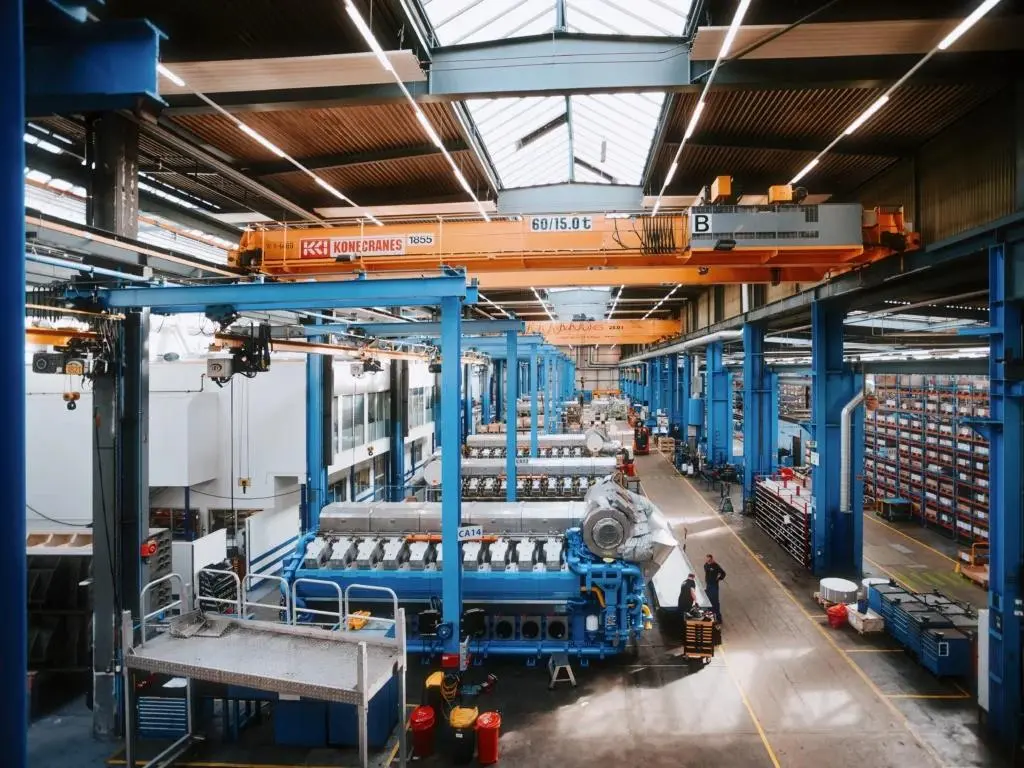
The move follows the commercialisation of a 15% hydrogen blend in 2022, after tests using a B35:40 lean-burn gas engine, and accords both with the Norwegian company’s goals and parent UK group’s overarching, long-term sustainability agenda.
The purchase of Bergen Engines from Rolls-Royce by privately-owned Langley Holdings on 31 December 2021 has given added momentum to the Hordvikneset factory’s drive to explore and expand future fuel options for the energy transition.
Last year, group chairman Tony Langley challenged the Bergen team to have a 100% hydrogen engine operating by the end of 2024. The 25% hydrogen blend development, designed to be applied without the need for modifications, was announced in June this year. It was reported then that technicians were on track to reach the goal of a 100% hydrogen-fuelled model before the close of 2024.
A versatile and clean energy carrier, hydrogen presents several key benefits besides environmental gains when blended with natural gas in reciprocating, medium-speed machinery. There are yields in terms of improved combustion efficiency and operational flexibility, in addition to significantly lower CO2 emissions. As higher volumes of hydrogen are incrementally incorporated into the fuel mix over the course of the development programme, engine running stability is a pivotal consideration.
Tony Langley expects hydrogen to become central to the global energy transition, but considers that it could be a decade or more before hydrogen is produced at scale. While the current work at Bergen is intended to ensure that the business will be ready to meet demand at that juncture, the company is in the meantime heavily engaged in the development of methanol- and ammonia-capable engines, and also biofuel-compatible options. It received a DNV-approved notation for its methanol-ready offering in February 2024.
Bergen’s modular engine design approach prioritises fuel flexibility, acknowledging the uncertainties that customers face when making long-term investments in ships and plant, as regards future fuel availability, costs, and regulatory landscapes, including potential CO2 taxes. Flexibility has to come with reliability and top efficiency ratings, whatever fuel type or combination is adopted.
The continuing evolution of the Bergen range is testament to the unremitting investment in R&D and production wherewithal at the Hordvikneset factory, which is widely associated with lean-burn K-G series gas engine technology introduced into the four-stroke portfolio in 1990.
Langley’s long-term mindset and commitment to research was swiftly confirmed after the takeover, backing Bergen Engines in the Ammonia Zero Emissions(AMAZE) project, a three-year study to develop technology for a high-pressure, multi-fuel, internal combustion engine using carbon-free ammonia as the primary fuel. Advanced fuel injection and combustion technology is expected to ensure high efficiency and close to zero emissions. Bergen’s collaborators in the endeavour, part-funded by the Research Council of Norway, include the Norwegian University of Science & Technology(NTNU) and energy group Equinor.
Earlier this year, Bergen also threw its weight behind the work of the FME Maritime Energy Transition Center(MarTrans). Sponsored by the Research Council of Norway to the tune of more than NOK300m($28m), the initiative is one of the largest maritime research programmes of its kind worldwide, involving 65 partners from across the industry and academia, and spanning an eight-year timescale.
Bergen Engines, whose catalogue comprises liquid-fuelled and gas fuel engines with ratings in the 1,400-11,800kW band, now forms the core of Langley’s new Power Solutions Division. Within the Division, the Norwegian producer works closely with two other Langley subsidiaries, Piller Power Systems of Germany and Marelli Motori of Italy. For instance, the latter’s alternators provide pairing opportunities with Bergen prime movers in marine gensets.
The shipping market’s pressing need for solutions that promise flexibility while meeting efficiency and regulatory criteria has been illustrated by several new contract awards so far this year. One of these concerns four 7,000dwt short-sea, multi-purpose cargo vessels ordered by Norwegian operator Skarv Shipping from Huanghai Shibuilding in China. The newbuilds have been specified with Bergen C25:33L6A gensets, featuring variable valve timing and variable-speed technology, under a deal which provides for future conversion of the engines from diesel to ammonia operation, pending the owner’s decision.
Bergen C25:33 generators, using eight-cylinder engine drives, have also been selected as part of the power installations in two 117m hydrogen ro-pax ferry newbuilds for Torghatten Nord. Each double-ended newbuild will employ the gensets in support of the hydrogen-fed fuel cell plant which will provide main propulsion. Hydrogen-electric will be the primary operating mode, and diesel-electric the secondary mode. Furthermore, the Bergen engines will have the capability to burn hydrotreated vegetable oil(HVO), such that regular sailings with the vessels will entail a hybrid mix of 85% hydrogen and 15% biofuel.
Scheduled for commissioning during 2026, and constituting something of a milestone in the industry’s shift to cleaner energy sources, the shipbuilding contract has been awarded to western Norway’s Myklebust Verft, which has assigned hull fabrication to Cemre Shipyard of Turkey. With the vessels in operation, CO2 emissions on the Vestfjord ferry connection, among the longest in the coastal network, are expected to be cut by 26,500t per annum.
Related Articles
 AMMONIA
 HYDROGEN
 HYDROGEN