



Building on a versatile Ro-Pax platform
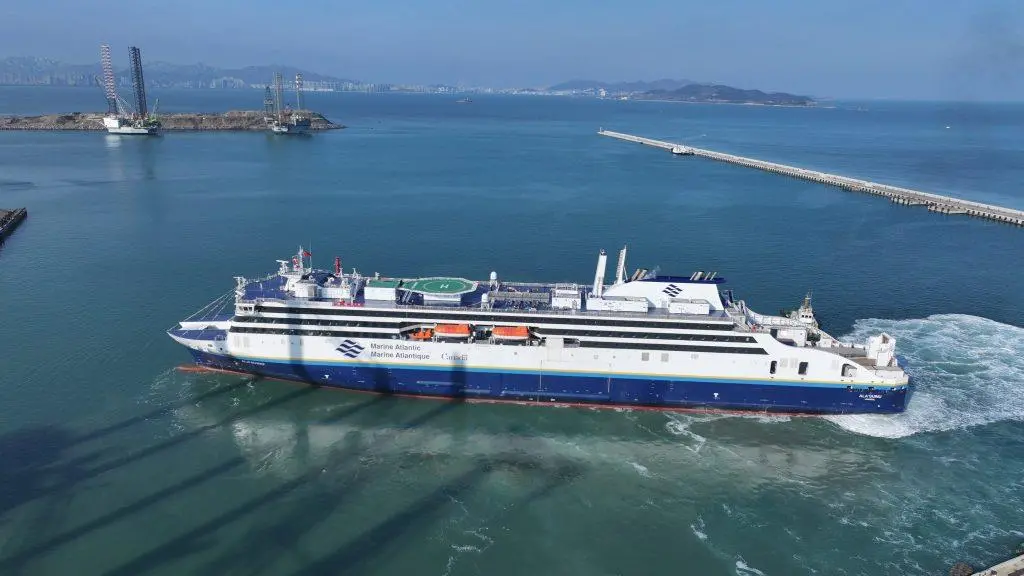
Marrying Nordic technical and operational know-how with cost-competitive Chinese production, the E-Flexer template provides for multiple configurations as regards hull length, payload capacity and mix, internal layout and powering arrangements. Besides the versatility as to delivered form and specification, the platform affords maximum flexibility for adapting to potential carbon-neutral fuels and systems in the coming decades.
The new deal takes the tally of confirmed orders to 15, and shipbuilding contractor CMI Jinling Weihai(formerly AVIC Weihai) has duly delivered 10 of the vessels so far. The business transacted by Stena RoRo involves established operators in commercially and geographically disparate spheres of the ferry business, including the Irish Sea, the eastern Channel, the western Channel and Anglo-Spanish traffic, the Canadian east coast, western Mediterranean and the Adriatic. The application of a core design to service areas and regions entailing substantially different sea conditions and scheduling demands speaks further to its adaptability.
While five of the ships booked to date have been enrolled into the short-sea network maintained by Stena RoRo’s sister company Stena Line, 10 have been fixed on a long-term basis to other, high-profile players.
Market soundings indicate sustained strong interest in the concept, and Stena RoRo has now broadened the offering with more freight-orientated ro-pax versions plus a pure ro-ro design, the C-Flexer, of up to 5,050 lane-metre intake. The E-Flexer’s inherent flexibility is also embraced by the 147m NewMax version optimised for access to restricted ports, and which has already attracted orders for two newbuilds, also entrusted to CMI Jinling Weihai.
The latest endorsement of the E-Flexer design emanates from the Athena Group, an enterprising member of the expansive Greek ferry community. Attica has entered into a long-term charter agreement against the two further vessels ordered in China by Stena RoRo, constituting the 14th and 15th in the series.
Customised to Attica’s Superfast-branded operation, the ferries are scheduled to be ready for Adriatic service during 2027. The 240m newbuilds rank among the largest E-Flexer variants to date, laid out for 1,500 passengers and 3,320 lane-metres of freight, equating to some 200 trucks.
The nature and extent of the commercial terms are similar to those underpinning previous E-Flexer contracts, whereby Attica will take the ships into its fleet under 10-year bareboat charter, with an option to purchase after the initial five years. Moreover, options on two more vessels are expected to be appended to the deal.
The Attica-assigned newbuilds are described by Stena RoRo as the most bespoke E-Flexers yet, testament to the utility built into the original design template by the Swedish company in collaboration with Finnish-based, Chinese-owned consultancy Deltamarin. The latest iteration is the product of close cooperation between the Stena RoRo and Attica technical teams.
The Greek firm has shown its propensity for innovation over the years, notably with the original Superfast series that re-defined Adriatic route connections in terms of speed and quality, followed by the Blue Star Patmos ro-pax type, and most recently by the 32-knot Aero Highspeed catamaran ferry class.
Specifications
Attica’s E-Flexers will each have a two main, medium-speed propulsion engines that can be run on conventional marine gas oil(MGO), heavy fuel oil(HFO) or biodiesel, while prepared also for future operation on methanol.
In addition, the specification and layout will accord with a classification society notation signifying readiness for future utilisation of batteries. When and if such a course of action is adopted will depend on energy storage system technological development and costings. Installation of a battery pack would mean less usage and reliance on diesel generators. The fact that battery packs in a range of capacities have been nominated for a number of E-Flexers currently on order will no doubt inform the latest project.
In any event, on scheduled completion in April and August 2027, the new vessels will have an substantial environmental impact from the outset, reducing the company’s greenhouse gas emissions per unit of transport by 60% relative to the existing vessels coming up for retirement.
E-Flexer deliveries started in November 2019 with the handover of the Stena Estrid to Stena Line for Irish Sea duty. As the ‘standard’ design, the vessel provides capacity for some 1,000 passengers 3,100 lane-metres of freight within a length of 214.5m on a 27.8m beam, and the subsequent five newbuilds, variously commissioned into the Stena, Brittany Ferries and DFDS fleets, embrace the same main parameters. The seventh and eighth ro-pax ships are extended versions of 240m, taking a vehicular payload of up to 3,600 lane-metres in Stena Line service.
Subsequent deliveries and orders have brought customisation to the fore, resulting in a range of lengths and capacities, albeit on the common, original beam of 27.8m. The 2024-delivered 10th in series Ala’suinu for Canadian company Marine Atlantic embodies a shorter version, at 203m due to port constraints. The Corsica Linea-fixed 13th newbuild, to be allocated to the Marseilles/Corsica traffic, will be of similar dimensions and capacity to the Ala’suinu.
Two E-Flexers in build for Brittany Ferries’ cross-Channel operations have been specified at 195m length in keeping with terminal and manoeuvring space criteria, but with differing provisions for freight according to the distinct routes involved. The forthcoming additions to the Attica fleet denote a return to the 240m length as employed for the Stena Estelle/Stena Ebba sisters completed in 2022.
Rather than the four-engine layout that has typified large ro-pax ferries hitherto, the E-Flexer is powered by two medium-speed engines geared down to controllable pitch propellers for a speed in the region of 22-23 knots. The use of fully-feathering screws means that, at speeds less than 18 knots, the ship can run more economically on a single propeller, with the other unit ‘feathered’ so as to reduce resistance.
The main engines in the diesel-mechanical installations driving the first five vessels are ‘gas ready’, to facilitate possible future conversion to LNG or methanol fuel, while the sixth ship, Brittany Ferries’ Salamanca, was fitted with LNG dual-fuel machinery from the outset. The adoption of a 2.3MWh battery pack in the Marine Atlantic ferry introduced a hybrid element into the E-Flexer series, and application of the technology to the design will reach a new scale by way of 11.3MWh battery installations to supplement the LNG dual-fuel main plant in the Guillaume de Normandie and Saint-Malo now taking shape in China for Brittany Ferries.
The initial use of MaK M43C medium-speed engines, whose production was terminated by the Caterpillar Group a couple of years ago, has been followed by the adoption of the Wartsila 46 wide-bore type, predominantly in its W46DF dual-fuel format.
As exercised through Stena RoRo, the Stena Group’s proficiency in structuring and managing turnkey projects, complementing its prowess in ship design and operational know-how, quickly came to the fore in the mid 1970s, when the company entrusted a major programme to South Korea’s emergent shipbuilding industry. A series of 11 ro-ro freight vessels dubbed the Searunner class, delivered to various short-sea operators over the course of 1977 and 1978, not only put down a new template for the trade but also entailed a design that had been prepared from the outset for later-stage adaptation, be it jumboisation or conversion.
The twin Pielstick-engined Searunner became something of a standard in the trailership sector, and the flotilla proved highly productive over many years in different spheres, delivering what was regarded at the time as good efficiency. A number of the vessels actually went through more than one conversion.
The bold move in taking such an extensive series to what was then a young shipyard, Hyundai Heavy Industries, which had little experience in ro-ro construction, was testament to Stena’s ability to identify promising, cost-competitive builders and undertake the requisite project management to ensure contractual performance and delivered quality.
The transaction helped drive the Hyundai Group’s ascendancy on the international stage. While Stena RoRo has fulfilled numerous other projects entailing multiple examples of new ro-ro and ro-pax designs throughout the intervening years, the E-Flexer programme provides a further illustration of the Swedish company’s skill in matching a suitable production resource with a design offering broad market reach through a concept that lends itself to customisation and modification.
It has given a major uplift to Chinese shipbuilding and helped the industry become the major global force in the ro-ro newbuild sector. In fact, Chinese preparedness to adjust designs and specifications conceived fundamentally for serial construction to individual operators’ requirements can be seen as a strength, one that compares favourably with yards in other parts of the Orient which are far less amenable and/or highly price-sensitive to adjustments in the standard ‘package’.
| Name | Operator | Delivery | Length(beam: 27.8m) |
|---|---|---|---|
|
1. Stena Estrid |
Stena Line |
2019 |
214.5m |
|
2. Stena Edda |
Stena Line |
2020 |
214.5m |
|
3. Galicia |
Brittany Ferries |
2020 |
214.5m |
|
4. Stena Embla |
Stena Line |
2021 |
214.5m |
|
5. Cote d’Opale |
DFDS |
2021 |
214.5m |
|
6. Salamanca |
Brittany Ferries |
2021 |
214.5m |
|
7. Stena Estelle |
Stena Line |
2022 |
239.7m |
|
8. Stena Ebba |
Stena Line |
2022 |
239.7m |
|
9. Santona |
Brittany Ferries |
2022 |
214.5m |
|
10. Ala’suinu |
Marine Atlantic |
2024 |
203.0m |
|
11. Guillaume de Normandie |
Brittany Ferries |
2025 |
194.7m |
|
12. Saint-Malo |
Brittany Ferries |
2025 |
194.7m |
|
13. – |
Corsica Linea |
2026 |
203.0m |
|
14. – |
Attica Group |
2027 |
239.7m |
|
15. – |
Attica Group |
2027 |
239.7m |
Related Articles
 BATTERIES, SUPERCAPACITORS, FUEL CELLS AND OTHER ENERGY STORAGE TECHNOLOGY
 BATTERY HYBRIDS & FULL-ELECTRIC VESSELS
 BATTERY HYBRIDS & FULL-ELECTRIC VESSELS