



Fuel cell advances help boost long-term competitiveness
In May this year, a group of stakeholders led by the Mærsk Mc-Kinney Møller Center for Zero Carbon Shipping published their research into the viability of fuel cells in the report: Fuel Cell Technologies and Applications for Deep-Sea Shipping. The focus was on replacing diesel generators with a fuel cell as the authors believe it appears unrealistic to assume that fuel cells will compete with or entirely replace internal combustion engines in the short term. Rather, it seems more likely that different technologies will co-exist for the foreseeable future due to the high initial costs currently associated with fuel cells and the adjustments that would be required in ships’ engine room design and standard operating procedures for crews.
The investigation involved a desktop study of an 82,000dwt bulk carrier, an LR2 tanker, and a 15,000 TEU container ship. The fuel cell configurations considered were liquid hydrogen fuel for a PEM fuel cell, methanol fuel reformed for a PEM fuel cell, and methane fuel for an SOFC. These options were compared to generators running on either LSFO, bio-methanol, or bio-methane.
Real-world data was used for vessel operational profiles so that energy efficiency, greenhouse gas emissions, and fuel and equipment costs could be evaluated from 2025 to 2040. The calculations included replacement costs for fuel cells which are expected to be significant, as approximately 30-40% of the initial system is likely to be replaced every 3-4 years.
The results indicate that fuel cells could reduce both onboard fuel demand and greenhouse gas emissions. The technologies do not appear to require design modifications that would affect ship operations or costs beyond what can be expected for the combination of alternative fuels and internal combustion engines. However, as well as the high costs currently forecast for alternative fuels, the additional cost premium of fuel cells affects their competitiveness in the short and medium term. Long-term, the financial outlook improves but remains conditional on a carbon tax or similar mechanism.
Powercell was one of many companies that provided input for the study. Stig Kallestad, Business Manager, PowerCell Sweden, says while fuel cells can be a true zero emission solution, they do still have relatively high CAPEX versus legacy commoditised, fossil energy sources. However, this algorithm is altering swiftly in favour of fuel cells as economies of scale increase, carbon pricing ratchets up, commercial incentives rise, and legislation tightens.
“As regulations evolve and technology costs decrease, shipowners must constantly re-evaluate their decarbonisation options. Moreover, as the act of polluting becomes more costly through mechanisms like the EU Emissions Trading System, the payback period for zero-emission technology is shortened.”
He says the total addressable market for fuel cell gensets is huge and points to the fuel flexibility of PowerCell’s technology which is powered by hydrogen, pure or reformed, and can also handle other types of e-fuels when connected with reformer technology.
“In terms of vessel types, fuel cells can replace the primary propulsion systems on many fixed route and short-sea ships such as ropax ferries. This is the case with the recent O.S. Energy windfarm support vessel agreement. At PowerCell, we have been calling these vessels ‘the 15%’ – vessels under 5,000 deadweight tonnes – as they are estimated to account for 15% of shipping emissions, with larger ocean-going vessels accounting for the remaining 85%. The 15% has been a focus because they are ready for decarbonisation today through fuel cells,” says Kallestad.
PowerCell released its Marine System 225 in June, an adaptation of its previous Marine System 200 that offers enhanced power output and improved operational efficiency while maintaining a compact footprint. It is expected to receive Lloyd’s Register type approval.
“While fuel cells will continue to rapidly evolve, it is important to recognise that this technology is now very much proven.”
Partnering with shipowners
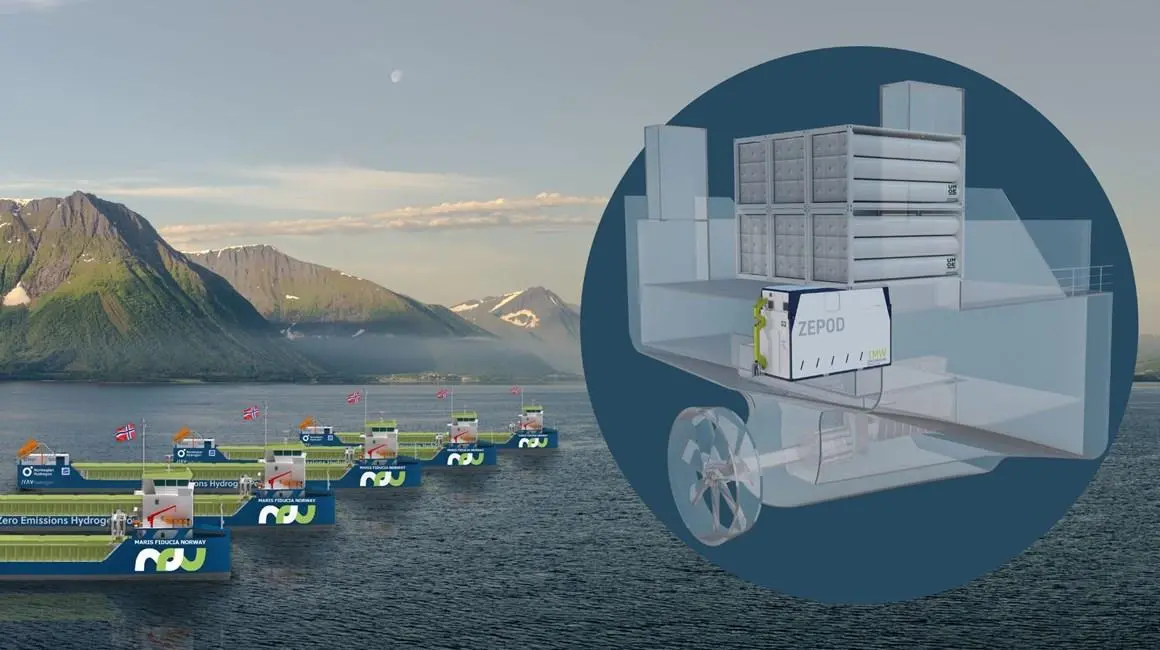
HAV Hydrogen (pictured) has teamed up with shipowner Maris Fiducia and ship designer Ankerbeer on developing, building, and operating hydrogen-powered dry bulk vessels in Europe. The vessels will go on hire through a zero-emission time charter agreement with Schulte & Bruns and be coupled with Norwegian Hydrogen’s hydrogen infrastructure.
HAV Hydrogen has obtained Approval in Principle from DNV for its Zero Emission Pod, ZEPOD®, a deckhouse containing a complete hydrogen energy system that can be used for main propulsion systems or auxiliary power. “As a specialist supplier and integrator of maritime fuel cell solutions, there is obviously a limit to how much we can influence the maritime industry on our own. By collaborating with a shipowner and a producer of green hydrogen, we enable a value chain approach that can tear down further barriers towards realisation of hydrogen as maritime fuel,” says Kristian Osnes, managing director of HAV Hydrogen.
H2 storage above or below?
Torghatten Nord’s two hydrogen ferries, being built at Norwegian Myklebust Verft will have an installed fuel cell power of 6.4MW. Hyex Safety highlights that all hydrogen systems will be installed on the top deck well above passengers. The main reason for this is that the project was a commercial tender in which 10+ years of operational cost were included in the tender. The cost of hydrogen therefore dominated the total tender cost, and the significantly higher cost of LH2 made it necessary to use compressed hydrogen to win. For a car ferry, a storage below deck would also reduce the capacity to carry vehicles.
This contrasts with a superyacht launched this year by Feadship which includes a 92m3 LH2 storage tank to feed the 3MW PEM fuel cell systems from PowerCell. Hyex Safety considered LH2 storage a more practical solution than compressed hydrogen in this case as hydrogen is stored at a higher energy density as a liquid compared to a compressed storage, and much less space is required for a liquid tank.
A compressed storage will typically consist of numerous pressure vessels, each with valves and piping, at 300-500 bar. For an LH2 tank there are much fewer leak points at much lower pressure (< 10 bar). A lower likelihood for leaks would be expected with a liquid storage.
LH2 storage below deck was considered far safer in this case. An LH2 storage tank centrally below deck is well protected against collision and impact loads. For comparison a tank above deck may be more exposed to collisions with vessels or bridges, dropped objects and projectiles.
An LH2 storage tank below deck is better protected against external fires as major fires in the lower part of the vessel can be prevented by eliminating flammable substances near the tank, or by stopping FSHS ventilation. A major impact breaking a tank placed above deck will form a cold hydrogen plume initially denser than air, potentially falling to lower deck areas representing a fire/explosion risk.
Hydrogen fuel project pipeline questioned
Hydrogen fuel suppliers fear a lack of demand, according to a new Transport & Environment (T&E) study shows. T&E’s mapping of green hydrogen projects across Europe shows that nearly 4% of European shipping could run on green e-fuels by 2030, but fuel suppliers appear to be reluctant to commit financially to projects without more guarantees that there will be demand for these fuels in the near future. This means the vast majority of projects may never come online in this decade, warns T&E.
However, through the European Hydrogen Bank the European Commission is awarding nearly €720 million to seven renewable hydrogen projects in Europe using revenue from the EU Emissions Trading System. The winning bidders will receive a subsidy to bridge the price difference between their production costs and the market price for hydrogen.
According to Nick Edström, managing editor, Hydrogen at S&P Global: “The economics of expanding low carbon renewable ammonia supply and to an even greater extent low carbon renewable hydrogen supply remain challenging, with regulatory support required to bridge the gap in price expectations between suppliers and prospective buyers. Improved price transparency is needed, as this will play a key role in helping the evolution of these markets.”
Related Articles
 AMMONIA
 HYDROGEN
 HYDROGEN