



Fuel cost savings brought to the fore
Our editorial predecessors reminded readers that the large Diesel Engine is particularly fuel-efficient, compared with other propulsion methods. Nevertheless, although it was felt that the technology had reached an advanced stage and there was little that could be done to cut specific fuel consumption further, there were savings to be made in other ways. One promising advance was in fuel treatment, with additives permitting cheaper, heavier grades of fuel oil to be burnt efficiently and reliably. Waste heat recovery was seen as another way of producing a useful energy boost.
The medium speed engine was still being regarded as the only serious challenger to the ‘cathedral’ type two-stroke; its growing popularity being celebrated in a special supplement, which noted that there were 22 different such engines in the market, capable of 600 bhp/cylinder and above.
Not all medium speed engines were four-stroke – the August 1974 issue told that work was resuming, after various takeover and consolidation measures in the UK industry, on the Doxford Seahorse. This opposed-piston two-stroke engine was quoted as being rated at 2,500 bhp/cylinder at 300 rpm. This meant a high output from fewer cylinders, considered advantageous for maintenance.
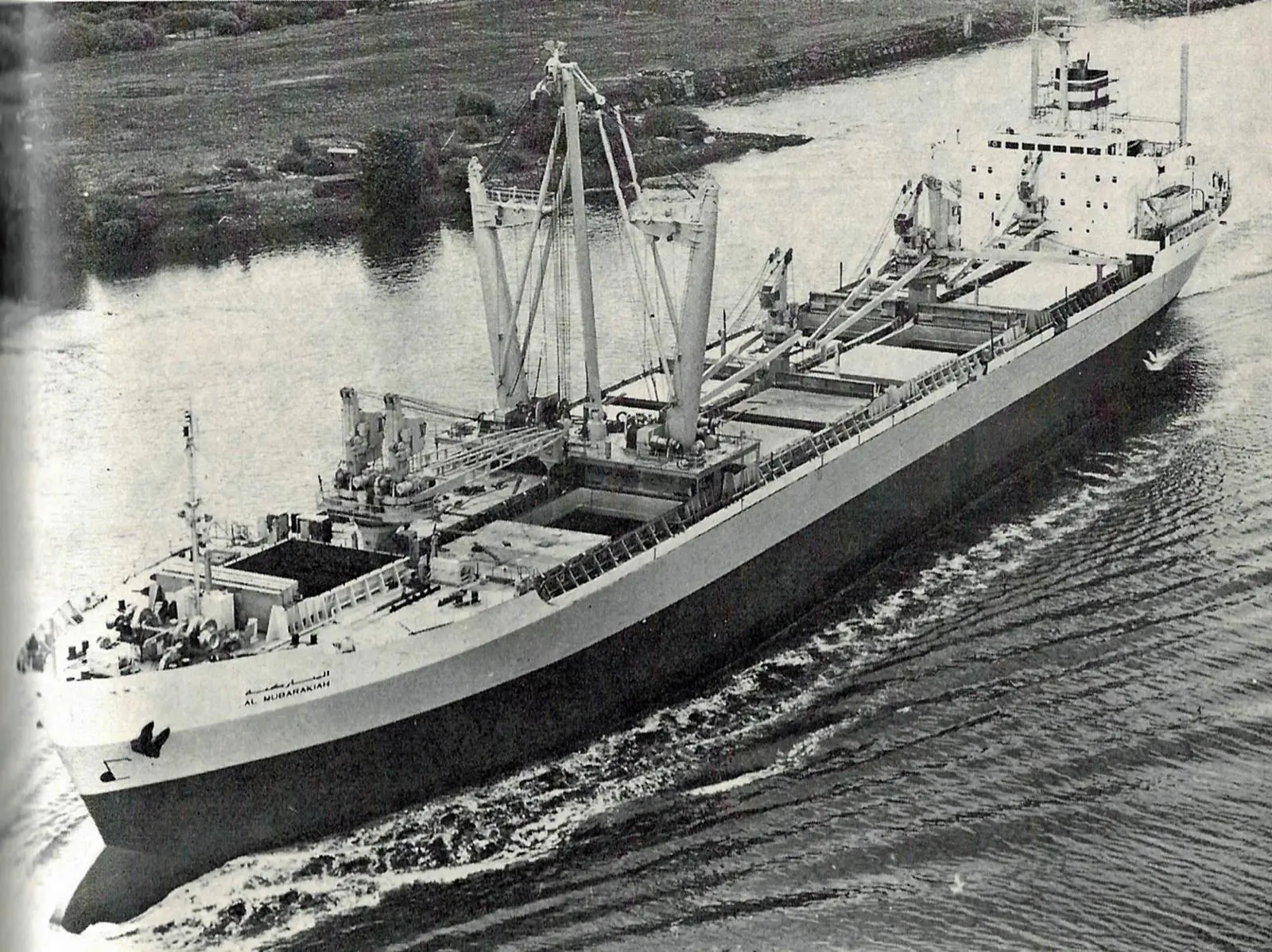
Ship descriptions took something of a back seat, the main one in August concerning the Al Mubarakiah, first of eight heavy lift cargo liners for Kuwait Shipping, delivered from the Govan yard. At 23,200 dwt, the owner considered these would offer an efficiency gain over the 12-15,000 dwt break-bulk vessels normally employed on the Europe-Middle East services. The ship was designed for simplicity of operation, to carry a variety of cargoes, including military vehicles and long pipes. Machinery was based on a single two-stroke Kincaid-B&W 6K74EF engine, rated at 11,400 bhp. The simple-to-operate philosophy meant that the trend for more sophisticated control and monitoring was eschewed in this case, the engine being operated hydraulically from a console adjacent to the engine. Five main holds, each with a tweendeck, were divided by central bulkheads incorporating removable grain boards. Six cranes, including a 105t main derrick, were provided to handle the heavy cargoes.
Back to engines, and an August article described the Stork-Werkspoor SWD TM620, at the time the most powerful medium speed engine – apart from the afore-mentioned Doxford Seahorse. The engine described was a six-cylinder unit, of 620mm bore and 660mm stroke, rated at 1700 bhp/cylinder, thus capable of a total output of 10,200 bhp, but with potential to increase this with further development. SWD’s market research had shown a demand for such high outputs, so the company developed a much larger version of its successful TM410. The intention was to offer in-line and V-form engines of six to 18 cylinders, i.e. up to 30,600bhp, thus providing serious competition to large low-speed machinery, in a more compact and lighter-weight package, stealing a march on Doxford, whose opposed-piston design resulted in the need for greater headroom.
Finally, a type of ship about which we seldom hear today – the rail ferry. In August 1974, The Motor Ship was heralding “A new era for European Train Ferries”. At the time, there were some 60 such vessels in service worldwide, and one on order destined for a 550 mile Baltic route, travelling at 20 knots. German predictions suggested the popularity of containerised freight would spark an increase in ro-ro traffic, particularly containers carried on rail wagons.
Related Articles
 2-STROKE & 4-STROKE
 2-STROKE & 4-STROKE
 2-STROKE & 4-STROKE