



MAN Energy Solutions unveils methanol retrofit package for four-stroke engines
This development addresses the growing demand for climate-neutral shipping solutions. Green methanol, with its favourable energy density, is considered an ideal fuel for four-stroke applications. MAN Energy Solutions has already received numerous inquiries from customers seeking to transition their fleets to methanol.
“We are excited to offer our customers an economically viable path to decarbonization,” said Stefan Eefting, head of MAN PrimeServ Germany. “By converting older engines to methanol operation, ship owners can not only reduce their environmental impact but also protect their investment and enjoy a strong return on investment.”
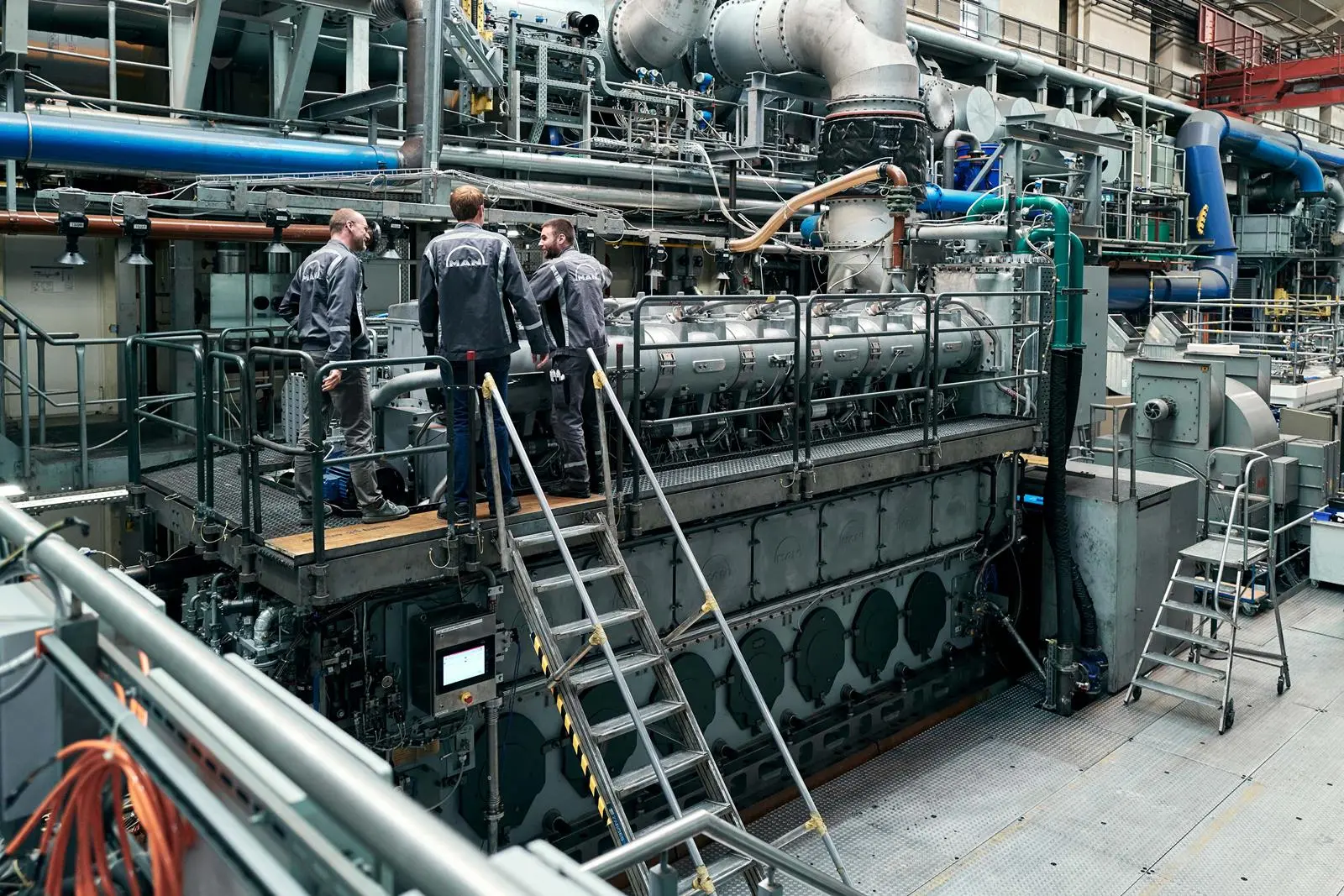
The retrofit package will transform conventional MAN 48/60 engines into the advanced MAN 51/60R-DF-M, capable of operating on both diesel and methanol. This upgrade not only enables methanol combustion but also delivers improved efficiency during diesel operation. Furthermore, the engines will incorporate the latest control and safety systems from MAN Energy Solutions.
“Our extensive testing with the MAN 51/60R-DF-M has yielded impressive results in combustion management and methanol injection,” explained Alexander Knafl, head of engineering R&D four-stroke at MAN Energy Solutions. “We are now focused on fine-tuning the technology to ensure consistently high engine efficiency across both fuel types.”
Bernd Siebert, head of retrofits & upgrades, MAN PrimeServ, emphasised the importance of retrofitting existing engines: “While newbuilds are essential for the industry, decarbonizing the existing fleet is equally crucial. With a typical lifespan of 20 to 30 years, retrofitting offers a cost-effective and efficient way to reduce emissions.”
MAN Energy Solutions’ methanol retrofit package represents a significant step towards a sustainable future for the maritime industry. By providing ship owners with a practical and economically attractive solution, the company is empowering them to play a vital role in mitigating climate change.
Related Articles
 ALTERNATIVE FUELS & LUBRICANTS
 ALTERNATIVE FUELS & LUBRICANTS
 ALTERNATIVE FUELS & LUBRICANTS