



Ammonia agenda for the vehicle trades
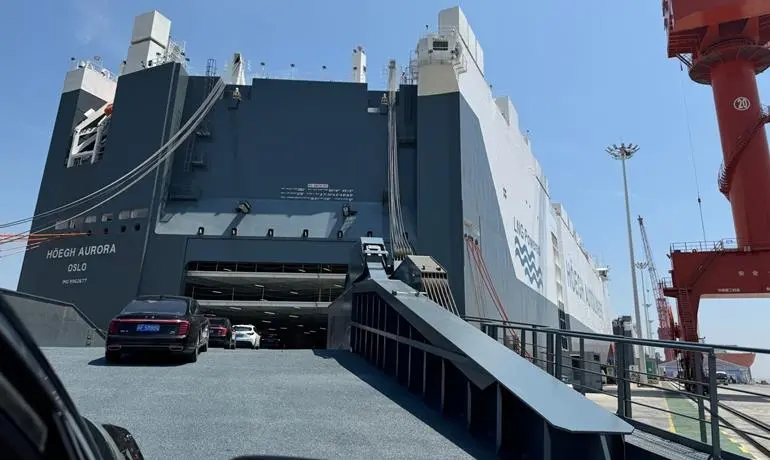
Construction of a total of 12 Aurora newbuilds of 9,100CEU (car equivalent unit) capacity has to date been entrusted, in three contractual tranches, to China Merchants Heavy Industry (Jiangsu) Co (CMHI) at Haimen, and an eventual series of 16 could be in prospect.
The programme is innovative in its specific combination of considerable unit capacity, load flexibility, multi-fuel powering arrangements, and environmental circumspection. Applying characteristic long-term thinking, it builds on the advances achieved with the Horizon series of 8,500CEU PCTCs that also came from China, but from Xiamen Shipbuilding, in 2015/2016.
The concept design was prepared for the Oslo-headquartered shipowner by Deltamarin, which subsequently undertook basic and detail design for shipbuilding contractor CMHI. Central to the Aurora generation is a two-stroke propulsion engine capable of running on either LNG or marine gas oil(MGO), and suited to future adaptation to alternative fuel.
To that end, the Aurora newbuilds are coming into service bearing DNV’s ammonia- and methanol-ready notations, the first in the PCTC segment to be so accredited, and are set to put down another marker for the industry through planned future operation on zero-carbon ammonia.
It is claimed that the particular engineering arrangements together with the design’s scale economies will yield the lowest greenhouse gas (GHG) footprint per transported car throughout the world vehicle carrier fleet. From the start, first-of-class Hoegh Aurora promises to cut carbon emissions per car transported by up to 58% compared to what is described as an industry standard PCTC, at some 6,500CEU intake. Furthermore, the Aurora breed opens a path to net zero emission status, which Hoegh Autoliners has for some years said it aims to achieve by 2040.
Hoegh Aurora made her service debut in August this year, loading a shipment in central China and making a passage to northwest Europe via the Cape of Good Hope, with scheduled arrival at the port of Le Havre during early October. Handover of second-of-class Hoegh Borealis was imminent at the time of writing.
The final delivery under the 12-ship programme is anticipated during the first half of 2027, and options on four further newbuilds promise continuity of the production run at Haimen. As well as promoting shipbuilding economics through serial repetition, the commonality that the programme will instil in the fleet offers many practical advantages for the shipowner.
The versatile loading capacity, embracing cars, commercial vehicles, agricultural and mining equipment, rolling stock, breakbulk cargo and heavy machinery, is optimised within a 37.8m-wide hull envelope conforming to the 200m length restriction imposed by Japanese loading ports and terminals.
Cargo access and egress is by way of a jumbo quarter ramp designed by MacGregor and incorporating the proprietary Load Monitor System (LMS), maximising both the ramp’s 375t load rating and the vessel’s versatility as to heavier project consignments. Moreover, the strengthened decks and internal ramp systems will enable electric vehicles (EVs) to be carried throughout the 14-deck configuration. To expedite cargo working, a side ramp in the starboard aftship section caters to the handling of cars and vans.
The Aurora generation provides a showcase for advances in ‘cathedral’ engine design as regards fuel flexibility and future fuel preparedness by way of a seven-cylinder installation of the gas-injected version of the S60ME-C type from MAN Energy Solutions. In its all-diesel form, as the 6S60ME-C8.2, the 600mm-bore engine already has a high profile in the Hoegh Autoliners fleet, having been chosen to propel the New Horizon series.
The plant driving the Hoegh Aurora bears the designation 7S60ME-C10.5-GI-EcoEGR, whereby the suffix denotes exhaust gas recirculation in both Tier II and Tier III modes. The model’s nominal maximum continuous rating (MCR) is 17,430kW at a crankshaft speed of 105rpm, albeit with a layout diagram offering substantial flexibility for clients in stipulating lower contractual ratings and power and speed combinations. The GI type enables primary operation on LNG with the capability to switch to low-sulphur fuel at will.
The ‘ammonia-ready’ and also ‘methanol-ready’ notations conferred on the Aurora class by DNV, and the planned operation of later newbuilds on carbon-neutral ammonia immediately pursuant to delivery, is indicative of the potential of the chosen MAN two-stroke engine line, which is pivotal to the German group’s development of an ammonia-fired variant. Thus, the first eight ships have been conceived to facilitate conversion for operation on ammonia, while the subsequent four vessels are to be delivered with the technology to enable operation on ‘green’ ammonia from the outset in 2027.
Retrofits will entail the adoption of a new cylinder head to enable combustion of the desired alternative fuel, plus associated connections to auxiliary systems.
Operation on ‘green’ ammonia is expected to reduce primary emissions by close to 100%. Hoegh Autoliners has partnered with several of the world’s leading ammonia producers to ensure supply and usage, one of the latest initiatives having involved Sumitomo Corporation, with whom a letter of intent was signed towards the end of last year. The ports of Singapore and Jacksonville (USA) are envisaged as the first bunker hubs under the prospective arrangements.
The company has this year been awarded grants totalling NOK255.4 million ($24.3m) from the Norwegian Government funding agency Enova to ensure that four Aurora newbuilds can burn ammonia as mainstream fuel when phased into service in 2027. The allocations form part of the largest-ever Enova funding round supporting the maritime energy transition.
Through its membership of the First Movers Coalition (FMC), Hoegh Autoliners has committed to powering at least 5% of its deep-sea operations with zero-emission fuels, ostensibly green ammonia but potentially also green methanol, by 2030. This is in keeping with FMC policy whereby, in general, member companies commit to purchasing a percentage of near-zero or zero carbon solutions from suppliers, despite the cost premium.
Bonn-headquartered cryogenic engineering specialist TGE Marine, which has a fully-fledged presence on the Chinese market by way of its Shanghai affiliate, has been retained for the supply of critical components to the entire series. The company’s contractual scope for each of the 12 ships embraces the high-pressure fuel gas system for the two-stroke main engine, low-pressure fuel gas system serving the four-stroke auxiliaries, and 3,400m3 bi-lobe, Type C fuel gas tank, plus proprietary recondenser for boil-off gas(BOG) management.
The storage tanks, meeting the requirements for DNV’s ammonia- and methanol-ready notations, are claimed to be the first in the PCTC sector that can be converted to carry zero-carbon ammonia bunkers.
Hoegh Aurora is powered and faired for a laden speed of 14.5 knots, and hydrodynamic efficiency is enhanced by a PROMAS propulsion solution, whereby propeller, hub cap, bulb, and rudder form an integrated whole.
To exploit new ways to reduce emissions, increase predictability and improve safety, Hoegh Autoliners was the first customer of Vessel Insight, Kongsberg Digital’s Cloud infrastructure. Vessel Insight installations have subsequently been specified for each of the Aurora PCTCs, underscoring the shipowner’s belief in digitalisation as a tool for realising efficiency and sustainability goals. The generated datasets will enable personnel to perform functions such as determining ideal routes to minimise fuel consumption, identifying potential maintenance issues to prevent lengthy or unscheduled downtime, and reporting regulatory requirements automatically.
So as to train crew assigned to Aurora-class ships in the use of hybrid and future fuel types, Hoegh has retained Kongsberg Digital for the development and delivery of an engine simulator model. In addition, and in keeping with the bridge outfit provided by Kongsberg Maritime to each newbuild, a customised bridge simulation model is also being supplied by Kongsberg Digital. The Norwegian Training Centre, located at Manila in the Philippines, will use the models to train Hoegh officers and marine engineers.
Besides the K-Bridge navigation system, input from the Norwegian group to the new ships encompasses the K-IMS emission monitoring and reporting solution, and K-Chief engine control system.
The Aurora PCTC includes a 1,500m2 array of solar panels on the top deck, said to provide for a reduction in up to 30-35% of electricity production from the gensets. Provision has also been made in the design for emission-free port operations using electrical power from ashore.
Deltamarin completed the steel design work for the Aurora PCTCs using new E3D software created by UK-based Aveva. The companies approach streamlined theprocess for obtaining DNV endorsement.
This new standard for 3D model-based class approval was a move away from 2D structure drawings to a 3D digital twin offering potential gains in terms of efficiency.
Clearly, Hoegh Autoliners considers ‘clean’ ammonia as a future maritime fuel with high potential, and as a contributor to solving the GHG emission challenges confronting the industry. The Aurora generation weaves a multi-fuel strategy into a design required to excel in performance in a sphere of shipping entailing high-value, handling-sensitive cargoes.
Related Articles
 ALTERNATIVE FUELS & LUBRICANTS
 ALTERNATIVE FUELS & LUBRICANTS
 ALTERNATIVE FUELS & LUBRICANTS