



Short sea ro-ro at record scale
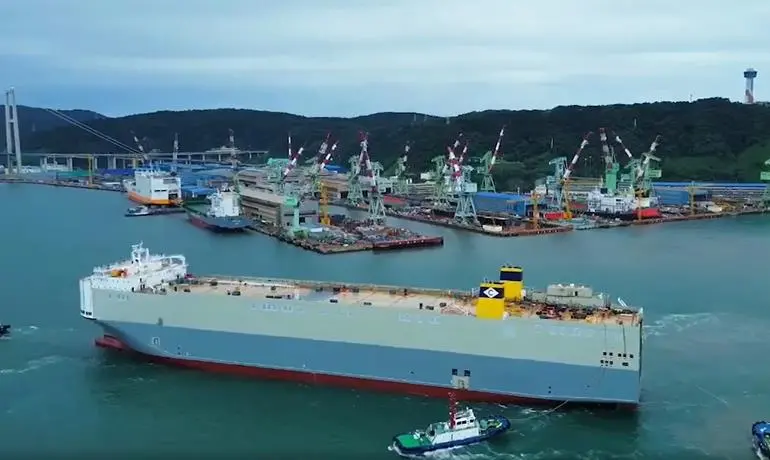
While offering the same payload intake as the company’s Celine and Delphine, which had introduced a record-breaking unit capacity of 8,000 lane-metres on delivery by HMD in 2017 and 2018, the newbuild type will have a markedly lower carbon footprint. The technological progression, reflected in the adoption of dual-fuel, low-speed main machinery and a hybrid propulsion train, is such that the Chaumine will yield a 40% reduction in CO2 emissions relative to the earlier ships.
Production of a sister newbuild to Chaumine is also under way at the Ulsan yard, and the two freight carriers attest to a sustained process of fleet renewal and development on the part of the Luxembourg-based, integrated transport operator, associated with Cobelfret. The vessels will be assigned to one or other of the higher-volume routes maintained by CLdN between the British Isles and near-Continent, and will cater to the broadest spread of cargo, ranging from road trailers and rolltrailer-loaded containers and industrial goods to factory-new vehicles and components.
A champion of two-stroke power in short-sea deployment, the 74,300gt Chaumine and the second-of-class have each been specified with two dual-fuel S60ME-GI engines of 11,000kW from the MAN portfolio, incorporating proprietary exhaust gas recirculation(EGR) systems to ensure Tier III compliance. By comparison, the Celine type is fitted with a single, 18,700kW MAN diesel.
The hybrid element is expressed in the nomination of two potent shaft generators for each vessel. The PTO/PTI installation in full-electric mode will enable the 6MW machines to be clutched to the respective shaftlines with sufficient effect to drive the ship at as much as 16 or 17 knots. The 22,000kW main engine power concentration will otherwise allow for a speed of 20 knots-plus.
The high degree of design flexibility allows for ease of integration of new fuels, fuel cells and/or battery technology in the future.
To gain scale economies, reduce fuel consumption and emissions, CLdN has ploughed some É750 million into newbuild ro-ros and eco-upgrades of existing vessels over the past 10 years.
The company’s 2023 results showed that its average fleet emissions amounted to 39g of CO2 per tonne-kilometre, reckoned to be 19% better than the next-best performing short-sea operator.
CLdN has commissioned a project to assess the potential for a new shore power and connection system at its Distriport terminal in Rotterdam. By drawing on electricity from the landside grid, and shutting off shipboard generators, it is estimated that emissions from vessels at berth can be cut by as much as 95%.
Distriport was acquired from Broekman earlier this year, and is located opposite CLdN’s existing terminal in the Brittanniehaven.
Related Articles
 BATTERIES, SUPERCAPACITORS, FUEL CELLS AND OTHER ENERGY STORAGE TECHNOLOGY
 BATTERY HYBRIDS & FULL-ELECTRIC VESSELS
 BATTERY HYBRIDS & FULL-ELECTRIC VESSELS