



AiP for liquid hydrogen vacuum tank
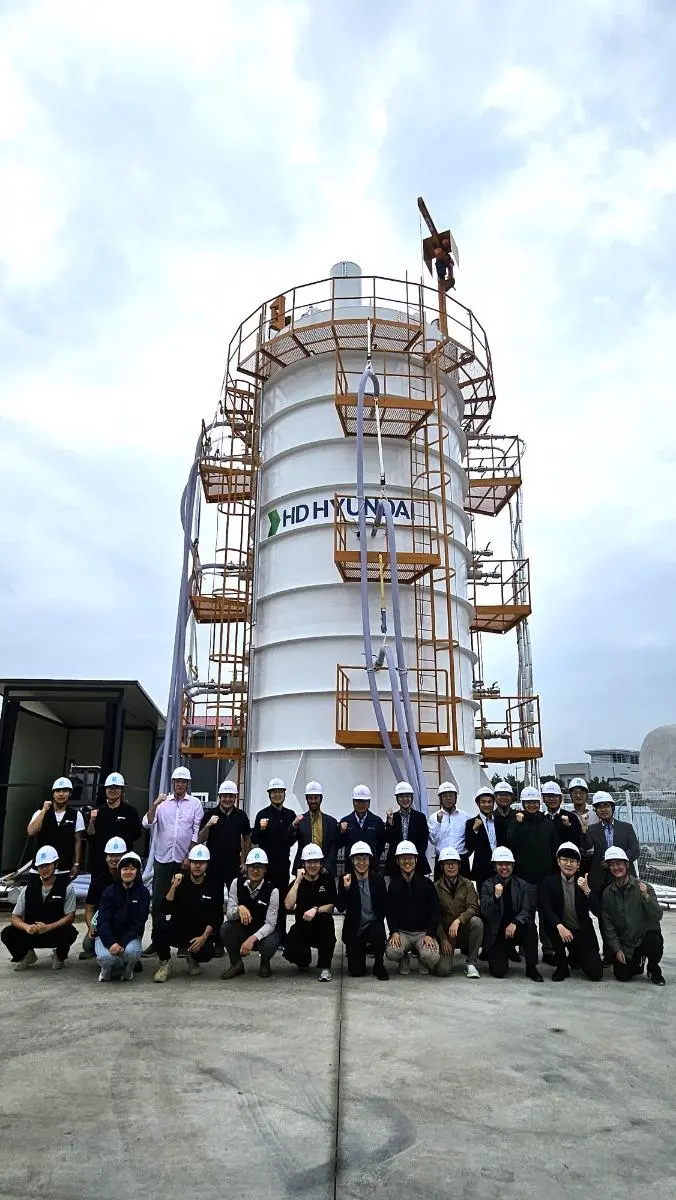
The successful testing of the chamber also marked the world’s first technical validation of large-scale liquid H2 tank insulation design.
The vacuum insulation system addresses some of the most pressing challenges of using hydrogen in the maritime industry, namely the scalability of liquefied hydrogen storage and transportation of the fuel.
“HD KSOE has been dedicated to providing technological solutions for large-scale energy shipping such as LNG, LPG, ammonia, CO2, and now hydrogen,” said Dr Byeongyong Yoo, vice president at HD KSOE.
“This hydrogen vacuum system solution and large-scale validation test are part of these efforts.”
Storing liquid hydrogen at -253°C while minimising boil-off gas requires vacuum-insulated tanks similar to thermos flasks, but achieving this on a large scale in ships is technically unproven.
HD KSOE’s vacuum system provides an innovative solution that drastically reduces the time required to achieve a vacuum in large tanks.
Global hydrogen industry participants, including Woodside Energy, Mitsui O.S.K. Lines and Hyundai Glovis, contributed to the design development and validation.
All three classification societies undertook design assessments and performance verifications of the soft vacuum insulation system, in line with their classification rules and international standards for gas ships.
“This AiP not only reinforces LR’s commitment to advancing sustainable solutions for decarbonisation but also sets a new benchmark for the maritime industry,” said Sung-Gu Park, president of LR North East Asia.
KIM Daeheon, executive vice president of KR’s R&D Division, added: “This AIP reflects HD KSOE’s technological excellence and highlights the promising potential of the hydrogen industry.”
Updated on 20 January 2025 to add DNV
Related Articles
 AMMONIA
 HYDROGEN
 HYDROGEN