



Onboard carbon capture advances towards commercialisation
The long-term solutions for decarbonising ocean shipping revolve around low-carbon or zero-carbon fuels, but it is generally accepted that these solutions will not be available at scale, and the technology is still maturing. So in the same way that the original scrubbers offered an available method to reduce sulphur emissions from the ship exhaust while burning the standard heavy fuel oils, the next generation of exhaust gas cleaning is looking to incorporate carbon capture, to remove CO2 from emissions to the atmosphere.
As some smaller-scale systems are entering the marketplace, we hear of the first full-scale onboard carbon capture and storage (OCCS) project about to get underway.
Dutch Value Group company Value Maritime has enjoyed some initial uptake of its Filtree system, an exhaust gas scrubber that includes an optional carbon capture module, suitable for smaller or medium sized vessels. The carbon capture module is able to remove a proportion of CO2 gas from the exhaust, which is then stored in a solvent in a ‘CO2 battery’ or onboard tank, for offloading onshore. The captured CO2 is then used in industries such as horticulture.
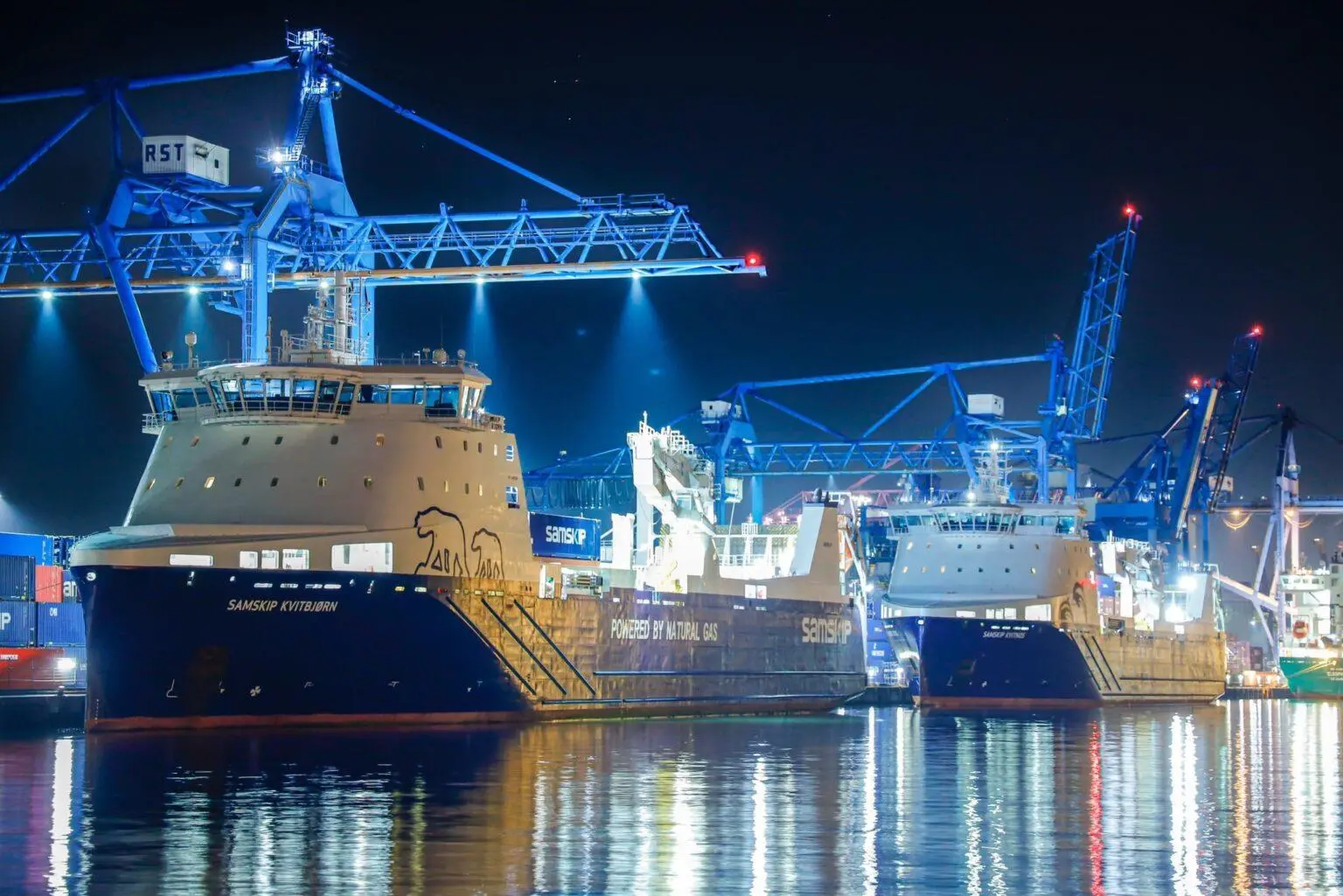
Value Maritime and its sister company Value Carbon have secured funding to establish an offloading and processing facility in Rotterdam. The Group is a member of the Maritime Efficient & Easy Carbon Capture (ME2CC) project, funded by Maritime Masterplan 2024. ME2CC’s aim is to demonstrate a compact system for OCCS, with a system installed onboard the LNG-fuelled vessel Samskip Kvitbjorn.
Samskip Kvitbjorn operates on a fixed route from Rotterdam along the Norwegian west coast to Hammerfest, a regions regarded as particularly environmentally sensitive. Even burning LNG, which offers a potentially significant reduction in CO2, will not alone meet the IMO GHG goals. Retrofitting the vessel with Value Maritime’s CO2 capture system, the consortium is building on experience gained in its earlier pilot project with a small-scale OCCS system on the Nordica in 2022.
ME2CC is headed by Value Maritime, and includes Samskip Holding, B2B Marine, Fusie Engineers, Devoteq, Brusche Process Technology, Heatmaster, and Yard Energy Group. It aims to create a scalable carbon capture system that is up to 30% smaller than previous systems, while maintaining low pressure drop. The system incorporates recovery of hot flue gas for onboard electricity generation, contributing to both operational efficiency and emission reduction.
The modular system, aimed at shortsea and inland shipping as well as larger offshore vessels, is designed for simple installation and removal, with leasing models in mind to enable wider access to OCCS technology.
Erik Hofmeester, Samskip Head of Vessel Management, said: “We have spent years actively pursuing sustainable solutions across our fleet, and the retrofitting of the Samskip Kvitbjorn aligns perfectly with our vision for the future of shipping. Working alongside Value Maritime and the ME2CC consortium members, we are ensuring that the Samskip Kvitbjorn meets the low-emission requirements set by the EU and Norwegian authorities, all while continuing to provide reliable service for our customers.”
Dissolving CO2 gas
Finnish company Langh Tech, best known for its SOx scrubbers, has recently entered the OCCS market with its own system, which is said to apply a post-combustion technique, using a capture unit which dissolves CO2 into a liquid phase through counter-currently flowing aqueous sodium hydroxide solution. Several consecutive reactions then chemically bind the CO2 into a thermodynamically stable product of sodium carbonate.
The company’s first OCC system has been running successfully in test mode since spring 2024. The end-product, sodium carbonate, can be marketed as a key for industries such as the manufacture of glass and detergents. The system is said to require minimal additional resources, with no need for solvent regeneration or CO2 compression, which can require extra energy consumption onboard.
The pilot plant has shown that it could be possible to capture some 80% to 90% of CO2 from the exhaust gas; corresponding to a goal of 60% reduction in emissions overall.
The first commercial installations of Langh Tech’s combined hybrid scrubber and OCCS system are due to be performed in 2025 by Damen Shipyards Group on four bulk carriers. These are part of a project involving Langh Tech, Atal Solutions, BAM Shipping and Damen Shipyards.
Rutger van Dam, business development manager, Damen Shipyards Group said: ”The decision to choose Langh Tech was simple. CO2 capturing is the only economic way to drastically reduce emissions as of now. My main concern was the value of the CO2 end product being created onboard the ship. Langh Tech delivered on every front: a high capture rate, a high-value CO2 end product, and a significant reduction in emissions. From a commercial perspective, it made perfect sense. On a personal note, we share the same vision and goal: to greenify the global fleet. That alignment made Langh Tech the natural choice.”
Full-scale OCCS
What is said to be the first large-scale OCCS project is due to begin in early 2025. Norwegian ship operator Solvang says that its full-scale carbon capture facility is ready for pilot testing, with the hope that the technology will become an important milestone for ocean shipping en route to zero emissions.
The ship involved in the project, Clipper Eris, is owned by Solvang The pilot project is a collaborative effort between Solvang, Wärtsilä, MAN Energy Solutions and Norwegian research institute Sintef. Clipper Eris is believed to be the first large vessel to be fitted with full-scale OCCS technology able to reduce CO2 emissions by up to 70%, before it is stored in deck tanks for discharge to sequestration or usage.
Solvang says that has seven new vessels under construction, all of which have been designed to be ready for installation of OCCS technology.
Solvang CEO Edvin Endresen said: “Onboard carbon capture combined with existing cleaning technology is a significant shortcut to decarbonisation of the world’s deep-sea fleet. This stands out as one of the more promising solutions for future vessels.”
Roger Holm, Wärtsilä Marine Pesident, added: “The introduction of carbon capture and storage capabilities on board the Clipper Eris is a major leap forward for maritime sustainability. It represents a system change that has been made possible by close collaboration between our companies. We at Wärtsilä are proud to be helping shape the decarbonization of the marine industry, and we congratulate Solvang for their vision and support in making this breakthrough possible.”
The OCCS technology has been installed on Clipper Eris during drydocking for a full refit at the Seatrium Admiralty Yard in Singapore, ready for the beginning of the pilot test, scheduled for early February 2025.
Infrastructure needed
Endresen said: “CO2 can be recycled and used in land-based industries, but the global infrastructure for discharge for shipping needs to be developed fast. In addition, IMO must implement global regulations with benefits and penalty schemes for achieving the set goals. Predictability is necessary for the industry to invest in solutions for reducing CO2 emissions.”
The installation has been enabled through funding from Norwegian government agency Enova.
Enova senior advisor Børge Noddeland said: “Enova is following this demonstration project with great anticipation. Carbon capture on board ships is a very interesting technology, that can play an important role in the transition towards the low emission society.”
The principle behind Wärtsilä’s OCCS system is to capture the CO2 in a spray tower. The CO2-saturated solvent is then transported to a separate column where the captured CO2 is stripped off. By regenerating the solvent with heat, the CO2 is released from the solvent, liquefied and stored; and the solvent can then be re-used in the capture process loop.
Just as shipping found the SOx scrubber to offer an effective means of compliance with the IMO 2020 sulphur emissions cap, several branches of the industry are looking at a further advancement in scrubber (exhaust gas cleaning system) technology to address the IMO decarbonisation targets.
Related Articles
 CARBON CAPTURE
 CARBON CAPTURE
 ALTERNATIVE FUELS & LUBRICANTS