



2026: An inflection point for wind propulsion
The COVID pandemic slowed the uptake of wind assist propulsion, but Gavin Allwright, Secretary General of the International Windship Association, sees 2025 as a transition year, taking the industry from an experience building and information drive in 2024 to exponential growth in 2026.
“2024 was such a big year. It’s probably the last year where we are doing the big push in the market from an Association point of view – educating, getting information out into the market, going to as many conferences as humanly possible. What we’re seeing in 2025 is a transition year, because 2026 is the year we’ve identified as the real inflection year.”
There will be 100 installations by the end of 2025, and the building blocks are in place for further growth. OEMs are shaving 10-20% off manufacturing costs each year, and several companies are moving to large-scale production. Chinese yards have already installed at least 30 systems, and Bar Technologies, Anemoi and Norsepower have production facilities there, along with local companies CSSC and Dealfeng New Energy Technology.
Companies such as Union Maritime, MOL, Maersk Tankers, and Louis Dreyfus Armateurs (LDA) have placed multi-vessel orders, adding momentum to what Allwright sees as a transition to fleet-level ordering. There’s three facets to the market, he says: retrofit, newbuilds that are essentially retrofits on standard vessel designs, and newbuild wind-optimised vessels.
This last category includes the Neoline and TOWT cargo ships and passenger ships such as the newly designed expedition vessel Captain Arctic. Will we see large sailing cargo ships? Allwright points to Wallenius Marine’s car carrier concept Oceanbird.
“The ability to have large cargo ships primarily driven by wind is absolutely there. We can have 200, 300 metre vessels already designed, so we’ve got the science. There’ some stability concerns if you’ve got very large rigs, but the technical issues have mitigation pathways.
“Probably the biggest concern is cost. It’s going to cost more to build a ship like that, but from a total operational viewpoint, it’ll be far, far cheaper than burning fuel for the lifetime of the vessel. Return on investment could take up to 10 years with a primarily wind-powered vessel, and then you’ve got 20 years of pure profit.”
Regulatory driving
There is also a growing regulatory driver. “A vessel can be fully compliant with the FuelEU regulations up until 2030 just with wind, and almost fully compliant up to 2035 if large systems are installed. So, the compliance solutions are there, and along with the financial savings – it’s a perfect storm.”
Bulk carriers and tankers are particularly well-suited for wind propulsion installation as they typically have the deck space needed, and uptake is increasing. Marflet Marine’s 182-meter Santiago I tanker is being retrofitted with four eSails from Bound4Blue, and the Tern Vik tanker currently under construction will be equipped with four 16-meter Ventofoil systems from eConowind.
In December 2024, Anemoi Marine Technologies completed the installation of five rotor sails on the 400,000 dwt VLOC, Sohar Max, making it the largest vessel to receive wind propulsion technology to date.
Claes Horndahl, commercial director of Anemoi, says one of the key ways shipowners can further maximise the benefits of wind propulsion is through combining Anemoi’s rotor sails with voyage optimisation solutions. The company recently partnered with NAPA to combine their weather routing and voyage optimisation tools so that operators can plan routes that take advantage of favourable wind conditions, significantly amplifying the efficiency gains. “When combining rotor sails with voyage optimisation on a VLOC sailing between Brazil and Singapore, we estimate emission reductions improve from 10% to an even more impressive 25%.”
Horndahl says the benefits are quantifiable. “Take an MR tanker travelling between West Coast US and Shanghai with just two rotor sails, we estimate annual savings of approximately 1,000 tonnes of fuel and nearly 3,000 tonnes of carbon emissions, representing a 23% reduction. For a 210,000 dwt Newcastlemax bulk carrier with four rotor sails, we’re achieving more than a 14% reduction in fuel consumption and emissions.”
Daniel Karlberg, senior customer success manager for Shipping Solutions at NAPA, says the position of any sails can have a big impact on their effectiveness because they can interact with each other and with the ship. Even which side of the ship they are positioned on can have an effect. “The biggest challenge is to accurately model the actual effect of the wind to the sail and ship and how it affects and provides thrust. Accurate modelling is the key.”
Way the wind blows
Berge Bulk has adopted Sofar’s Wayfinder platform across its fleet of owned vessels, including two vessels equipped with wind propulsion technology. Berge Bulk says Berge Olympus and Berge Neblina’s sails make them more weather-dependent, as propulsive wind now significantly impacts performance. Wayfinder will always dynamically adjust its guidance to find the optimal balance between engine propulsion and wind propulsion to maximise profitability. If fuel prices are high, for example, wind propulsion becomes more valuable and this is included in Wayfinder’s guidance.
Aude Leblanc, technology leader for sustainable shipping at Bureau Veritas, says energy management systems with predictive algorithms can optimize the distribution of wind-generated power for both propulsion and onboard electrical needs. Innovative projects are even investigating the use of hydro generators to convert wind energy into electricity which can then be directly used onboard or be stored in batteries. This coupling of wind power and energy storage helps manage the variability of wind-generated energy, enhancing the overall efficiency and autonomy of wind-powered operations. By reducing engine vibrations, wind propulsion can also contribute to lower underwater radiated noise levels, which can have a positive impact on the marine ecosystem.
Canopée was the first hybrid industrial vessel equipped with collapsible wings that was designed specifically for wind assist propulsion. The shipowner Alizée was looking for a shallow-draft RORO with an efficient and reliable wind assisted propulsion system to operate on a transatlantic route. Design criteria included a light weight system and small deck footprint (2.5m) to match both the stability constraints and the cargo hold design.
OceanWings technology was chosen for the vessel, and COO, Romain Grandsart, says that although it was a newbuild, it wasn’t fully optimised for wind as it has to sail up a river in French Guana that necessitated a maximum 4m draft. “There’s a lot of things we couldn’t do.”
Still the sails have demonstrated 35% fuel savings. Grandsart says OceanWings provides the highest thrust-to-weight ratio (59%) of the market, guaranteeing stability and easy integration while maximizing commercial cargo space. It offers a large operating window with net propulsive power from 5° of apparent wind angle. The sail’s geometry (11m wide) offers a natural roll damping effect which is particularly appreciated by the crew on such a shallow draft vessel.
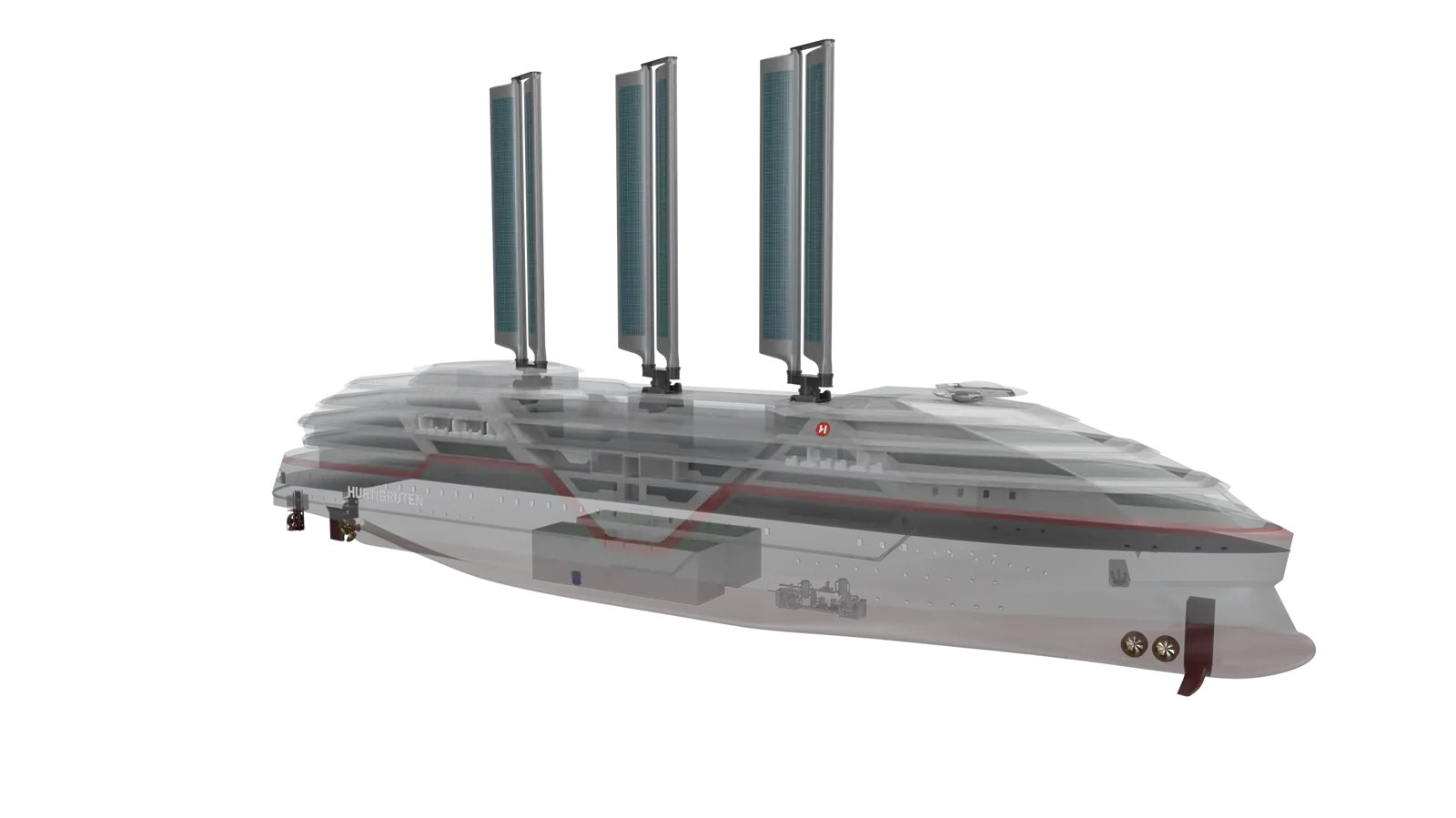
OceanWings is being considered as Hurtigruten continues to refine its Sea Zero cruise ship design with SINTEF and Vard. Preliminary estimates indicate that the vessel’s sails could reduce energy consumption by around 10% and solar panels will contribute another 2-3% in energy savings. With additional features such as contra-rotating propellers, calculations show that the ship will use about 40-50% less energy than today’s ships, which makes it possible to operate primarily on batteries as the main energy source. That means that the emissions will be determined by the carbon footprint of the energy the batteries are charged from.
Wallenius Marine is conducting advanced wind tunnel tests aimed at realising the world’s first wind-powered PCTC, Orcelle Wind. It is the first vessel in the Oceanbird concept and is being developed in cooperation with Oceanbird, RISE SSPA Maritime and KTH (Royal Institute of Technology, Stockholm). Carl Fagergren, Naval Architect and Project Manager at Wallenius Marine, says the design of the vessel is optimized for sailing and minimized emissions.
“The maximum speed with engine only is about 17 knots, and with the wings it is possible to reach speeds over 20 knots in favourable conditions,” says Fagergren. “But if you want to get the most out of the wind, you need to sail slower. The biggest energy savings can be achieved if you sail the vessel at about 8-10 knots on average, and the faster you need to sail the more engine power you will need and the less fuel savings/emission reductions you will get.”
The hull is optimized for sailing with a larger beam for increased stability, and hull shape optimized for low increased resistance in waves and reduced drift. Larger rudders and fins boost manoeuvring safety by reducing drift, and specialized software for the control of wings, propulsion, and rudders, together as one system.
Related Articles
 ALTERNATIVE FUELS & LUBRICANTS
 ALTERNATIVE FUELS & LUBRICANTS
 ALTERNATIVE FUELS & LUBRICANTS