



Potent Russian icebreaker for Russian Arctic
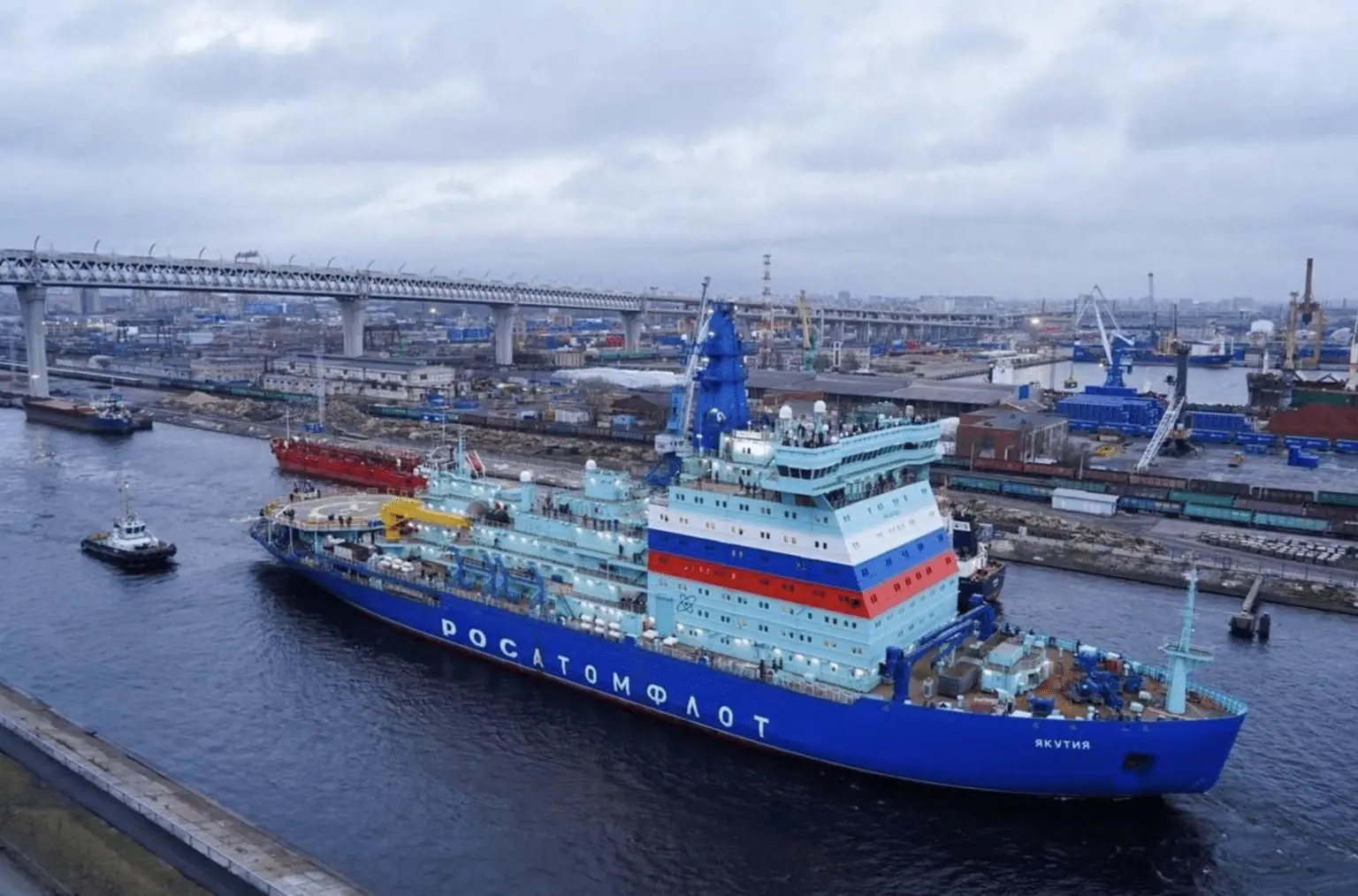
Hosting 60MW of propulsive power, the vessel is the fourth representative of the domestically-designed, -engineered and -built Arktika series commissioned by operator FSUE Atomflot. Variously known as the Project 22220 or LK-60 generation, the type made its debut in 2020 with the delivery of first-of-class Arktika from Baltiysky Zavod, part of state-owned United Shipbuilding Corporation.
Second and third ships Sibir and Ural were completed in December 2021 and towards the end of 2022, respectively. Yakutiya is due to be followed in 2026 by a fifth newbuild, the Chukotka, which was launched at the St Petersburg yard in November this year.
During 2023, funds were authorised for the construction of sixth and seventh examples of the LK-60 design. Respective handover deadlines of December 2028 and December 2030 were stipulated with contractor Baltiysky Zavod. While initially allocated the names Kamchatka and Sakhalin, it is understood that the icebreakers will now be christened Leningrad and Stalingrad.
Russia’s ambitious nuclear icebreaker programme has not been without issues, a graphic illustration having been the need for early surgery on the Arktika following a propulsion motor failure. To what extent the current build schedule will be affected by Western sanctions and government budgetary constraints in the wake of Russia’s escalated aggression towards the Ukraine remains to be seen. Nonetheless, the anticipated completion of the entire seven-ship class within an overall build period of about a decade and a half speaks to the country’s experience in constructing such complex, atomic-powered vessels.
Some sources have made much of the prospective influence of global warming on the Arctic seaway, inferring that reduced ice severity leading to an extended season for shipping throughout the route undermines the longer-term case for massive expenditure on the most powerful icebreakers. In fact, the eastern Arctic region has witnessed a cooling trend in recent years, making for increased ice cover and more difficult conditions over the NSR’s eastern section, reversing the earlier warming effects.
For sure, the challenges facing all vessels and mariners in those high latitudes can never be underestimated, and the safe and effective use of the transportation conduit that is the NSR remains reliant on a substantial icebreaker fleet.
In such circumstances, given the remoteness of the region and paucity of bunkering and port infrastructure on the Siberian shore, nuclear propulsion comes into its own, conferring the requisite endurance factors as well as potency.
The NSR is Russia’s Arctic conduit for the region’s industry and communities, energy and metal exports. Even in the face of widening Western sanctions, the Arctic shipping lane was used by vessels carrying some 40 million tonnes of cargo in 2024, up from the 35 million tonnes conveyed the year before. Although westbound traffic and full international transits by foreign ships had initially seen a setback, a recovery in activity has taken place and the more arduous eastern passage has grown in importance, fuelled by trade exchange with Asia.
Development of the NSR is a priority for Russia. With Russian oil and gas exports shifting from Europe to Asia, as one consequence of a mixed international reaction to its February 2022 invasion of the Ukraine, the icebreaker fleet has become an ever-more essential tool in effecting the country’s Arctic hydrocarbon strategy. The voyage distance from Murmansk to Japanese ports, for example, is half that of the route via Suez, involving a sailing time of 18 days instead of 37 days.
The LK-60 newbuilds are each installed with two RITM-200 pressurised water reactors (PWRs), mounted side by side, producing a combined 350MW of thermal energy. Steam is delivered to two main turbogenerators, each yielding 36MW of electrical power, and propulsive effect is via three shaft lines driven in each case by a 20MW electric motor, for a combined propulsive power of 60MW (60,000kW).
The RITM-200 is a PWR with a thermal capacity of 175MW, developed and manufactured by Rosatom’s nuclear engineering affiliate Afrikantov at Nizhny Novgorod. It uses forced circulation of the primary coolant and an external gas pressuriser. Offering a service life of 40 years, the reactor has a compact, integrated layout placing equipment within the steam generator casing, halving system weight compared to earlier designs and improving operability in heavy seas. It is understood that refuelling interval is about seven years, with a 20-year overhaul period.
The capacity of the plant, together with the ship’s underwater form, cutaway bow and structural robustness, will enable the Yakutiya to open up channels in solid ice of 2.9m thickness while maintaining a speed of 1.5 to two knots, with the muscle to also negotiate high ice ridges. The waterline width of 33m ensures that the requisite clearance can be secured for the largest commercial ships sailing the NSR.
The dual-draught Arktika ‘breakers have been conceived for deployments throughout the 3,500-mile (5,600km) seaway, encompassing not only the western section and the most arduous eastern length, but also the shallow bights and estuaries along its course, including the Gulf of Ob and the Yenisei River to Dudinka. The design has an open-water speed of around 22 knots.
The marine application scope of the RITM-200 is such that the reactor forms the basis for the design of Rosatom’s proposed floating nuclear power plant, envisaged with capacities in the 100-106MW range.
Currently in hand in Russia is a newbuild that will not only exceed the Arktika type in operational capabilities, but will also surpass all icebreakers worldwide in terms of power and performance. The 209m Rossiya, laid down at the Zvezda Shipbuilding Complex near Vladivostock in the Russian Far East during July 2021, will be vested with an astonishing 120MW of propulsive power, delivered through four shafts turned by 30MW electric motors.
Encapsulating the Project 10510/Lidr (Leader) design, the ship’s two RITM-400 nuclear reactors will produce a combined 630MW thermal energy, with steam fed to four 37MW turbogenerators. It is claimed that the behemoth will be able to clear channels through ice of up to 4.5m thickness.
However, while originally planned for delivery to Atomflot in 2027, the Rossiya is not now expected to be commissioned until 2030. Technical challenges and construction delays, including those attributed to switching supply of large steel castings from the Ukraine to domestic factories, have been accompanied by considerable cost increases. Originally foreseen as a three-ship programme, plans for second and third sisters appear to have been shelved in the medium-term at least, due to national budgetary pressures.
Even though its ambitions have been trimmed, Russia’s commitment to atomic-powered vessels in the non-defence sphere endures at a time when nuclear propulsion is commanding greater attention and stimulating new technological initiatives in the global, commercial maritime industry, looking to long-term, carbon-free emission solutions.
Related Articles
 PROPULSION
 GENERAL NEWS
 HYDROGEN