



A safe route to the ammonia alternative
Latest published figures from Clarksons Research indicate that 25 ammonia-fueled ships were ordered during 20241.
Given that 50% of all 2024 ships ordered will burn alternatives to conventional fuels, ammonia’s contribution to a low CO2 emission future, therefore, appears modest, compared to 390 fueled by LNG, 119 by methanol, 72 by LPG (and 12 by hydrogen), and 206 with battery/hybrid propulsion.
However, the figure compares to just four ammonia-fueled ship orders in 2023, according to the same source, while a broader view counts 130 of the ships ordered in 2024 as ammonia ‘ready’. These add to 322 ammonia-ready ships on order at the start of 2024, according to Clarksons.
Numbers such as these suggest a market that is prepared to consider a greater commitment to ammonia as a fuel type at a later date.
Advocates for ammonia point to the fact that it does not emit CO2 when burned. Using renewable energy sources and electrolysis to create ‘green’ ammonia would result in a fuel that would cut GHG emissions through its lifecycle by up to 90% – meeting International Maritime Organization zero-carbon expectations even if translated to a ‘well-to-wake’ assessment.
Advances in ammonia
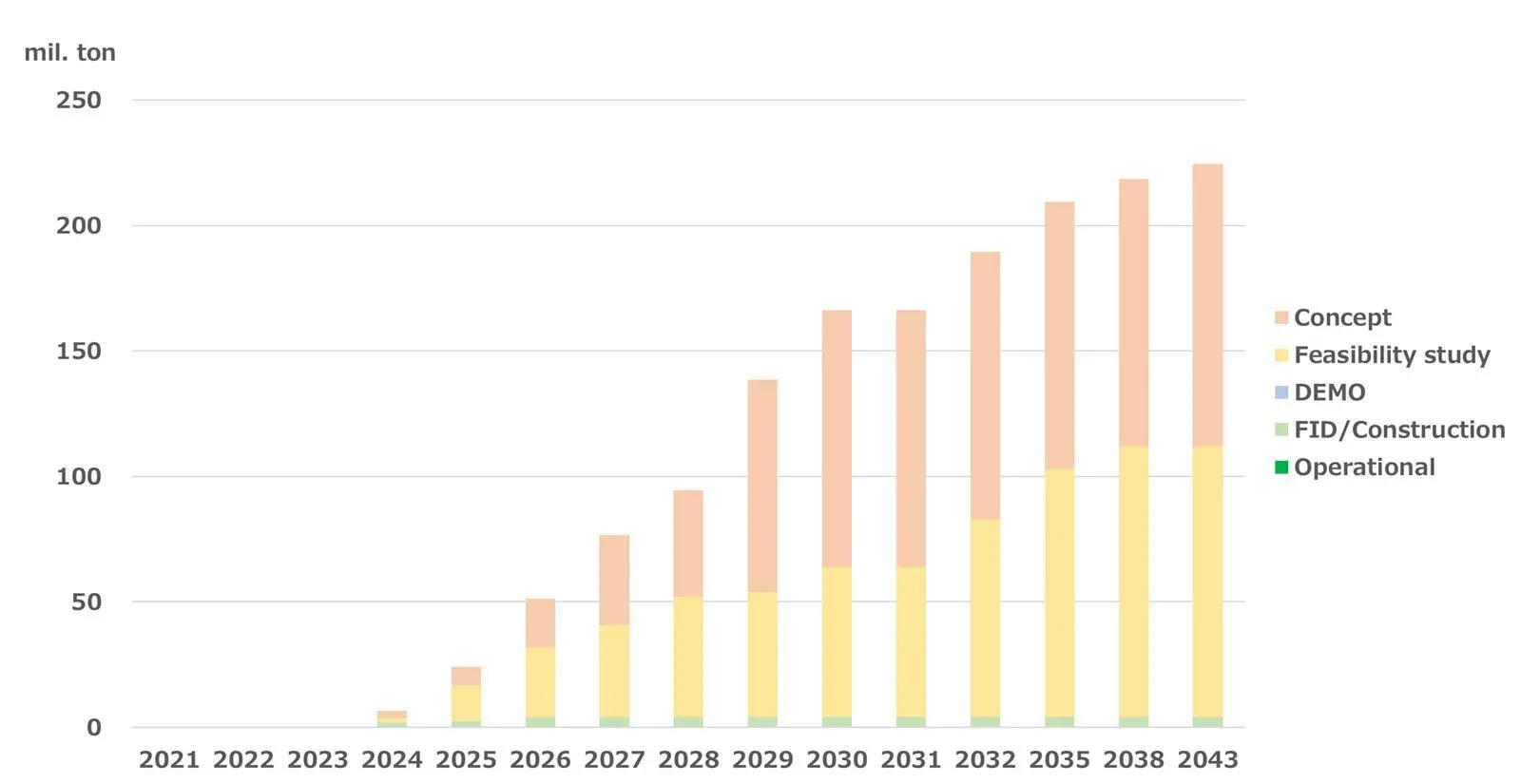
Research recently published by ClassNK shows that production capacity for green ammonia will reach around 220 million tons by 20432, taking account of all publicly announced projects – including those where the start-up has been most delayed.
If the number appears high (where the IMO estimates global ships of above 5,000GT consume around 215 million tons of fuel oil a year3, though ammonia’s energy density differs from oil), it reflects expectations that ammonia will provide an alternative fuel for coal-fired thermal power plants and will be used as a hydrogen carrier. Furthermore, since most projects are still in the conceptual or feasibility stages, it is unlikely that all will go ahead.
But toxicity, rather than availability, represents the first obstacle to ammonia’s acceptability as a marine fuel. Even in low concentrations. Ammonia has an adverse effect on human health in cases of repeated exposure.
And its uptake will depend on not only advances in design, technology and training that protect seafarers and the environment from ammonia’s risks in theory, but also the changes to maritime law that ensure that any usage upholds necessary and agreed standards in practice.
In December 2024, the IMO’s Maritime Safety Committee moved forward with interim guidelines covering the use of ammonia, and towards an international standard for ships using ammonia as fuel. The new guidelines are an important milestone in developing rules on ship design including the arrangement of fuel tanks, machinery space, piping, and containment, bunkering and fuel supply, as well as control, monitoring, and safety systems.
Work will continue on these guidelines, and on extending the IGF Code covering low-flashpoint fuels to include ammonia in 2025. Meanwhile, changes to the IGC Code will enter into force on 1 July 2026 that allows it as a fuel pathway.
Guidance on risk
Where technical support and the development of formalized ship and equipment design requirements are concerned, ClassNK has been in the vanguard of several projects contributing to cumulative knowledge on the use of ammonia as a marine fuel.
For the maritime industry to move forward with the practical application of ammonia-fueled ships, it will be essential to incorporate comprehensive risk assessments in ship design. A recently published study offers a further reminder of ClassNK’s energetic work to advance the viability of ammonia as a future mainstream marine fuel. A key component of these assessments involves estimating the probability of ammonia leaks from various onboard components.
Conducted in a collaboration with the Society and Research Institute of Science for Safety and Sustainability (RISS), National Institute of Advanced Industrial Science and Technology (AIST), the study estimates the probabilities of leakages in ship fuel systems using ammonia.
Leakage frequency from piping, storage tanks, and associated equipment will vary depending on the type of gas in the fuel system. Deriving estimates for ammonia leakage is therefore an essential part of the design risk assessment process. The purpose of the study has been to develop a more robust and reliable basis for future risk assessment work on the prevention of leakages, with results also helpful for developing measures to protect crew safety and the surrounding environment.
Given the lack of existing ammonia-fueled ship systems, however, authors faced a practical challenge in estimation work. To overcome it they used the Bayesian method to estimate probabilities of leakage for each component by combining onshore ammonia leakage frequency data from the High Pressure Gas Safety Institute of Japan with leakage frequency data applied to risk assessments for LNG-fueled ships.
The result is the world’s first ammonia leak frequency estimates for onboard components for ammonia-fueled ships (valves, hoses, pipes, flanges, joints, etc. – see Table 1).
The study feeds into the knowledge bank at the disposal of the ClassNK Transition Support Services to support customers on their journey towards zero-emission emissions. In addition, leak frequencies associated with specific components have been included by ClassNK as an appendix to Part C of Guidelines for Ships Using Alternative Fuels (Edition 3.0).
Drawing on real projects to update its Guidelines for Ships Using Ammonia as Fuel, ClassNK is also amassing further food for thought for regulators working on how ammonia can be safely brought into use and take its place in The IGF Code and The IGC Code.
ClassNK’s updated Guidelines independently establish provisions for minimizing risks to ships, seafarers, and the environment, as well as standards for the equipment (including control and monitoring systems).
Table 1: Estimated Leak frequencies for onboard ammonia fuel components

Sources:
2. ClassNK Alternative Fuels Insight, Technical Journal No.10 2024 (II), p12
3. https://futurefuels.imo.org/home/latest-information/fuel-consumption-dcs/
Related Articles
 AMMONIA
 AMMONIA
 AMMONIA