



China advances ammonia fuelled shipping
Ammonia was bunkered for the first time in China late last year when Liaoning Suppliers refuelled the tugboat Yuantuo 1. It was one of very few ammonia bunker transfers to date globally, and the operation was conducted at the COSCO SHIPPING Heavy Industry terminal in Dalian thanks in part to guidance from China Classification Society (CCS).
The 5,500HP tugboat was the first ammonia-fuelled ship built in China, and CCS played a major role in the vessel design, including designing the ammonia fuel containment and supply system. The society also conducted research into the catalyst technology used in the vessel’s SCR, among other technical developments.
CCS released its Guidelines for Ships Using Ammonia Fuel in 2022 and continues to research safety and new vessel designs. It’s part of a national push. Also in 2022, China’s National Energy Administration released a “Medium and Long-term Plan for the Development of Hydrogen Energy Industry (2021-2035)” which actively promoted the advance of ammonia-fuelled vessels.
CCS has been involved in the development of a range of ship designs including a 16,000 TEU container ship designed by MARIC, a 3,500 TEU container ship designed by CSSC Huangpu Wenchong Shipbuilding, bunkering vessels by MARIC and DSDC, oil tankers by MARIC and DIMC ORIC and a bulk carrier by SDARI.
In November 2024, CCS granted AiP to China’s first medium-speed high-power ammonia fuelled engine developed by CRRC Dalian Company. CCS was first to grant AiP for Wärtsilä’s W25DF ammonia engine. It has also granted AiP for WinGD and Dalian University of Technology engines, for ammonia fuel valves to PK Valve & Engineering in South Korea, and for an ammonia fuel supply system by COSCO SHIPPING Heavy Industry Technology (Weihai).
In December last year, MSC 109 adopted amendments to the IGC Code to enable the use of ammonia cargo as fuel, and this has paved the way for vessel designs such as the 50,000 cubic meter ammonia carrier jointly developed by COSCO SHIPPING Energy and COSCO SHIPPING Heavy Industry. Primarily designed for ammonia cargo, it also has the capability to carry LPG simultaneously. The ammonia dual-fuel engine system is expected to achieve net-zero carbon emissions.
Getting beyond the design stage for ammonia fuelled cargo vessels will require favourable economics, another area of research for CCS. The International Renewable Energy Agency (IRENA) has calculated the current cost of producing green ammonia at $700 to $1,300 per ton. That is expected to decrease to $450-$900 by 2030, a range confirmed by CCS’s own calculations. “After 2035, the economy of ships using green ammonia will begin to be equivalent to that of ships using fuel oil. After 2045, ships using green ammonia will generally be more economical than ships using fuel oil,” says Jin Ding, CCS Wuhan Rules & Research Institute.
Safety risks will need to be mitigated. Lei Wei, CCS Wuhan Rules & Research Institute, says toxicity is the primary risk to be controlled when using ammonia as fuel. This means controlling ammonia leakage and accumulation, preventing ammonia contact, and life-saving measures. Mitigation measures include the use double-walled pipes, avoidance of threaded joints as much as possible, mechanical ventilation, water spraying, the division of toxic areas and restricted access to high-risk leakage areas.
Ammonia’s corrosive properties rule out the use of materials such as copper, zinc, nickel and their alloys, and plastics, so steel is commonly used as the metal in ammonia storage tanks, pipelines and fittings. For seals, nitrile rubber can be used instead of conventional rubber.
Ammonia has a relatively low risk of explosion as it is not easy to ignite and has a high lower limit of flammable concentration (15%). However, it can exacerbate the consequences of an explosion caused by other fuels or flammable materials, and it reacts with oxidants such as chlorine and bleach to produce explosive compounds.
Ammonia-fuelled vessels should be equipped with at least three sets of safety protection equipment, and each should be able to provide sufficient protection to allow entry into gas-filled areas. This means at least one self-contained positive pressure air respirator (including the entire mask) with a capacity of at least 1,200 litres of free air (without using stored oxygen), airtight protective clothing, boots, gloves, steel core rescue rope with belt and an explosion-proof lamp. Ammonia-fuelled vessels should also have safe shelters that can accommodate all personnel onboard in case of severe ammonia fuel leakage.
The ammonia fuel tank and ammonia fuel preparation room should be located in areas where the hull structure is stable and not easily affected by external factors such as collision or grounding. They should be arranged outside of Class A machinery areas. When the ammonia fuel tank is located on deck, a coaming, water spray system, and independent ammonia water release system should be installed to avoid direct discharge of aqueous solutions containing liquid ammonia or dissolved ammonia overboard.
An instantly available water curtain should be installed at the entry to the ammonia fuel preparation room, and it should be able to be activated from outside the room. Gaseous ammonia has good solubility in water, so this measure can be effective in containing a leak.
An ammonia release management system is required to collect any ammonia releases during normal or reasonably foreseeable abnormal situations. This includes ventilation of double shut-off vent valves in ammonia fuel pipelines, release of safety valves in the ammonia fuel system and release of ammonia during pipeline purges.
Due to the toxicity of ammonia fuel, it may be better to adopt enclosed or semi-enclosed design for the ammonia fuel bunkering station, says Niu Song CCS Shanghai Rules & Research Institute. This contrasts with LNG and methanol bunkering stations that are preferably arranged in well-ventilated areas such as open decks.
The IMO guidelines stipulate that regardless of whether the bunkering station is in an open area, semi-enclosed area, or enclosed area, a risk assessment must be conducted which considers factors such as the isolation of the bunkering station from other areas of the ship, the division of hazardous and toxic areas, ventilation requirements, leak detection and safe measures. These can include direct monitoring or closed-circuit television monitoring of the bunkering station.
“As a preliminary application of a new system and technology, ammonia-fuelled vessels still lack the experience of onboard application despite their high technological maturity. It is necessary to adopt acceptable and recognized risk analysis techniques to assess the potential risks involved in the design of ammonia-fuelled vessels, in order to eliminate or mitigate their adverse effects on onboard personnel, environment, structural strength, or ship integrity,” says Nui.
On-going service
CCS has established a scientific research and service centre for the establishment of rules and standards, approval of ships and systems, risk analysis and carbon intensity assessments. Despite the advances made, the society sees some challenges ahead. For example, cost, safety, infrastructure, regulatory framework, technological maturity, and market acceptance. These challenges will need to be addressed through global cooperation, technological innovation, policy support, and investment.
“There is a certain foundation for the development of the regulations, rules, and standards related to ammonia-fuelled vessels worldwide, and the corresponding rules and standards have taken shape,” says Ma Dan CCS Wuhan Rules & Research Institute. “However, there are still deficiencies and improvement. In the future, in-depth research needs to be made in the following five aspects: the standards for specifications of marine ammonia fuel; the standards for ammonia fuel bunkering; the standards for testing ammonia fuel power plants (engines, boilers); the standards for design and testing of ammonia fuel supply system; the standards for design and testing of ammonia emission reduction system.”
For bunkering, CCS launched a research project titled “Research on Technical Standards for Ammonia Fuel Bunkering Ships and Operation” in 2024. The aim is to conduct research on technical standards for ammonia bunkering operations and ammonia bunkering ships. The work undertaken has already included development of technical standards for the arrangement of bunkering vessels, bunkering systems, cargo containment systems, related monitoring and safety systems, personnel protection, evacuation, and fire protection systems. “Guidelines for Ships Using Ammonia Fuel” and “Guidelines for Marine Ammonia Fuel Bunkering Operation” are expected to be released around the end of 2025.
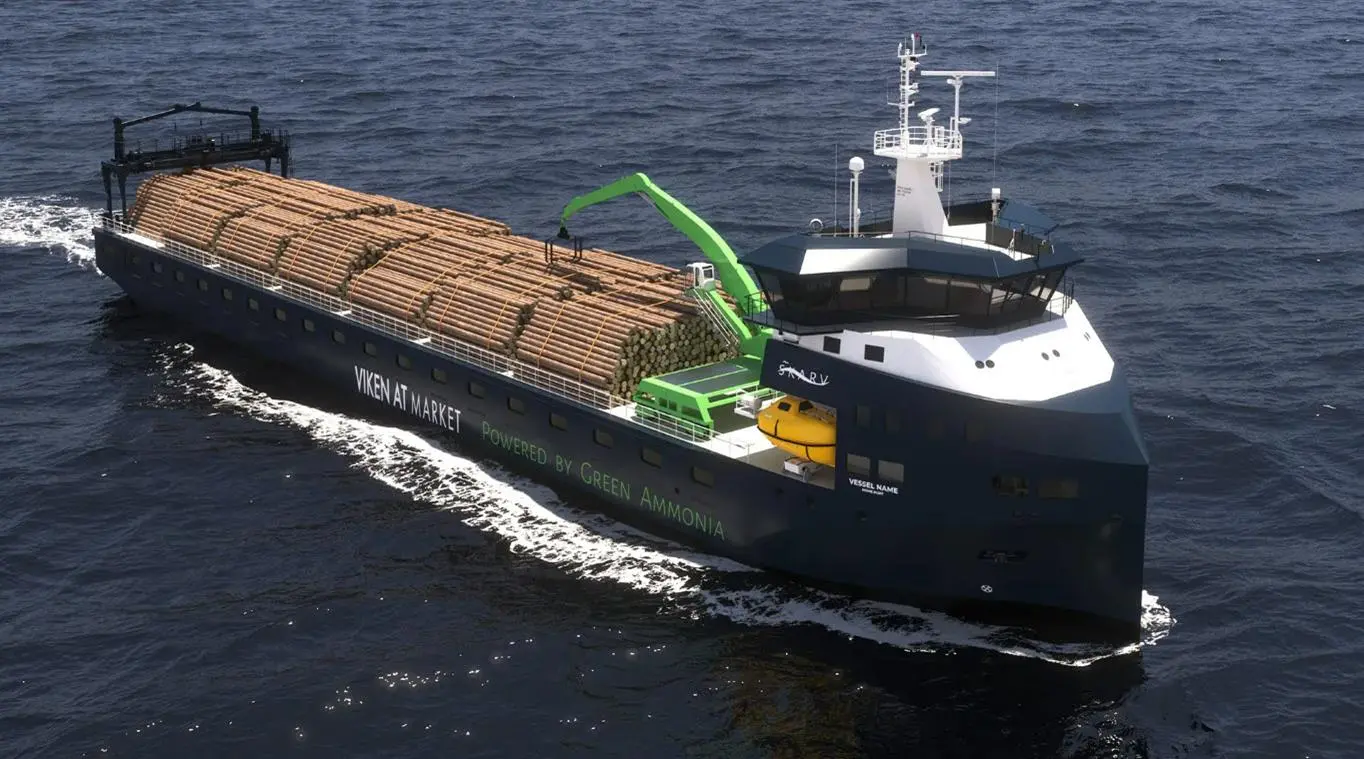
Meanwhile, Chinese yards are already attracting orders globally for ammonia-fuelled vessels. Last year, CMB.TECH and Yara Clean Ammonia announced the order of the world’s first ammonia-powered container ship to be built at Qingdao Yangfan Shipbuilding. More recently, on February 19, Norway’s Skarv Shipping announced it had contracted an ammonia-fuelled general cargo vessel from Huanghai Shipbuilding for delivery in 2027.
Related Articles
 AMMONIA
 AMMONIA
 AMMONIA