



ORC Waste Heat Recovery Paired with Methanol
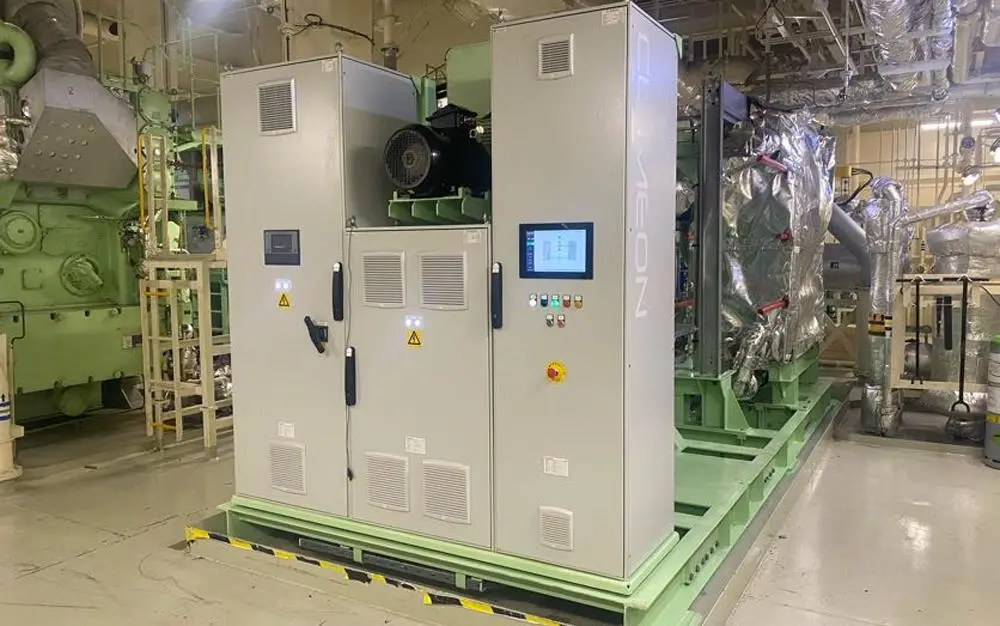
Climeon foresees the already favourable payback period for its autonomous Organic Rankine Cycle (ORC) waste heat recovery system as potentially being cut in half by 2030.
CEO Lena Sundquist says the application of the EU ETS to maritime means that shipowners operating in Europe are now required to purchase emission allowances which are expected to reach EUR 70 per ton of CO2 this year, and a Bloomberg analysis forecasts that the price will continue to rise, potentially exceeding EUR 200 per ton by 2040.
“With the new European GHG-reducing incentives such as EU ETS and FuelEU now in force and the IMO global CO2 tax proposal accepted, the operational cost for ship operators will increase rapidly unless energy efficiency and/or GHG emission reduction measures are taken,” says Sundquist.
“Installing Climeon ORC will increase energy efficiency and can save a substantial amount of operational costs for the operators and owners. For example, consider a large container ship with a 54MW engine operating 50% of its time in EU waters, at an average engine load of 46%, and running on VLSFO. In this case, the Climeon HeatPower 300 can reduce annual fuel consumption by approximately 240 tons and cut CO2 emissions by around 760 tons per year. At an estimated EU ETS price of €70 per ton of CO2 in 2025, this translates to annual operational cost savings of roughly €182,000.”
“For the same vessel, assuming a five-year investment horizon, the GHG abatement cost of the ORC system is estimated at only €20 per ton of CO2 reduced – equivalent to just 30% of the anticipated EU ETS cost per ton.”
Looking ahead, Climeon’s interpretation of future GHG-related financial incentives, including the IMO’s global CO₂ tax, suggests that combined savings from both reduced fuel consumption and avoided GHG-related charges could increase up to fivefold over the next 20 years for a vessel operating on fossil fuel. Already today, if green methanol is used as fuel, the operational cost savings can reach €700,000 or higher each year even though the fuel has no CO2 emissions-related cost.
In 2024, the company completed deliveries of six HeatPower 300 units to HD Hyundai Heavy Industries for integration into A.P. Moller-Maersk’s 17,200 TEU capacity dual-fuel, green methanol container ships. Commissioning of HeatPower 300 on both Maersk’s newbuild vessels and the existing ships is scheduled during 2025.
NovaAlgoma Cement Carriers (NACC) has also placed an order for a HeatPower 300 to be installed the world’s largest cement carrier – a methanol dual-fuel vessel being built to RINA class.
“Vessels operating on alternative marine fuels typically offer a more favourable waste heat profile for ORC systems compared to those running on HFO,” says Fredrik Thoren, executive vice president, head of marine sales at Climeon. “For example, methanol-fuelled vessels often require less auxiliary heating, such as tank heating, which means more waste heat is available for recovery. In many cases, this allows the Climeon HeatPower 300 to generate more electricity.
“Additionally, methanol engines often produce lower exhaust gas temperatures. HeatPower 300 can operate effectively using only the jacket water or high-temperature cooling water, without the need for an added steam boost, making it particularly well-suited for vessels without excess steam. However, the actual waste heat profile still depends on several factors, including engine type, manufacturer, model, onboard heat consumers, and operational patterns.”
Whether multiple Climeon units are installed depends on the ship’s design and operational profile. An example case would be a RoPax vessel with a 4-stroke engine having total engine capacity around 30MW, operating primarily in colder climates and at high speeds—or maintaining an average main engine load above 60%. Under these conditions, a significant and consistent amount of waste heat is available, making the installation of multiple HeatPower 300 units a practical way to maximize energy recovery and cost savings, says Thoren.
He says there is strong interest from shipping companies and vessel owners in improving fleet efficiency, and from shipyards in offering cost-effective technical solutions for this purpose. This applies both to newbuilds and retrofits.
Based on the current product portfolio, Climeon’s addressable market includes approximately 30 percent of the 1,500–1,800 new vessels built each year. In addition, an estimated 8 to 10 percent of the roughly 110,000 vessels over 100 gross tons in the existing global fleet are considered suitable, based on age and size, for Climeon’s technology.
How it works
Over half of the energy from fuel consumed by the combustion engines that power ships is lost as waste heat. Around 50% of this waste heat is available as low-temperature heat (below 100°C).
ORC is a thermodynamic process that converts low-temperature waste heat into electricity. Climeon’s HeatPower system utilizes an organic fluid with a lower boiling point than water in a closed-loop design. Heat evaporates the fluid, turning it into pressurized gas to drive a turbine and generate power. The fluid is then cooled, condensed back into a liquid, and recirculated. The system’s efficiency depends on the thermal energy available and the temperature gradient between the heat source and cooling medium.
The HeatPower 300 Marine can generate up to 355kW of clean electricity by harnessing the low-temperature waste heat (80-100°C) found in engine cooling water. It primarily uses waste heat from jacket cooling, enabling more stable and consistent power production over time. When excess steam is available, it can be used to further increase output, maximizing overall energy recovery. Additionally, the system is designed to use seawater for cooling the ORC process, reducing integration costs.
Retrofit logistics
Climeon and a leading global shipping company have completed the first of two planned HeatPower 300 retrofit installations without disrupting the vessel’s regular operations. During routine dry docking in China last year, preparatory work was carried out, including modifications to the engine cooling or waste heat recovery circuit and electrical cabling, to facilitate the installation.
After factory acceptance and performance tests with class approval are performed at Climeon’s test site in Stockholm, Sweden, the HeatPower 300 unit is disassembled into predefined sub-assemblies suitable for packaging. All packages are dimensioned to be easy to transport, lift onboard and into to the selected place in the ship engine room without impact on vessel structure.
The system, including service space, requires an installation footprint of approximately 7.5 x 3.7 meters. To support retrofitting in existing vessels, the modules are specifically designed to pass through openings as small as 2 x 2 meters. In this case, the smallest entry was 2.05m x 1.45m.
The packages containing the HeatPower 300 unit were transported to Hamburg and were loaded onboard during the ship’s normal docking at port during cargo loading. Before loading and installation, the ship was prepared by the owner with the additional piping and equipment necessary to provide the HeatPower unit with pressurized air, hot and cold water as well as electrical connection. The owner also prepared connection with the vessel control system to enable monitoring and control of the system.
When the packages were loaded onboard, the HeatPower 300 was re-assembled and connected to prepared interfaces. For commissioning, the HeatPower 300 was re-filled with working media and oil, and signal testing was performed. After that, the unit was commissioned and set to produce power. The commissioning phase needs to be performed when the vessel is in operation or engines are running on normal load to provide the right conditions, i.e. hot water and cold-water temperatures and flows, for the HeatPower to operate as designed.
The HeatPower 300 system is primarily targeted at larger vessels with large main engines (2 or 4-stroke) within both the cruise and commercial shipping sectors. Other segments and engine sizes may also be of interest depending on the available waste heat and the vessel’s operating profile. Large container ships and other ships with two stroke engines normally have more space in their engine rooms for easier retrofit installation. However, cruise and ro-pax vessels with more than one four stroke engine and an existing waste heat recovery circuit are also a good fit for retrofit.
Vessels that operate on higher speed/higher engine load and with fewer other heat consumers on board will have more available waste heat and will benefit the most from an ORC retrofit installation. Operation in colder sea water temperatures will also increase power output from the ORC. Best suited for retrofit are vessels younger than 15 years. However, there is no technical limit related to the age of the ship.
Related Articles
 ENERGY SAVING DEVICES
 LNG
LNG
 ALTERNATIVE FUELS & LUBRICANTS