



Methanol-ready market acceptance growing
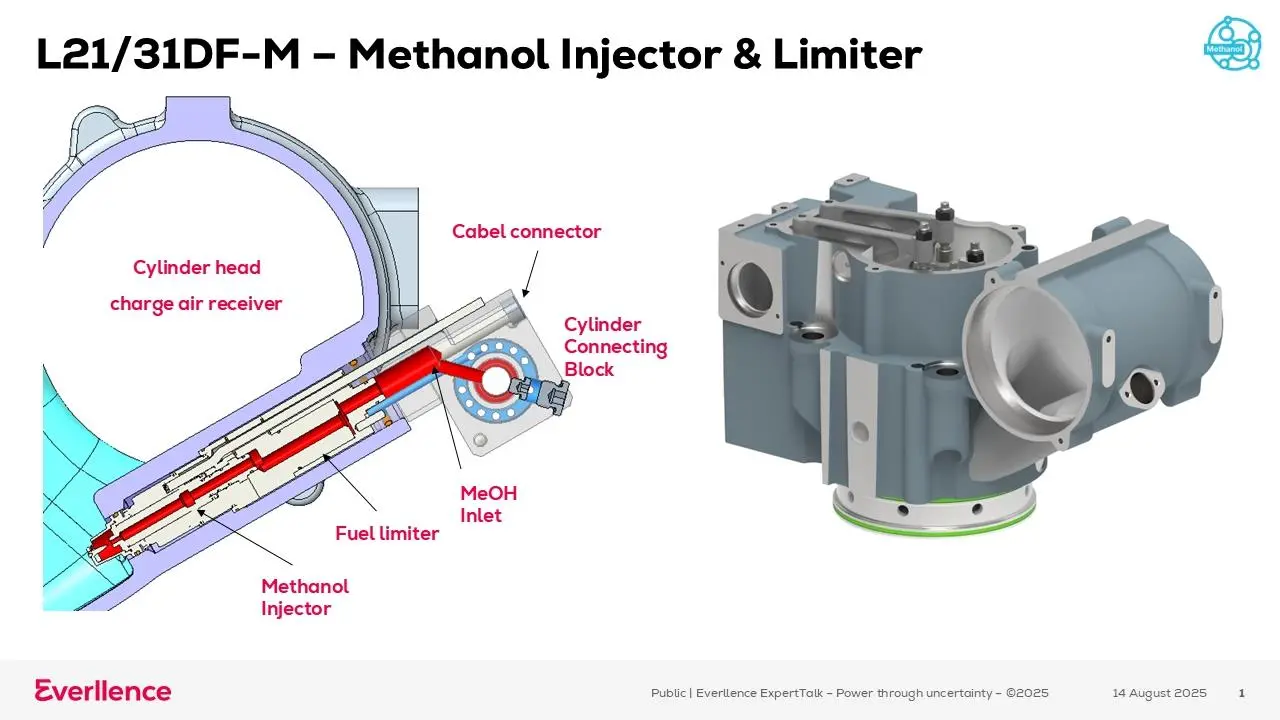
Hakon Juel Hansen, Everllence global business development manager, says the port fuel injection (PFI) concept employed in the MAN 7L21/31DF-M (dual-fuel methanol) small-bore genset has already gained market acceptance.
The 1-2MW engine successfully passed Type Approval Test (TAT) in China in February, and the number of orders for the engine is increasing. Among them is four shipsets of three gensets for diesel-electric construction and commissioning service operation vessels under construction in China for Deutsche Offshore Schifffahrt.
Hansen sees offshore support vessels as a growing market, but the gensets are being taken up in other sectors too, both as an auxiliary genset and for propulsive power for diesel-electric or diesel mechanical configurations.
The 2-3.7MW 27/38DF-M dual-fuel methanol genset is experiencing increasing traction within the container vessel market. A notable example is and order from Danish shipowner Navigare Capital Partners for 16 engines (+30MW) with an additional 16 units as options.
“In the feeder container vessel segment, particularly in the 3,000 to 5,000 TEU and 7,000 to 11,000 TEU ranges, owners are actively seeking cost-efficient engine solutions that are supported by a robust global service infrastructure,” says Hansen.
Auxiliary gensets have already been delivered for six car carriers each with three 7L21/31DF-M, and three sets of 6L21/31DF-M have been delivered for each of three chemical tankers.
Klaus Petersen, Senior Engine Specialist, says the PFI design provided a fast way to market that still offers high efficiency in diesel mode – an important consideration when the availability of green methanol is limited. The range is built around a “family design” which means many of the components in the engine, including pistons and combustion chamber, are the same regardless of whether it’s used for auxiliary or propulsive power. “And that means we can move a lot faster with development, especially concerning fuel consumption.”
He claims the best fuel consumption in the market for the 21/31 with 180 grams per kilowatt hour at 75% load and 185 grams at 50% load. The fuel map indicates optimal operation for methanol between 20-90% methanol share. However, combustion at a “60/40%vol” (methanol/biofuel) ratio minimises methanol slip.
Everllence has achieved optimal emissions control using oxicat treatment prior to the exhaust gas reaching the SCR, and this combined with the 60/40 concept keeps methanol exiting in the exhaust gas at levels below its lower explosion level. This means there is no need for an exhaust gas blower. There is no need for crankcase ventilation either, leading to low installation costs.
The 60/40 concept is also partly a response to the relative expense of green methanol fuel. All other methanol would be green-washing and should not be used, says Petersen. Instead, a biofuel and green methanol combination is a very low carbon solution.
Petersen says there is minimum time off-hire when converting to methanol operation from the methanol-ready configuration. The cylinder head is pre-prepared for the methanol injector as a dummy has been pre-installed. The cylinder has been pre-prepared with a knocking sensor, and the hotbox covers, camshaft, side covers, exhaust pipe and wastegate system are also ready for methanol operation.
Petersen notes that engine development is on-going and safety concepts could change as classification societies advance their interpretation of the IGF Code, but Everllence has already demonstrated that its methanol dual-fuel engines based on PFI can fulfil the requirements of the IGF Code and IACS classification requirements.
A new version of the 21/31 genset with advanced engine control and greater partial load optimisation is already under development. The Mk.2 is expected to offer improved fuel efficiency without additional cost. Everllence is aiming for the market’s lowest middle-speed specific fuel oil consumption in the 40-80% engine operation area.
Petersen points out that although the wastegate system on the current 21/31 adds to the cost, it saves turbocharger running time in diesel mode and controls the airflow in the engine in methanol mode. So, until green methanol is available, it brings a fuel saving.
Next in development pipeline will be L27/38. First commissioning of the L27/38 Mk.2 is expected in 2026 and L27/38 DF-M in 2027.
PFI thermodynamic performance confirmed
A CIMAC 2025 presentation by researchers from WTZ Roßlau and University of Rostock detailed research into methanol as a potential fuel for high-speed engines using port fuel injection (PFI).
Extensive thermodynamic investigations were conducted on a 175mm-bore single-cylinder research engine as part of a publicly funded research project at WTZ Roßlau. The experiments considered parameters such as charge air temperature, excess air ratio, and combustion centre to evaluate their influence on engine performance, exhaust gas emissions, and combustion stability.
Without adjustment, methanol combustion led to prolonged ignition delay and high cylinder pressure gradients. However, by optimising the operating parameters, combustion of over 90% was achieved, with 96.5% possible at full load operation.
Earlier combustion positions and lower excess air ratios improve efficiency, combustion stability, and methanol emissions in the evaluations undertaken, but the researchers consider further optimisation will be required.
Future research will focus on different compression ratios, valve timing as well as evaluation of exhaust gas recirculation, low-pressure methanol direct injection, and a mono-fuel combustion process with spark plug ignition.
The paper was authored by Karsten Stenzel, Phillip Thorau, Leon Beckmann, Frederick Schirrmeister, Dr.-Ing. Christian Reiser of WTZ Roßlau and Prof. Dr.-Ing. Bert Buchholz of University of Rostock. Other research partners included Everllence and the Technical University of Darmstadt.
To learn more about technical advancements in the field of future marine fuels, click here for the provisional programme for this year’s Propulsion and Future Fuels event in Hamburg, the longest-running technical maritime conference in the world.
Related Articles
 METHANOL
 METHANOL
 2-STROKE & 4-STROKE