



Hybrid ro-ro marries record scale with flexibility
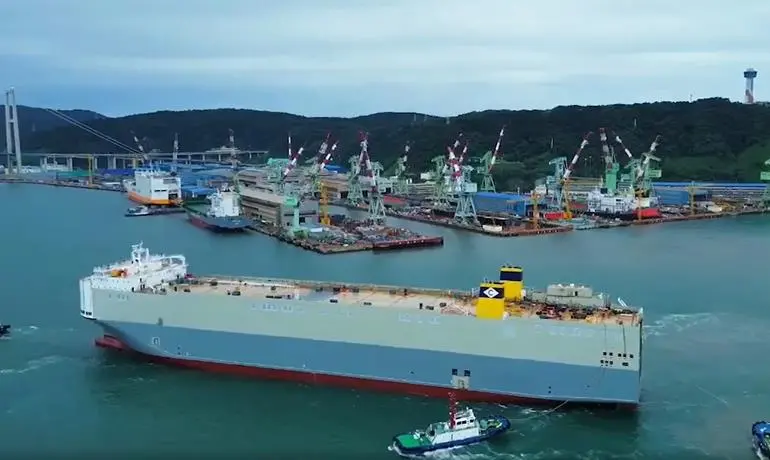
The 8,000 lane-metre capacity rating is in the same category as the operator’s 2017/2018-built record-breakers Celine and Delphine. Although modelled on the earlier pair, the latest ship differs significantly by way of a sophisticated propulsion train and also as regards the internal cargo carrying configuration. By the measure of both gross tonnage and freight intake, Chaumine is the largest short-sea ro-ro to date, and promises a remarkable 40% reduction in carbon emissions on the preceding generation.
Conceived primarily for CLdN’s highest-volume routes, notably the links between company-controlled terminals on the north-west Continent, at Rotterdam and Zeebrugge, with Killingholme, on the UK’s east coast, the 234-metre Chaumine is the first of a pair ordered from HD Hyundai Mipo. Second-of-class Leonine is fitting out at the contractor’s Ulsan premises on the Korean peninsula, and her delivery is imminent.
Testament both to the builder’s depth of experience in ro-ro vessel construction, and to its enduring business link with Luxembourg-based CLdN, the new design features twin two-stroke, dual-fuel main engines, twin propellers, exceptionally powerful shaft generators, a battery installation and provision for shore power.
Celine and Delphine came from the same yard seven and eight years ago, respectively, bolstering the through-transport operator’s market stance, service offering and unit efficiency, and laying the foundation for the new generation that raises the bar not only in performance and flexibility, but also in environmental credentials.
Power generation
The Celine/Delphine type incorporates a single, 18,660kW ‘gas-ready’ MAN 9L60ME-C8.5 main engine driving a Rolls-Royce controllable pitch propeller. By contrast, and while retaining the MAN marque at the 600mm bore size, the Chaumine employs two LNG-capable 6S60ME-GI engines derated to 11,000kW and turning twin, large-diameter Kawasaki variable pitch screws.
The dual-fuel plant, incorporating proprietary exhaust gas recirculation (EGR), is IMO Tier III-compliant, and provides for a speed in excess of 20 knots. The design power margin is substantial, since the individual, nominal MCR of the six-cylinder models is 14,940kW at 105rpm.
The Wartsila SAM shaft generators confer PTO/PTI/PTH functionality, imbuing power and energy usage flexibility and economy, together with a high level of redundancy. In the event of main engine malfunction or breakdown, each machine clutched to the shaftline in PTI mode can deliver auxiliary propulsion power, potentially up to 6MW.
The ship’s two main gensets of some 2,100kW apiece are complemented by an energy storage system of 2.72MWh capacity. The engineering design provides for the battery installation to be augmented in the future and thereby assume a greater role in energy production.
The mix of shaft motors and the ESS, which was also supplied by Wartsila, together with an altogether smaller array of tunnel thrusters for manoeuvring, has allowed CLdN to substantially reduce the auxiliary genset outfit. The two HiMSEN 9H25/33-driven aggregates of the Chaumine compare with a total of four HiMSEN sets in the Celine class, made up of three 7H32/40 models and one 7H25/33.
Onboard preparation for using shore power when alongside allies with the shipping company’s environmental and efficiency objectives and a corporate strategy that encompasses current investments in shore power connections at its dedicated port terminals.
CLdN has a track record in operating single-screw ro-ros and con-ros in the short-sea traffic, and that propulsion philosophy was taken to a new level in the Celine and Delphine, which in turn necessitated a relatively immense thruster plant so as to meet the challenges of manoeuvring in close quarter situations in often challenging weather and tidal conditions. But the twin-propeller option selected for the latest ships, in conjunction with high-lift flap rudders, gives better manoeuvrability. The overall solution embraces two Kawasaki bow thrusters of 2,500kW, whereas the Celine type has five tunnel thrusters, two at the bow and three at the stern.
Furthermore, the thruster tunnels in the newbuilds have been specified with Elogrid coverings developed and supplied by the Finnish company Elomatic and claimed to cut fuel consumption by one or two percent per grid without penalising thruster effectiveness. The savings result from lessened resistance due to the improved flow entry into the bow thruster tunnels at cruising speed. An added gain is the reduction in vibration, enhancing onboard comfort and habitability.
Manoeuvrability is indeed critical to such ships, given the need to sustain intensive, time-critical schedules using wind-prone and tidal berths, ideally without having to engaged tugs in all but the most adverse circumstances. The high, slab-sided nature of a generation of vessels more akin to vehicle carriers than ro-ros intensifies the handling challenge.
The nomination of high-pressure gas-injected ME-GI machinery follows two previous applications in the CLdN fleet, namely the fifth (Faustine) and sixth (Seraphine) examples of the 5,400 lane-metre Laureline series delivered by Hyundai Mipo Dockyard (now HD Hyundai Mipo) in 2021 and 2022. Whereas the initial four vessels of the design brought into commission during 2019 were each installed with a single MAN S50ME-C diesel and prepared for future conversion to allow LNG ingestion, Faustine and Seraphine started life under two-stroke, dual-fuel power using the equivalent ME-GI engine.
The cargo spaces of the Chaumine span eight levels, comprising five fixed decks and three hoistable decks, in a layout that differs from the preceding 8,000 lane-metre vessels. The payload rating in units is given as some 510 trailers plus 920 cars.
The design caters optimally to the broadest spread of cargo that characterises the CLdN offering. This ranges from road trailers, rolltrailers, double-stacked containers on cassettes, machinery, factory-new vehicles and components. Moreover, the ability to switch between any degree of freight mix to a 100% dedicated cargo is enshrined in the Chaumine and Leonine, as it was in the mould-breaking Celine.
Capacity
Cargo is worked across a MacGregor axial stern ramp that gives a 7.3m clearance. Side-hinged, watertight bulkhead doors are fitted midships to meet damage stability stipulations.
Provision for cars and vans is focused on the lower hold, which contains the ship’s three hoistable decks. Thus, the area below the main deck can be loaded with two levels of cars and two levels of vans, at 2.35m headroom. Alternatively, larger vehicles and trailers may be carried on the tank top, at 4.7m clearance, leaving two of the liftable decks deployed for cars, with the added option of having all movable decks fully hoisted so that freight, including double-stacked cassettes, can be transported.
The main deck affords a 7.2m clearance, and the surmounting three fixed cargo decks allow for trailers throughout.
Besides the use of HiMSEN four-stroke engines, Chaumine also provides a platform for home-grown technology in the shape of shipboard systems developed by the HD Hyundai autonomous navigation specialist Avikus.
The ship is fitted with the HINAS Navigation assistance solution, designed to improve forward situation awareness by linking with various navaids to support more precise navigation and obviate collision risks, and with a HINAS SVM multiple camera installation affording surveillance throughout the vessel.
Avikus took an early lead in the industry in commercialising an autonomous navigation solution that corresponds to IMO’s Level 2 criteria relating to autonomous operation, which allows for a remotely-controlled ship with seafarers aboard.
CLdN, denoting Compagnie Luxembourgeoise de Navigation, together with Cobelfret and other entities, is owned by the Cigrang family. The organisation is a through-transport practitioner, adopting an integrated approach to the business, melding ship operations with ownership or control of port facilities, terminals and large fleets of equipment including trailers and intermodal containers.
Chaumine has been placed under the technical husbandry of the Dutch arm of Anglo-Eastern Ship Management. Two other contractors employed for the ro-ro fleet are AW Ship Management of London and Maritime Management Services of the Netherlands.
At the time in February 2022, the contract for Chaumine and Leonine constituted the largest-ever single capital expenditure by CLdN, and was the product of two years’ engineering and development work with HD Hyundai Mipo.
In fact, CLdN has maintained a furious pace of investment for some years, involving not only shipping capacity renewal and expansion, but also the entire service infrastructure, a process which has embraced terminal and route developments and company takeovers. Most recent projects have ranged from new capital outlays on port terminals in the North Sea region to a first venture into the containership domain.
The latter initiative entails an extensive commitment from a trusted contractor, whereby construction of 10 feeder/intra-regional vessels of 1,100TEU has been awarded to HD Hyundai Mipo.
MAIN PARTICULARS
Chaumine
| Length overall | 233.9m |
|---|---|
|
Length bp |
226.0m |
|
Breadth |
35.0m |
|
Depth, to main deck |
12.7m |
|
Depth, to weather deck |
33.3m |
|
Draught |
8.0m |
|
Gross tonnage |
77,678t |
|
Deadweight |
25,595t |
|
Capacity, linear |
8,000 lane-m |
|
Capacity, units |
510 trailers + 920 cars |
|
Main engines |
2 x 11,000kW |
|
Speed, service |
20kn |
|
Shaft generators |
2 x 6MW |
|
Auxiliary gensets |
2 x c.2,100kW |
|
Energy storage system |
2.72MWh |
|
Class |
DNV |
|
Class notations |
1A Ro/Ro Ship, BIS, Battery (Power), CLEAN, Containers, DG (P), E0, Fuel ready (LNG[D; MEc]), LCS, NAUT (AW), Recyclable, Shaft align (1), Shore Power, TMON (oil-lubricated), ER (EGR, SCR, Tier III) |
|
Flag/registry |
Malta/Valletta |
Related Articles
 PROPULSION
 GENERAL NEWS
 HYDROGEN