



Heavy-lift shipping embraces green future
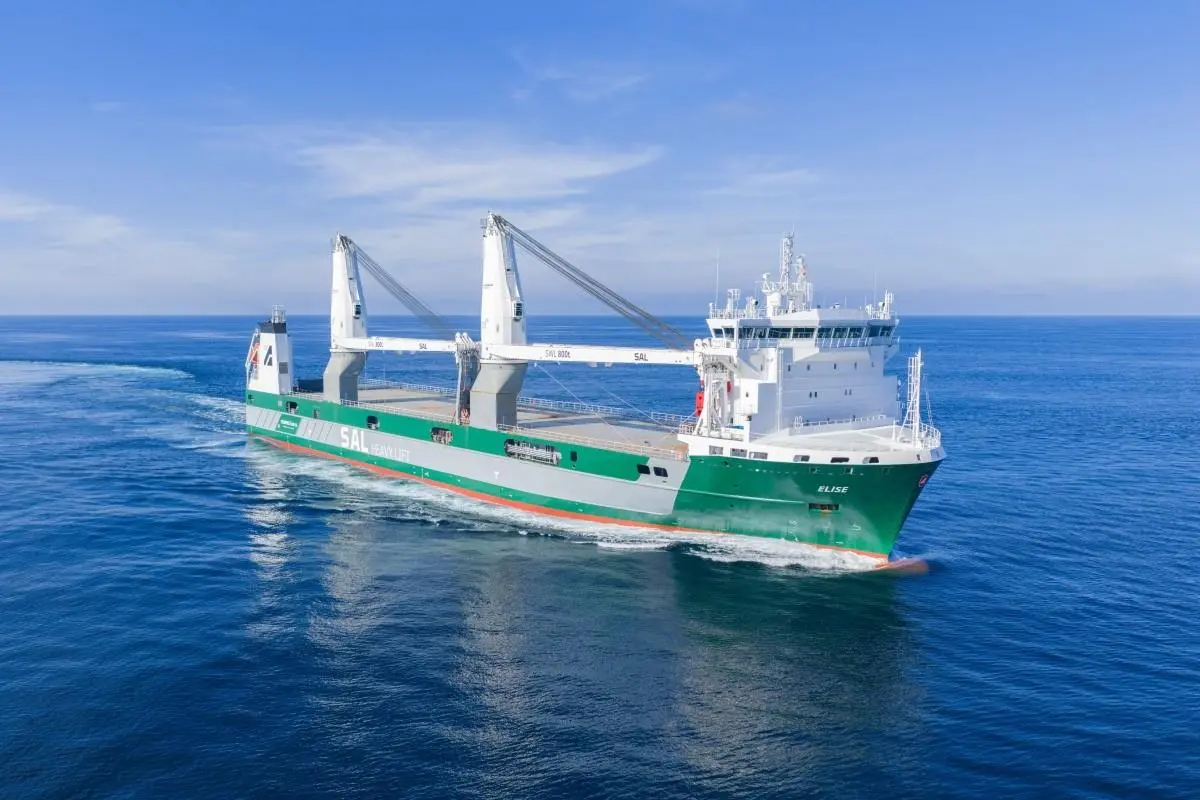
Constructed on the banks of the Yangtze, the 15,000dwt Orca class features two 800t-capacity deck cranes, affording the ability to handle ultra-large items of cargo, including some of the world’s biggest wind turbine components.
As well as establishing a new benchmark for performance in the project cargo category, the design also sets a high standard for current and future environmental compatibility, through a hybrid propulsion setup, full readiness to use methanol fuel, shore power connection, all-electric cranes and other elements.
Following the positioning voyage from China carrying wind turbine tower sections to the UK North Sea port of Hull, the lead vessel of the Orca generation, the 150m Elise, proceeded to Hamburg for her formal reception and christening ceremony by the German owners on November 6.
The build contract had initially been awarded to Wuhu Shipyard by the Haren Group company SAL Heavy Lift in 2022, in cooperation with the German company’s Dutch alliance partner Jumbo Shipping, and embraced four vessels with options on fifth and sixth units. The option on the fifth ship was subsequently exercised.
First-of-class Elise was primarily constructed at the Wuhu yard before transferring under own power in March to CMJL’s Weihai premises for installation of cranes, final outfitting and commissioning ahead of the September handover to SAL. Second and third newbuilds Frida and Patricia are at advanced stages of fitting out, and the fourth in the series, Carlotta, was launched at CMJL Weihai in June.
The first two newbuilds will be involved in the transportation of offshore wind farm components under a long-term commitment to Siemens Gamesa Renewable Energy. A holistic, sustainable approach including the lowest achievable emission values was a contractual prerequisite of Siemens Gamesa.
German funding
The specific nature of the power train and advanced technology adopted, resulting in the project’s favourable fuel- and emissions-saving characteristics, attracted German Government funding towards the capital costs. The award was made under the NaMKue (“Sustainable modernisation of coastal vessels”) programme overseen by the Federal Ministry for Digital and Transport.
Prospective beneficial effects include NOx abatement to a level 10% below the IMO Tier III level, and CO2 reduction some 20% under the EEDI Phase 3 level using intermediate fuel oil (IFO) or marine gas oil (MGO). The environmental ranking of the Orca generation as a whole is such that a shipper’s use of the vessel will contribute favourably to Scope 3 (supply chain) emission calculations.
In the context of the heavy-lift segment, the Orca series is a front runner with regard to machinery choice through the endorsement of methanol-capable, medium-speed main machinery. Wartsila’s 32M dual-fuel design has provided the shipowner with the means of using a clean-burning, sulphur free alternative to conventional, fossil-based marine fuels.
Moreover, SAL’s new ships are the first to employ propulsion engines with variable speed settings in a hybrid installation. Each vessel has been specified with two six-cylinder 32M main engines, and the Wartsila-supplied and -sourced hybrid package encompasses an energy storage system (ESS), PTO/PTI generator-cum-motor, multi-drive converter, and energy management system.
The ESS differs from most packs at sea through being composed of lithium-titanium-oxide (LTO) batteries, claimed to be able to handle more deep cycles than the lithium-ion (Li-ion) type.
The rationale for investing in battery power is to give the capability for peak shaving, especially as regards lessening engine load fluctuations in rough seas, with corresponding fuel savings. A companion aim is to provide a more economic source of energy for the deck cranes during cargo handling operations, and/or to reduce the size of the shore power connection.
The 32M has a design nominal rating of 580kW per cylinder at 750pm, such that the two six-cylinder models powering the Elise each turn out 3,480kW for an overall maximum continuous output of 6,960kW. The dual-fuel designation is something of a misnomer, as the machinery can ingest methanol, light fuel oil, heavy fuel oil, or liquid biofuels. Drive is through Wartsila reduction gear to a Schottel controllable pitch propeller.
As the latest addition to the versatile Wartsila 32 family, the 32M builds on the Finnish group’s longstanding reputation and extensive market presence in the 320mm-bore category. It features an uprated injector to accommodate a significant increase in injection pressure up to 600bar. This ensures optimum fuel efficiency and achieves a good emissions profile for methanol combustion. Injection is by common rail in methanol mode, and by jerk pump in diesel mode.
The hull form has been determined not only with regard to overall hydrodynamic efficiency but also out of particular consideration to seakeeping behaviour and to the minimisation of accelerations given the nature and value of the targeted cargo range.
During the evaluation period prior to main equipment being contracted, SAL commissioned open-water, self-propulsion and cavitation tests involving three competing makes of propeller. The results of hydrodynamic calculations from the model test programme carried out on the three contenders were analysed by China Ship Scientific Research Center (CSSRC) and the Shanghai Ship & Shipping Research Institute (SSSRI).
Schottel’s customised SC129 four-bladed, controllable pitch offering won the day, having rated especially high as regards cavitation behaviour and open-water curve.
The hybrid power setup in conjunction with the propeller design’s particular suitability for vessels with varied operating profiles, is claimed to provide the widest available range of speed settings for economy and flexibility, while ensuring redundancy. Sailing at 15 knots in good conditions, consumption is significantly less than 20t per day, comparable to many smaller, geared multipurpose vessels. Alternatively, the power and propeller arrangements facilitate trading at an ultra-efficient slow speed of 10 knots, burning just 6t per day, while offering the potency to make transits at up to 18.5knots for urgent shipments.
Rotational force for manoeuvring is exerted through Wartsila bow and stern thrusters, of 1,200kW and 900kW apiece respectively.
Ice Class
Ice class 1A notation, Polar Code certification, plus hull and equipment design conducive to operations in cold climates enhance the trading range of the ORCA breed. The DAT symbol in the ship’s array of DAT notations signifies ‘design ambient temperature’, covering material requirements for vessel operation in cold air temperatures outside polar waters.
The single hold extends for 107m of the ship’s 150m overall length and for 18.5m of the 27.2m beam. The underdeck cargo space is closed using MacGregor pontoon-type hatch covers which have the robustness to accept loads of 10t/m2. This equates to, for example, the capacity to carry 3,000t carousels above deck. The heavy-duty covers, moreover, are floatable for cargo handling purposes.
Meeting classification requirements for sailing in ‘open-top’ mode at up to full scantling draught, the vessel can accommodate over-height cargo in the hold, with a fully-opened hatchway.
The tanktop structure allows for loading to 18t/m2. So as to achieve compartmentalisation of the hold when the hatchway is closed, pontoon tweendeck covers can be deployed at four different heights, bearing a maximum 8t/m2.
The Orca generation provides an early reference for the LS800E all-electric crane developed and manufactured by Liebherr, using two such units mounted on the starboard bulwark. The crane has been conceived with a particular focus on the growing market demand for larger offshore wind industry components, necessitating both greater lift ‘muscle’ and crane outreach.
Although Liebherr has supplied onshore and offshore cranes in the 3,000-5,000t category, the 800t deck crane denotes a drive into a new segment of the marine business.
Furthermore, many years’ experience with all-electric drives in the port equipment sector has fed into the LS800E development project. All sections of the crane are electrically-driven, imbuing higher energy efficiency. In addition, all drive componentry and power electronics are installed within the crane, facilitating integration into the ship’s design and allowing improved utilisation of the below-deck spaces.
The new LS800E actively communicates with the vessel’s power management system, and recovered energy is fed back into the battery bank for release when the ship’s energy load increases, saving fuel.
The VisionMaster integrated bridge system from Sperry Marine features virtual network computing (VNC) watch modes, allowing watchkeepers to access critical tools, including the ice radar, directly at the conning position. This ensures greater situational awareness.
The vessel is the first newbuild equipped with Sperry’s new NAVISTAR satellite compass solution, conferring precise and reliable heading data, even at high latitudes, and the first to have a complete installation of the 27-inch VisionMaster Net Panel PCs. The outfit also includes the proprietary Fiber Optic Gyrocompasses, designed to deliver highly accurate heading data and to maintain stability even when external GNSS signals are disrupted.
The commercial association between SAL and Jumbo Shipping was strengthened in March 2024 through the addition of Intermarine to the joint venture, to create the JSI Alliance. Intermarine, which focuses on liner services in the Americas, had been fully taken over in 2022 by the Harren Group, following the acquisition of a 50% stake two years earlier, and has recently been renamed SAL Intermarine.
SAL as a whole currently deploys a fleet of some 80 multipurpose and ultra heavy-lift vessels, in operation and commercial management.
Main particulars
Elise
| Length overall | 149.93m |
|---|---|
|
Length bp |
142.27m |
|
Breadth |
27.20m |
|
Depth |
10.50m |
|
Draught, summer |
8.50m |
|
Gross tonnage |
16,671t |
|
Deadweight |
15,171t |
|
Holds |
1 |
|
Hold capacity |
23,600m3/833,400ft3 |
|
Container intake |
196TEU |
|
Deck cranes |
2 x 800t |
|
Max. lift capacity |
1,600t |
|
Propulsion engines |
2 x methanol dual-fuel |
|
Main engine power |
2 x 3,480kW |
|
Speed, maximum |
18.5kn |
|
Speed, service |
16.5kn |
|
Speed, ultra-efficient |
10.0kn |
|
Bow/stern thrusters |
1 x 1,200kW/1 x 900kW |
|
Class |
DNV |
|
Class notations |
+1A, BIS, Battery (Safety), BWM (T), Clean (Design, Tier III), COAT_PSPC (B), Container, DAT (-25degC), DG (P), E0, ECA (SOx-A), Grab (3-30t), Hatchcoverless, Ice (1A), LCS, NAUT (OC), Polar (-25degC), Recyclable, RP (1,60), RSD, Shore power, Strengthened (DK, HA, IB), TMON (oil-lub’d), ER (SCR, Tier III) |
|
Ice class |
1A |
|
Registry/flag |
Hamburg/Germany |
Related Articles
 METHANOL
 METHANOL
 2-STROKE & 4-STROKE