



Research firm predicts ammonia dominance in future marine fuels market
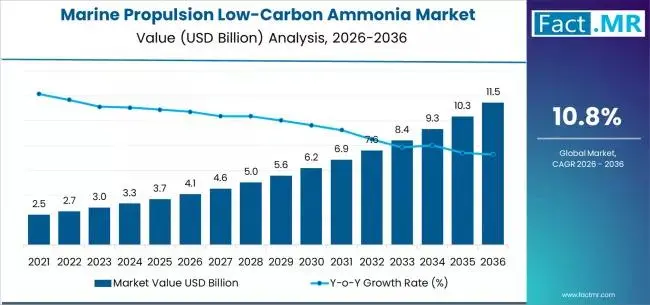
According to market research firm Fact.MR, the market is expected to expand from $4.11 billion in 2026 to $11.46 billion by 2036, representing a compound annual growth rate of 10.8%.
Fact.MR reports that low-carbon ammonia will account for nearly half of total market demand in 2026, reflecting its early dominance among alternative marine fuels. Container ships are projected to be the leading vessel segment, representing around 32% of demand, while commercial shipping is expected to remain the largest end-user, accounting for almost 47% of the market. Growth is anticipated to be strongest in countries that are actively investing in maritime decarbonisation and alternative fuel infrastructure, including Norway, Japan, South Korea and China, with the United States also showing robust momentum.
The scale of projected growth underlines what Fact.MR describes as a structural shift in the maritime energy landscape rather than a conventional market expansion. The transition is being driven primarily by increasingly stringent emissions regulations from the International Maritime Organization, alongside growing pressure on shipowners to identify scalable, zero-carbon fuel solutions capable of supporting global operations.
Ammonia’s appeal lies in its carbon-free combustion characteristics and the existence of a well-established global production, transport and storage network. Fact.MR notes that the development of both green and blue ammonia value chains is central to the market’s evolution, although significant technical and operational challenges remain. These include ammonia’s lower energy density compared with conventional marine fuels, the need for further adaptation of engine technologies, and the establishment of comprehensive bunkering, storage and safety systems.
Leading industrial players such as Yara International, Everllence, Wärtsilä, Mitsubishi Heavy Industries and Japan Engine Corporation are identified by Fact.MR as playing a key role in advancing engine development and fuel readiness. The research firm concludes that long-term success will depend on coordinated progress across engine technology, fuel supply logistics and regulatory frameworks, ensuring that environmental objectives are aligned with safety requirements and economic viability.
For more information about ammonia, read our Special Report on the fuel from last year, which highlighted possible issues with its widespread use such as price and availability.
Related Articles
 ALTERNATIVE FUELS & LUBRICANTS
 ALTERNATIVE FUELS & LUBRICANTS
 ALTERNATIVE FUELS & LUBRICANTS