



Wind sails gain tanker traction
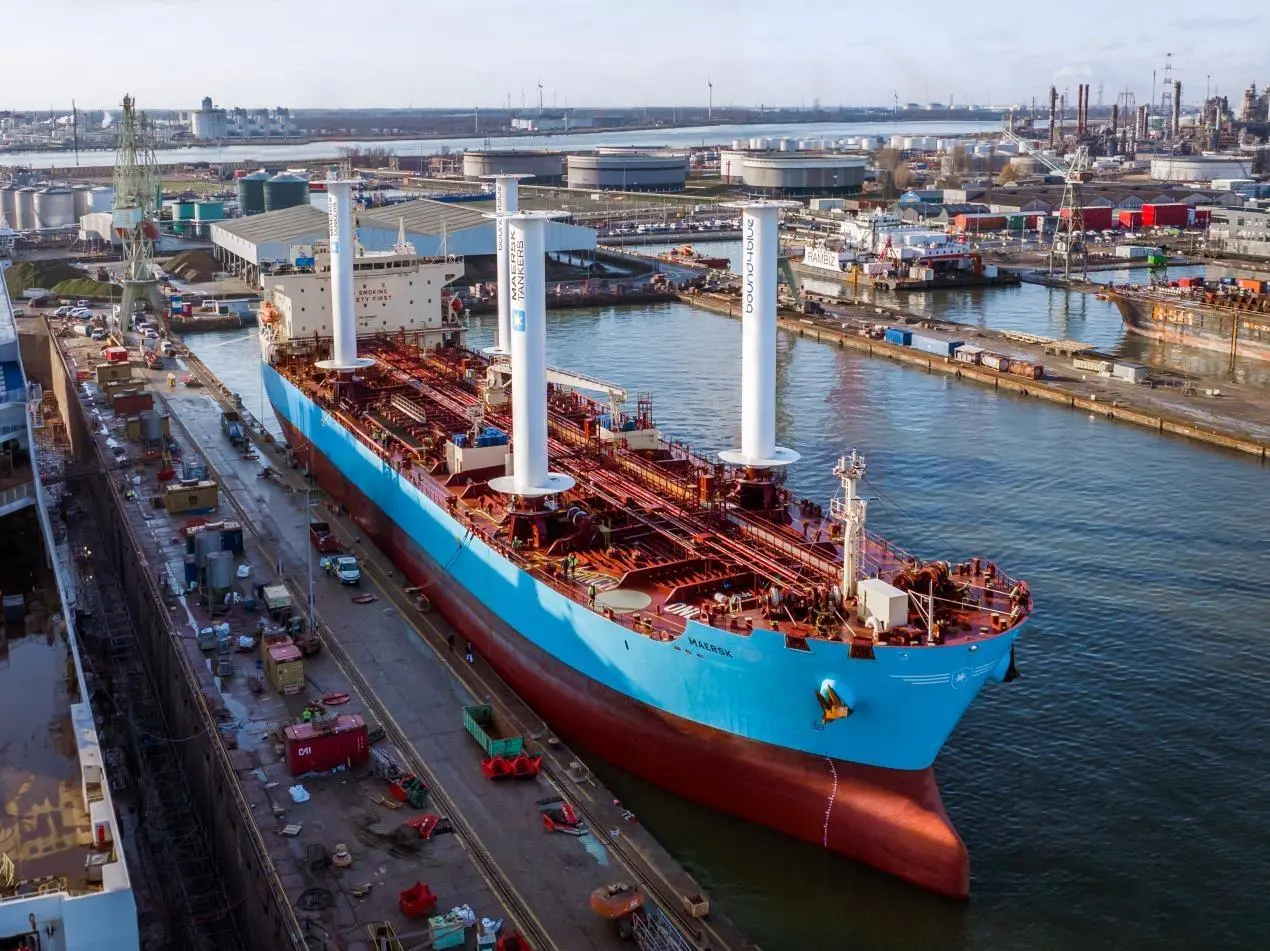
bound4blue chief executive and co-founder José Miguel Bermúdez described the milestone as ‘a watershed moment’ for an industry under pressure to cut emissions while remaining commercially viable.
“Progress demands concrete investments and implementation,” commented Maersk Tankers’ chief investment officer, Claus Grønborg. “Deploying wind-assisted propulsion at scale enables more energy-efficient voyages while supporting compliance with FuelEU Maritime and the EU Emissions Trading System.”
READ MORE: bound4blue lands Maersk Tankers contract
The autonomous eSAILs generate lift by drawing air across an aerodynamically optimised surface, delivering up to seven times more lift than conventional rigid sails of a similar size.
Configured for individual vessels, the systems can achieve double-digit reductions in fuel consumption and CO2 emissions, while improving Carbon Intensity Indicator ratings.
For the Maersk Trieste, bound4blue, Maersk Tankers and integrator Njord adopted a two-step installation process designed to minimise downtime. Preparatory ‘wind ready’ work was completed in Shenzhen before final installation in Belgium, where the units were lifted into place and connected in a pre-commissioned, plug-and-play process.
“Our system was designed from day one to deliver maximum performance with minimum complexity,” Bermúdez said. “That’s especially important for scaling up installations within segments that present specific integration challenges, such as tankers.”
He added that the latest installations show leading shipowners are embracing wind propulsion as a practical solution. “This is more than just another installation,” he said. “It’s proof that wind propulsion is ready to deliver at scale.”
The project follows a growing list of bound4blue installations across multiple shipping segments, reinforcing the sense that wind propulsion is moving rapidly from experimentation to execution.
READ MORE: Klaveness combination carriers install suction sails
Related Articles
 ENERGY SAVING DEVICES
 ENERGY SAVING DEVICES
 AMMONIA