



EXCLUSIVE: Alfa Laval expands remote support
As vessel systems grow more complex, crews are facing mounting operational and regulatory challenges. The introduction of new fuel types, stricter environmental rules and evolving compliance requirements are making rapid access to expert guidance more critical than ever.
At the same time, advances in satellite communications and onboard network infrastructure are enabling reliable connectivity even in deep-sea environments, opening the door to more responsive and collaborative support models.
Alfa Laval’s approach builds on years of development in connected equipment. The company has already deployed gateways across key systems such as ballast water management systems, fuel and lube oil purifiers, and oily water separators.
These systems allow for data-driven diagnostics, performance optimisation and improved compliance reporting. However, until recently, limited connectivity at sea constrained the full potential of these solutions.
That barrier is now diminishing. Through a collaborative initiative involving Maersk, Anglo-Eastern and Everllence PrimeServ, Alfa Laval has tested how onboard networks can be extended into machinery spaces to enable real-time monitoring and remote support of critical equipment. The trials demonstrated that relatively minor hardware upgrades are sufficient to connect engine-room systems, creating a scalable foundation for broader digital services.
The project validated a range of practical use cases, including troubleshooting, crew training, operational support and product evaluation. Remote experts were able to assist onboard personnel from shore-based locations, reducing response times and improving decision-making in critical situations. This model also supports more efficient knowledge sharing between crews and technical specialists, contributing to continuous operational improvement.
Augmented reality
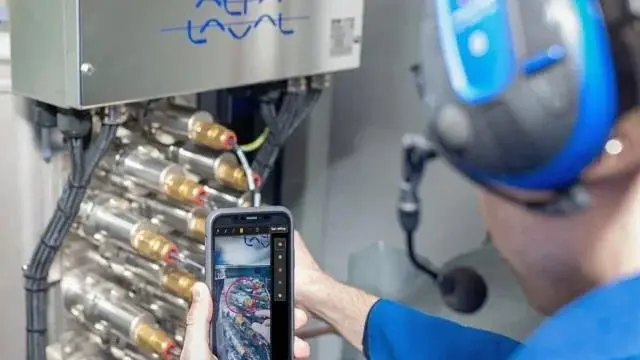
A key component of the initiative is the use of augmented reality to enhance remote collaboration. By enabling shore-based experts to see exactly what onboard crew members see, AR tools facilitate step-by-step guidance for complex procedures.
This has already been applied in real-world scenarios, including emergency boiler operations, separator maintenance, freshwater generator assessments and troubleshooting of methanol fuel systems.
Alfa Laval highlights the tool’s ability to augment a crew’s expertise. “It shouldn’t be seen as a replacement for knowledge nor trained crews,” Bjørn Pompe, global field services manager, BU WWF, Alfa Laval Technologies, told The Motorship.
“It is a tool that will help all to a smoother and quicker time to solution. Instead of running into a problem you can’t solve… the crew can now connect to Alfa Laval who will virtually go on board by using AR audio video and give support to the crew. It will save time on both ends.”
Beyond operational benefits, the technology also offers cost and environmental advantages. Reducing the need for service engineers to travel to vessels lowers both expenses and emissions, while minimising equipment downtime improves overall efficiency. Enhanced support capabilities also contribute to safer working conditions for crews, particularly when dealing with unfamiliar or technically demanding systems.
Looking ahead, Alfa Laval is aiming to expand its remote services beyond reactive troubleshooting. The next phase will focus on proactive compliance monitoring and performance optimisation across a wider range of onboard systems.
An upcoming compliance monitoring package for its PureBallast system is expected to mark an important step in this direction, enabling real-time oversight of regulatory performance.
Related Articles
 ALTERNATIVE FUELS & LUBRICANTS
 ALTERNATIVE FUELS & LUBRICANTS
 ALTERNATIVE FUELS & LUBRICANTS