



EXCLUSIVE: Everllence targets air lubrication and fuel flexibility
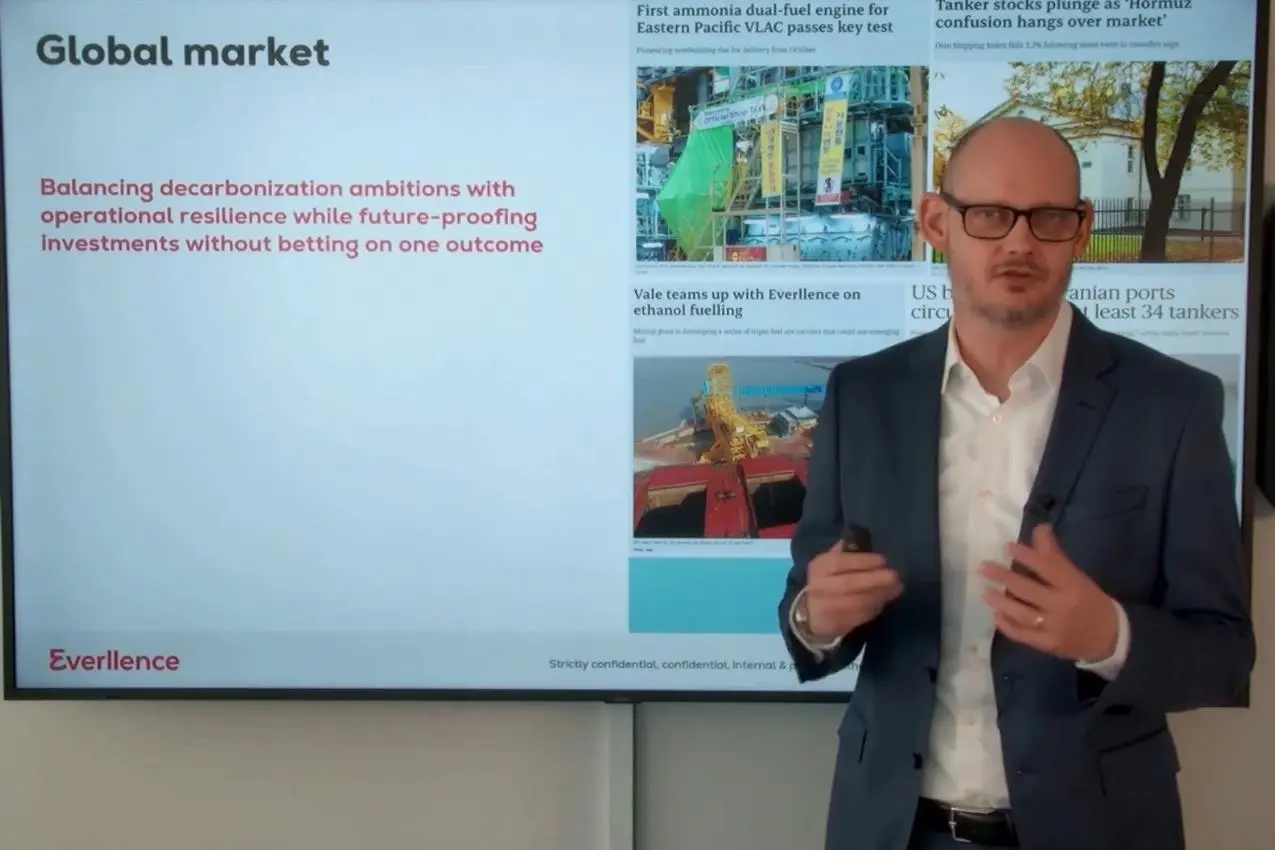
During its recent “Propulsion trends in 2026” webinar, the engine designer outlined how it sees the next phase of the newbuilding cycle developing, with particular emphasis on its new B&W engine platforms and its emerging Engine Supported Air Lubrication (ESAL) technology.
The message from the company was clear: Owners are still uncertain about long-term fuel choices, but they are actively investing in technologies that can lower fuel consumption now while preserving optionality for future fuels.
Christian Ludwig, vice president and head of global sales and promotion at Everllence, described a market caught between “energy transition versus energy security” and “fuel-agnostic versus fuel-optimised” investment decisions.
He argued that uncertainty around regulation and fuel availability continues to shape ordering behaviour across the container and tanker sectors. Despite that uncertainty, ordering activity remains strong.
State of the market
According to figures presented during the webinar, container ships and crude tankers accounted for more than 70% of contracted propulsion power in early 2026, while dual-fuel uptake remains concentrated in larger vessel segments.
In container shipping, Everllence sees LNG continuing to dominate among ultra-large vessels.
Nikolaos Kourtidis, director of new technologies and market development, said the company had secured 226 ME-GI references across large container ship projects in 2025 and early 2026.
He highlighted the diesel-cycle combustion characteristics of the ME-GI platform as central to its market appeal, combining high fuel efficiency with low methane slip and stable operation across varying ambient conditions.
However, the webinar also highlighted growing interest in methanol and ethanol pathways, particularly for regional and intra-European trades. Mr Ludwig noted that methanol-fuelled container vessels operating within Europe are benefiting from fuel availability and regulatory incentives, while ethanol is emerging as a potentially cost-effective option in regions where methanol infrastructure remains immature.
The company’s assessment remains that shipping will evolve into a multi-fuel market rather than converging around a single solution. Presentation data projected a steadily diversifying fuel mix through to 2050, including methane, methanol, ammonia and conventional fuels.
Efficiency focus
Alongside fuel flexibility, Everllence is now placing equal emphasis on propulsion efficiency technologies capable of delivering near-term emissions reductions without requiring alternative fuel infrastructure.
Central to that strategy is ESAL, which Mr Kourtidis described as a new approach to hull air lubrication using pressurised scavenge air from the main engine turbochargers.
Traditional air lubrication systems rely on standalone blower systems to create an air carpet beneath the hull, reducing frictional resistance. ESAL instead diverts pressurised scavenging air directly from the two-stroke engine into the lubrication system.
According to Everllence, this allows the propulsion plant itself to support the air lubrication process while avoiding the need for separate dedicated air-generation arrangements.
The company estimates net fuel savings of approximately 3.5%, even after accounting for what Mr Kourtidis described as an estimated 1% specific fuel oil consumption penalty at engine level.
“It’s not every day from a propulsion perspective you can offer something which is 3% plus in terms of overall efficiency savings,” Mr Ludwig said during the Q&A session.
Initial deployment is focused on G95 bore engines serving ultra-large container vessels, with commercial introduction targeted for Q4 2026.
The first rollout includes single-fuel, methane and methanol-capable variants, including retrofit applications for existing G95ME-C9.5 engines.
Mr Kourtidis stressed that ESAL deployment remains highly vessel-specific because hydrostatic pressure, beam, draft and operating profile all affect air requirements.
As a result, Everllence is developing the technology through three-way collaboration between the engine designer, shipyard and air lubrication supplier.
Beyond containers, the company also used the webinar to showcase its new B&W engine developments for tanker and bulk carrier applications.
Particular attention centred on the B&W G70ME-C10.58 platform, targeted at Suezmax tankers, Newcastlemax bulkers, LNG carriers and container feeders. The design retains the same footprint as previous generations while operating at lower gas pressure than the 10.7 platform, which Everllence said simplifies integration while still improving fuel consumption.
The wider 10.7 platform family also reflects a growing market preference for engines designed around future retrofit flexibility.
Mr Ludwig said some owners are currently favouring advanced single-fuel engines while retaining the ability to convert later as fuel markets mature. “You’re basically safeguarding your investment,” he said.
For Everllence, that combination of retrofit readiness, multi-fuel capability and incremental efficiency gains appears set to define its propulsion strategy as the shipping industry enters its next ordering cycle.
Related Articles
 ALTERNATIVE FUELS & LUBRICANTS
 ALTERNATIVE FUELS & LUBRICANTS
 ALTERNATIVE FUELS & LUBRICANTS