



Ship regasifies and discharges own LNG cargo
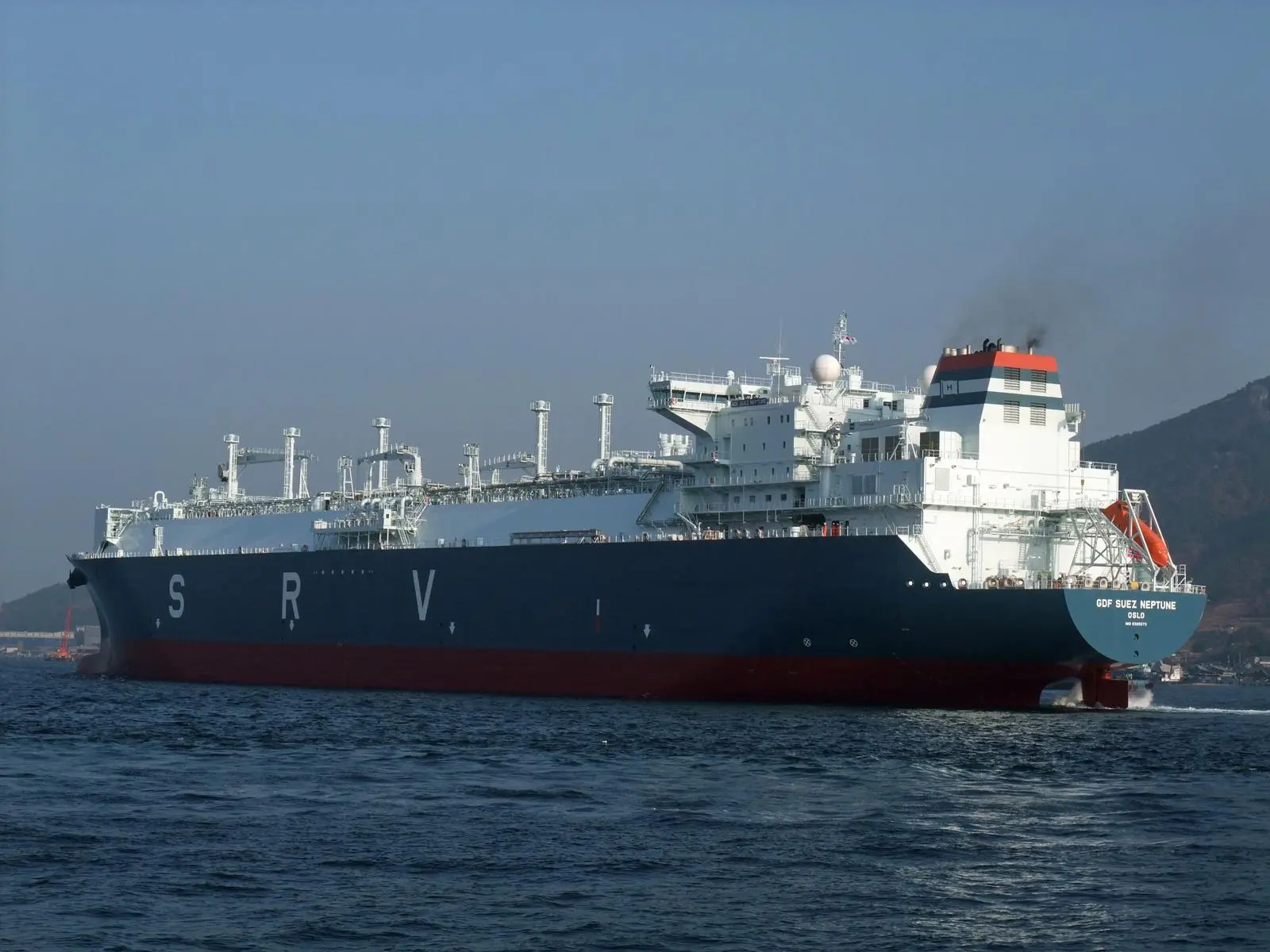
Hoegh LNG and Mitsui OSK Lines are the joint owners of GDF Suez Neptune, which was handed over on a long-term charter contract to GDF Suez at the end of 2009. This first shuttle and regasification vessel (SRV), is an LNG tanker that is equipped with her own LNG regasification system, allowing her to regasify and discharge natural gas under high pressure directly into a designated deep water port.
This regasification vessel is able to serve the GDF Suez group’s Neptune LNG Deep Water Port off the coast of Gloucester, Massachusetts, USA – to be commissioned in early 2010 – as well as other group projects elsewhere.
The GDF Suez Neptune vessel received the ‘Green Passport’ notation from DNV, certifying the environmental considerations taken when constructing, operating and ultimately disposing of the vessel. The Green Passport programme encourages the use of good practices throughout the vessels’ life cycle and notably right from the outset to ensure an eco-friendly policy is adhered to when dealing with potentially hazardous materials in the ships’ construction.
This innovative LNG carrier was constructed at the Samsung Heavy Industries (SHI) facility located on Geoje Island, South Korea. She is owned jointly by Höegh LNG and Mitsui OSK Lines (MOL), and will be operated by Höegh LNG for GDF Suez.
The vessel incorporates the reinforced GTT MKIII cargo containment system with 145,000 m³ of cargo carrying-capacity at 100% volumes. She is fitted with three regasification skids for a total output capacity of about 21 million standard m³ of natural gas per day, and is also capable of operating as a standard LNG carrier.
The GDF Suez Neptune is equipped with a tri-fuel (boil-off gas, HFO, distillate fuel oil) diesel electric propulsion system, with a single screw and rudder. In 2006-2007, the group received the first three diesel electric LNG carriers in the world, specifically built on its order. Diesel electric technology for LNG carriers has since been adopted by many other companies and has also equipped two other recently-delivered long-term chartered LNG carriers for the group, the BW GDF Suez Paris and the BW GDF Suez Brussels.
In May 2010, GDF Suez will receive a second SRV, the GDF Suez Cape Ann, which is a sister-ship of the GDF Suez Neptune.
Earlier in 2009 Höegh LNG received approval In principle (AiP) from DNV for its LNG FPSO project, including a reconfigured membrane containment system. The approval from DNV confirms that the Höegh LNG FPSO design complies with all rules and regulations and that there are no obstacles to its construction. This completes 18 months of engineering work by Höegh LNG.
The scope of DNV’s AiP assessment included review of the LNG FPSO FEED (front end engineering and design); while DNV has also been involved with Gaz Transport and Höegh LNG during all stages for the sloshing assessment of the containment system to ensure that the main assumptions, analysis tools, methods and acceptance criteria used are relevant and in line with DNV’s requirements.
The AIP covers the complete LNG FPSO design, including:
· The hull and all marine and utility systems designed for offshore use
· GTT No. 96 reinforced double row containment system designed by Gaz Transport Technigas
· Niche LNG liquefaction system design and patented by Chicago Bridge & Iron (CB&I)
· Gas inlet facilities
· Gas processing modules
· Power generation and distribution system
The Höegh LNG FPSO design consists of offshore classed ship-shaped structure and a topside plant with capacity to treat and liquefy a well stream of approximately 3.0 billion m³ per year, which will give an annual production of between 1.6 to 2.0 million tons of LNG and about 0.4 million tons of LPG/condensate, depending on the specification of the gas stream. The design is such that it can be expanded to 2.4 million tons per year of LNG or reduced to 1.0 million tons per year. The LNG FPSO will have storage capacity of 190,000 m³ of LNG and 30,000 m³ of LPG/condensate.
Höegh LNG currently owns and operates a fleet of four traditional LNG tankers, as well as the two SRV units due to begin operations in 2010 for the Neptune project in the USA. Höegh LNG further has under development two deepwater port terminals, Port Dolphin off the Florida coast, and Port Meridian off the western UK, and is actively pursuing other floating LNG projects.
Related Articles
 PROPULSION
 GENERAL NEWS
 HYDROGEN