



Hydrofoils in high speed craft
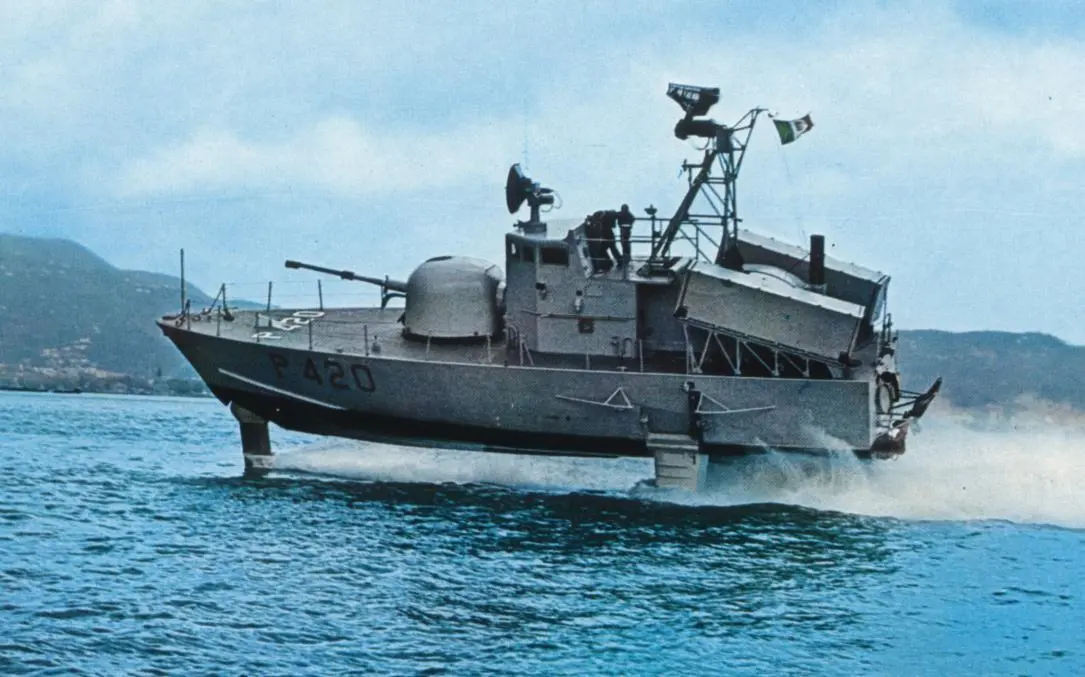
Much of this development was focussed in Russia and Italy where fast ferries were operated mainly on rivers and sheltered waters. Most of these early concepts focussed on using surface piercing foils, where the top part of the foil was above water, in a vee-configuration that created a self-stabilising system.
It was the military’s requirement for high speed patrol boats that led to the development of much more sophisticated hydrofoils based on computer controlled fully submerged foil systems. The US Navy Pegasus class was developed in 1977, and the Boeing jetfoil, originally developed for military requirements, was the first of these computer controlled hydrofoils to be refined for passenger carrying. With this form of hydrofoil speeds moved up to 50 knots, with some military versions capable of even higher speeds.
These were highly sophisticated craft, employing gas turbines with waterjet propulsion, in which a computer controlled the attitude of the vessel to give a remarkably level ride in waves. However it was this very sophistication that was to lead to the eventual downfall of the concept when much simpler catamaran ferries and, later, wave piercers were developed. 20 Boeing Jetfoils were built, and then they were constructed under licence by Kawasaki in Japan. Some of the Kawasaki jetfoils and a number of Russian and Italian built hydrofoils using surface piercing technology are still operating on several routes.
Few pure hydrofoil craft are built today and even the pioneer builder Rodriquez has now moved over largely to building fast catamaran and monohull ferries. However, foils are still widely used on ships and fast craft but they have now been relegated to a secondary role. The best known and most extensive use is in the fin stabilisers that are used on most passenger ships and large yachts. Some fast ferries use a more sophisticated ride control system based on T-foils at the bow and stern. Foil-based, computer-activated ride control systems are offered by companies including Naiad and Rolls-Royce that allow both pitching and rolling motions to be controlled.
A more basic application of foil systems is used in modern foil-assisted catamarans. Here a main foil, which is located between the two hulls, generates lift, which in turn reduces the wetted area of the hull and hence the friction. This main foil, which is located close to the longitudinal centre of gravity, is balanced by a pair of canard foils at the stern. The canard foils are usually adjustable in angle of attack so that the lift of the hull can be balanced according to the loading and the sea conditions.
This concept of foil assisted catamaran was originally developed in South Africa by Hysucraft and has been further developed by Teknicraft in New Zealand. Both companies licence their technology and many of these catamarans up to 30m in length have been built. They are widely used in the USA where Kvichak Marine has produced a series of these craft as the basis of passenger ferries and work boats. The designs have currently reached their third generation, where the sophisticated catamaran hulls are matched to an aluminium foil that is machined from a solid billet.
All American Marine is heavily engaged in building these craft and is currently developing two low-wash fast ferry designs for use on Puget Sound as commuter ferries. Geo Shipyard has built two catamarans using the Hysucraft technology for the Army Corps of Engineers as survey craft.
Development of foil assisted craft continues and it is reported that Rodriquez in Italy has a fully submerged foil craft under development. The prototype, known as the FSH-38, is reported to have completed the first phase of its sea trials. Development has been undertaken under a research project that has been partly funded by the European Union.
Another development at Rodriquez is the development of a foil assisted SWATH concept. This is similar to a foil assisted catamaran, and by attaching foils between the hulls of a SWATH the concept should produce a vessel that can operate effectively in rough seas combined with the ability to lift in the water in more moderate conditions, allowing it to maintain higher speeds. This concept has been around in various forms for many years. One previous concept was a SWATH style design where the hulls would float close to the surface and the foils would be used to produce negative lift to lower the hull in rough conditions.
Rodriquez’s AliSwath is reported to be under construction at their Messina shipyard but the application and focus of this new development have not been disclosed.
The effectiveness of foil craft can be seen in a sail craft built in France. L’Hydroptère is an 18m long by 23m wide trimaran that rides on foils at speed and it has recently set a world record under sail at 51.6 knots. As a sailboat it is totally impractical but the concept does demonstrate how foils can be used effectively to reduce the resistance of a hull by lifting it clear of the water. In these days when operators are seeking increased fuel economy there may be a motive to return to hydrofoil designs because of the efficiency they offer
However it does seem as though the days of the pure hydrofoil may be over, thanks to competition from less complex concepts. There is no current apparent demand for speeds of over 35 – 40 knots for fast ferries so that the use of foils will probably be relegated to applications where foils can be used to increase the efficiency of existing designs, such as catamarans and SWATHS. Certainly the development of the foil assisted catamaran continues and with an increasing focus on ride control systems, foils are finding many applications in the modern world. They are most effective on faster craft but there could be future applications on larger slower ships in the quest for increased efficiency.
Related Articles
 PROPULSION
 GENERAL NEWS
 HYDROGEN