



Innovative OSV design unveiled
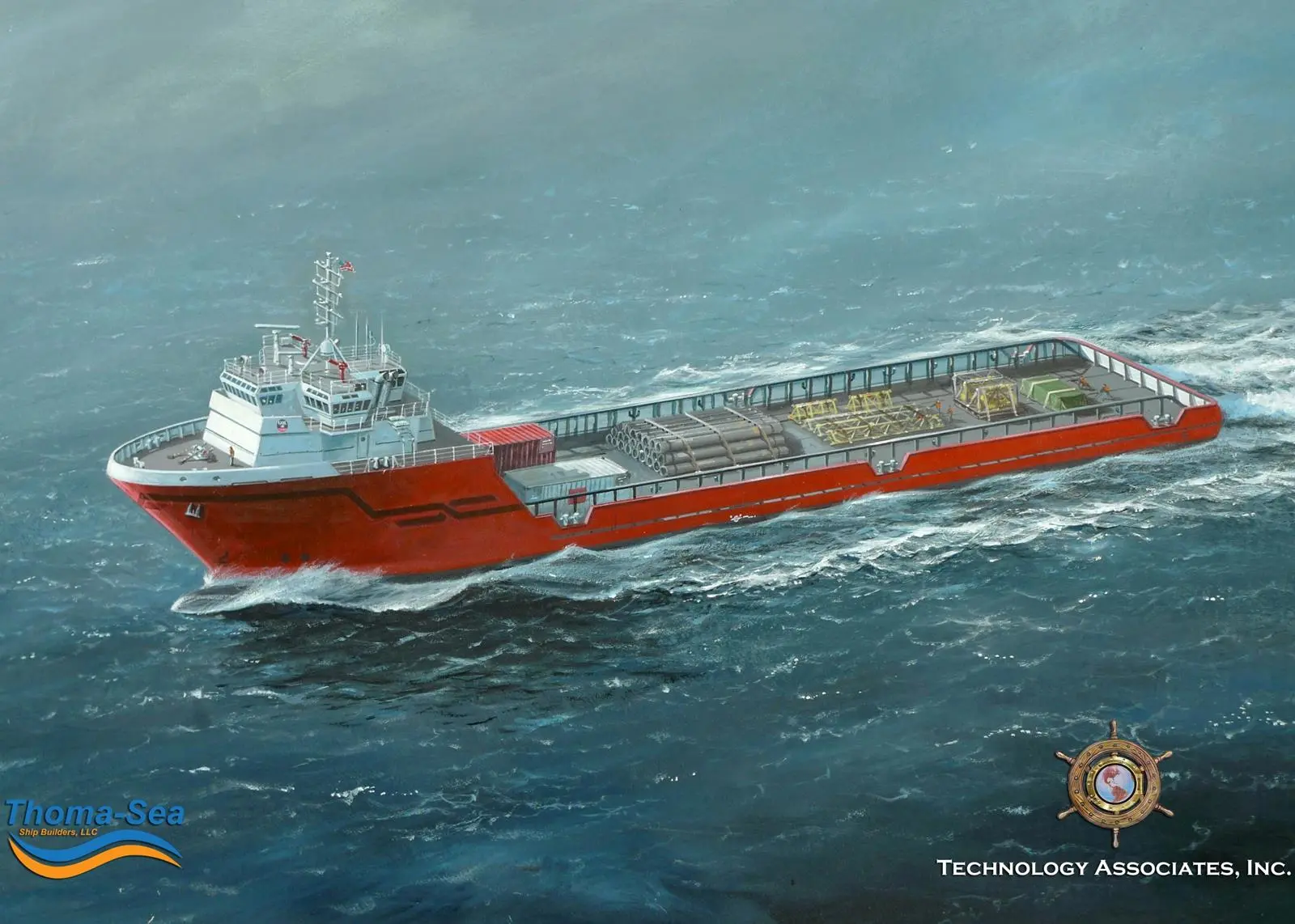
The ‘Technology EnviroMax 300’ design was developed in conjunction with Thoma-Sea Shipyards which will build up to six of the vessels at its yard in Lockport, La. The shipbuilder also intends to build more vessels to the new design at its shipyard in Houma, La.
A significant innovation is the use of the minimal welding bulkhead (MWB) concept for easier building and maintenance. This proprietary structural method is different from conventional methods and has a higher strength to weight ratio. The design of MWB bulkheads and floors allows for lower production cost, rapid construction, and maintenance free and efficient cleaning of tanks. Minimising welding also reduces green house gas emissions during production.
The first series of vessels are a part of a newbuild program for Gulf Offshore Logistics (GOL) and other builders and owners have also expressed an interest in the design. The 89.9m x18.9m x 7.01m vessel can carry in excess of 18,000 bbls of liquid mud and the target deadweight of the vessel is in excess of 5,700 tonnes. The vessel can also carry in excess of 3,400 tonnes of deck cargo, over 11,000ft3 of bulk mud, over 1,800 bbls of methanol, some 650,000 gallons of drill water, 68,000 gallons of potable water and over 270,000 gallons of fuel.
Even when the ship is fully loaded with deck cargo, there is a clear unobstructed passage way on both port and starboard side from forward to aft of the vessel outside the cargo rails which has been achieved without any loss in the deck cargo space. Use of cargo rails for venting the tanks and elevated spill containment is part of a TAI proprietary and copyrighted innovation in OSV design allowing the owner to gain maximum clear space with minimal additional construction cost. Traditional OSV’s have pipe vent, spill containments, and discharge and loading station obstructions outside the cargo rails which inhibit safe movement for the crew.
Overall hull performance has been optimised by minimising wave resistance at the fore body thanks to the development of an advanced bulbous bow both hydrodynamically and from a build-ability aspect. Continuous refinement of hull lines resulted in a 30% net reduction in wave resistance giving more speed with a lower installed engine power.
The OSV is equipped with an advanced DP2 dynamic positioning system allowing for good station keeping in the highest possible sea state. The main propulsion installation includes two Rolls-Royce US255P azimuth thrusters driven by 2,200kW electric motors giving a maximum speed in excess of 14 knots. The two CPP bow thrusters, each rated at 1,000kW, are also electrically driven. Thoma‐Sea decided to use Rolls-Royce as a complete integrated single system supplier which includes all generators and all major electric motors, the joystick system (POSCON), the ICON DP system and switch boards and propulsion drives.
The diesel electric plant comprises two 1,700kW and two 2,000kW gensets resulting in a total installed electric power of 7.4MW. A separate small generator allows in port duty and the total shut down of the diesel electric plant in harbour for additional fuel savings and carbon foot print reduction.
As the name implies, the ‘Technology EnviroMax 300’ design pays particular attention to environmental consideration and will carry the ABS Enviro notation on its certificate.
Recognising emerging legislation due to the 2010 Macondo oil spill in the Gulf of Mexico, oil and gas operators will be required to have enhanced and more capable oil spill response capability. The new OSV design has the flexibility to be readily adapted to oil spill collection functions while adaptations of the hull form also allow it to be used for short sea container shipping as well as a sub‐sea maintenance and support vessel.
Design parameters
The ‘Technology EnviroMax 300’ OSVcame about when Thoma‐Sea presented a set of challenging requirements to TAI which led the company to undertake an extensive study prior to developing the design goals and philosophy for the new OSV. This included a comprehensive analysis of publicly available cargo carrying capacity information of most leading designs in the industry.
In order to achieve a design that was superior in its capabilities as well as flexible in its applications, it would have to meet a number of criteria:
1. Maximised hull cargo space to total hull volume space ratio. This is a ratio developed by TAI whereby the volume of the hull devoted to actual carriage of cargoes is divided by the total volume of the hull. Even though all traditional OSV designs have hull cargo allocation which exceeds the vessel’s deadweight, the maximisation of this ratio is necessary to provide the vessel owner the optimum flexibility to market its vessel and carry a maximum mix of cargoes at any one time.
2. The design would need to have a hull form to achieve an optimal balance between minimum hull resistance and maximum deadweight. This means maximising the block coefficient to provide the maximum deadweight while minimising hull resistance and optimising sea keeping capabilities. The increased block coefficient intuitively goes against the least resistance approach and extensive computational fluid dynamics (CFD) analyses were performed in conjunction with MARIN to optimise the wake flow characteristics, the hull shape and the bulbous bow. Since deep water oil fields are further away and the transit distances are becoming longer, maximising transit speed is a key issue in offering more cargo to site with maximum annual turn around trips, thus increasing vessel utility for the charterer.
3. Within the new IMO environmental regulations, and the need to obtain ABS Green Passport and Enviro classification, the distribution of cargoes and their relative contiguity within the hull had to be reconsidered in order to obtain maximum use of the available hull space and obtain the hull cargo ratio in excess of other vessels in the marketplace. All of the pollution abatement equipment is in compliance with the latest MEPC regulations of MARPOL. The vessels will also be certified for ISM, IAPP, IOPP, and EIAPP while the coating systems will meet all the regulations for obtaining an international antifouling system certificate. Organotin compounds are not being used in the hull coating and all refrigerants used in the vessels are environmental friendly.
4. In the past, OSV designers have not concentrated their effort towards minimising fuel oil consumption because in traditional charter hire contracts the oil companies have provided the fuel. This contractual arrangement has not provided the vessel owner or designer with an incentive to minimise fuel consumption. However, in view of the increasing energy costs, oil and gas companies will start looking at the fuel consumption aspect very closely. By ensuring minimum fuel oil consumption this new design also provides a payback in terms of reduced emissions.
The above criteria led to a careful evaluation of the vessel’s power plant, propulsion system and to the choice of a carefully designed diesel electric power and propulsion system for optimal use of fuel consumption in transit and DP modes.
Retention of the best crews is an important aspect of successful OSV operations and significant effort was expended to ensure that the vessel design is sea kindly, and the accommodations and operational systems are designed with crew comfort in mind.
To keep life cycle maintenance cost low, simplicity of on-board systems, choice of supportable modern systems, ease of on-board and shipyard maintenance were also a design criteria.
The engine room is located forward with a proven stainless steel dry exhaust system, featuring noise and vibration reducers. Locating the engine forward has many advantages including access to the machinery space, operation and maintenance is facilitated and piping and cable routing are simpler. The diesel gensets are mounted using resilient mounts to minimise vibrations and noise while structure borne and airborne noise is reduced as much as possible.
Related Articles
 PROPULSION
 GENERAL NEWS
 HYDROGEN