



New force arrives in the super heavy-lift sector
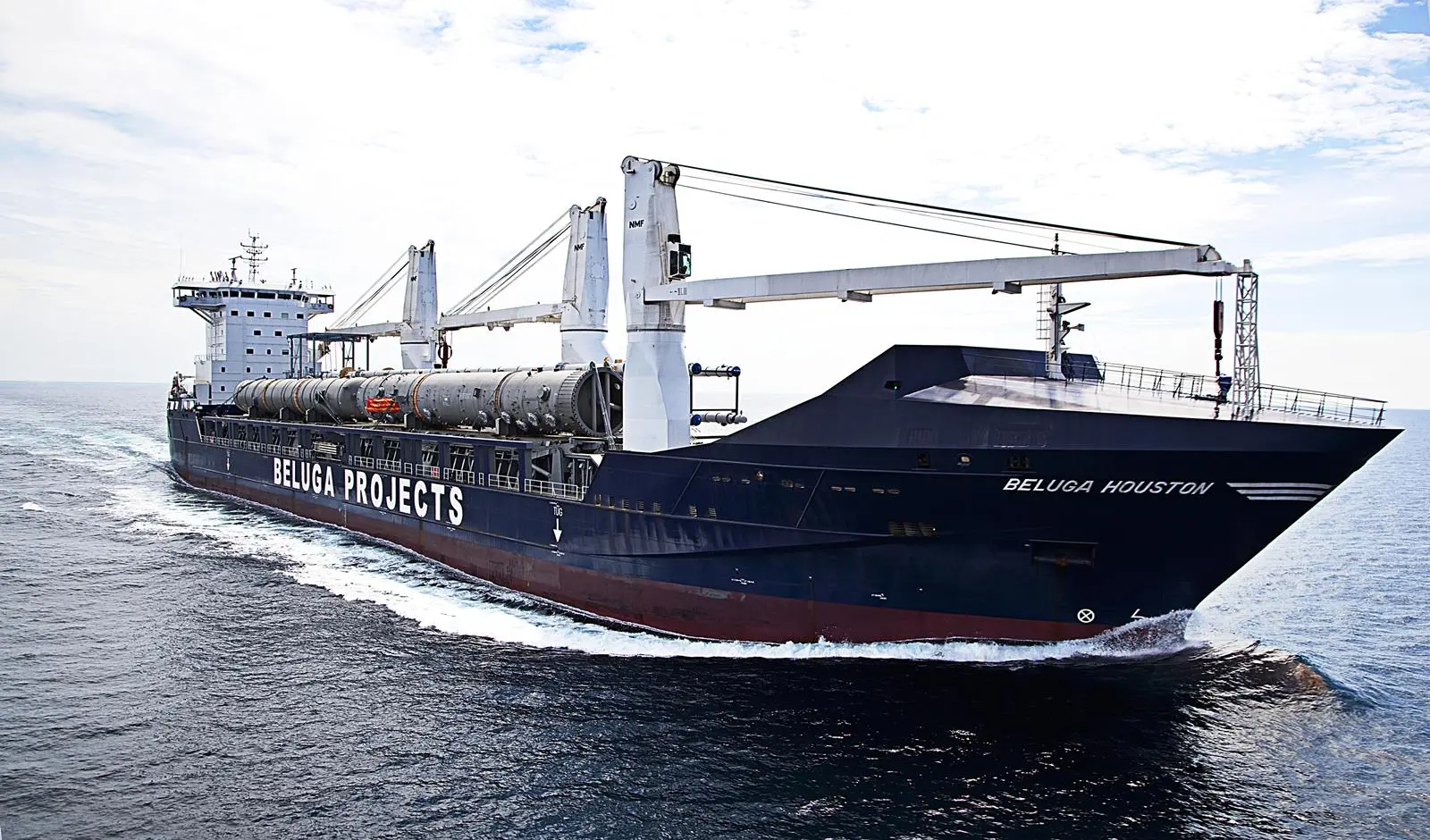
The 20,000 dwt P2 -type class of heavy-lift vessels were designed by Volharding Shipyards in the Netherlands and built in China by Hudong Shipyard. The class comprises four P2-800 and six P2-1400 types. The company has also ordered six of the slightly smaller 19,100 dwt P1 class vessels which are being built at the Qingshan Shipyard in Wuhan, China.
Beluga Houston was delivered as the first of the new Beluga flagships with 800 to 1,400 tonne crane capacities and an ice classification of Finnish-Swedish 1 A (German E3).
The newbuilding is a P-800 vessel where cranes 2 and 3 each have a capacity of 400 tonnes SWL, combinable to 800 tonnes SWL, and crane number 1 which has a lifting capacity of 120 tonnes. On the P2-1400 vessels, cranes 2 and 3 each have a capacity of 700 tonnes SWL, combinable to 1,400 tonnes SWL, while crane number 1 has a lifting capacity of 180 tonnes. All of the cranes for this class are being supplied by NMF in Germany.
With an overall hull length of 168.68m, a moulded breadth of 25.20m, a depth of 13.85m and a draught of 9.50m, the vessel has a gross tonnage of 17,628 tons and is strengthened for heavy cargoes while also capable of carrying 958 TEU or 428 FEU plus 102 TEU containers. The two holds have a total capacity of 25,959m3 and each has a removable tween deck to increase the amount of cargo area.
The propulsion system consists of a 9,800kW MAN 7L 58/64 diesel engine driving a single propeller for a service speed of 17 knots. Steering is by means of a free-hanging flap type of rudder while the vessel is also equipped with an 800kW bow thruster. Auxiliary power is provided by three 850kW gensets, a 150kW emergency genset and a 1,550kW shaft generator.
The newly constructed vessels of the P-class are equipped for voyages through polar latitudes and are capable of traversing the route of the Northeast passage along the Siberian coast, which shortens the sea transit from Europe to Asia by about one-third.
Related Articles
 PROPULSION
 GENERAL NEWS
 HYDROGEN