



Harnessing the wind
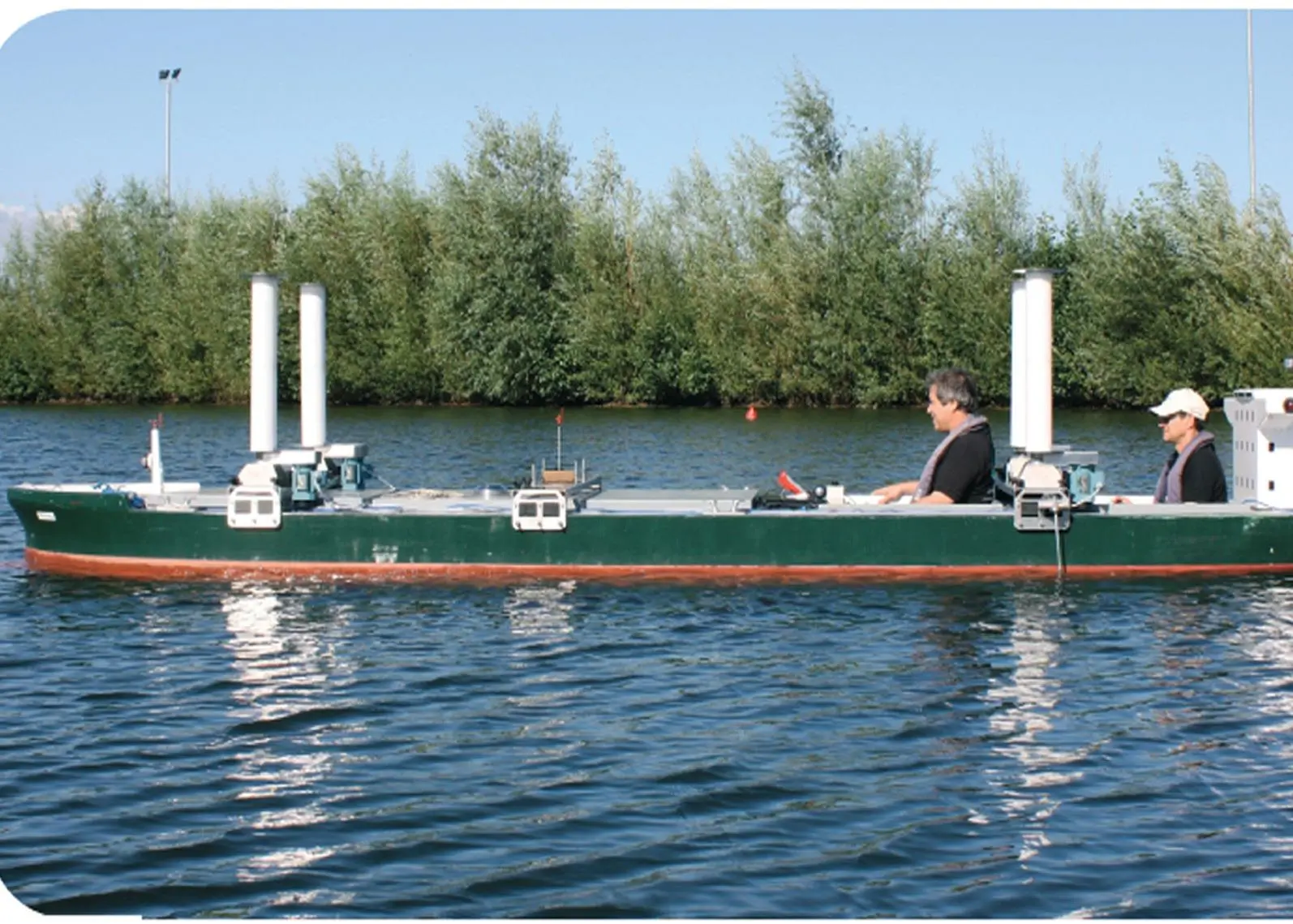
Wind engines are one of their projects, and the charity has been looking at a concept based on the Flettner Rotor, a spinning rotor that successfully sailed the Atlantic back in 1926.
Wind tunnel tests carried out by Greenwave have established that thrust developed by a Flettner rotor is 8 to 10 times more than the thrust developed by sails of equal surface area, and its team have since carried out a series of performance, handling and stability tests on a scaled wind engine aboard a a 25:1 scale model at Warsash Maritime Academy in Southampton.
Under the supervision of Lloyd’s Register, the model test results showed that wind assisted ship propulsion can produce significant fuel and emissions savings in favourable winds. The wind engines were also tested successfully in manoeuvring and crash-stopping of the vessel when counter rotated. The results shown by the model ship, lead to a decision to build a full scale rotor.
A full scale prototype, 17m high and 2.3m diameter, was fabricated and erected at the Port of Blyth in the North East of England, on a site close to the sea where strong winds are often experienced. The entire procedure with all the required testing equipment for the evaluation of the results was monitored by a Lloyd’s Register surveyor and the tests were witnessed by Lloyd’s Register’s Technical Investigation & Analysis department who verified the results.
The process of manufacturing and assembling the wind engine has proved an important learning curve for future development, and the next stage will be to develop and construct two improved type wind engines, which are to be installed on a sea going ship, for sea trial tests in actual sea conditions.
The wind engines, once implemented, can reduce greenhouse gas emissions and other exhaust harmful emission like NOx and SOx by an average of about 13% per ship per year which is claimed will make it the technology that delivers the most savings within this industry.
Greenwave achieves its objectives by funding research and development of emission reduction technologies to a fully developed and sea-trial stage, independently verified and type approved by Lloyds Register. The charity’s R&D team is made up of aerodynamics and hydrodynamics experts and based both in New Zealand and the UK, and their work is focused on developing systems that will deliver substantial reductions on harmful emissions.
Related Articles
 PROPULSION
 GENERAL NEWS
 HYDROGEN