



Stena E-MAXair – probably the greenest tanker in the world
Increasingly strict regulations on emissions reduction as well as the sombre assessment of expert panels on the development of the oil price further add to the cost pressure the industry is facing.
The Swedish shipping company Stena Bulk, a subsidiary of the Stena Group (Stena AB) and one of the leading tanker shipping companies with a fleet of 74 ships, has paved the way for a sustainable future by combining the most practicable and innovative eco-technologies on one ship, known as E-MAXair.
The main focus of the Stena E-MAXair concept is on reduced bunker consumption and emissions and full redundancy with double engines, duplicate steering gear and duplicate navigation systems. The vessel will still do an equally good, if not better, job as existing intermediate tonnage and will have ice class 1A. She will, of course, be built in accordance with the Stena MAX concept regarding redundancy, safety and large cargo intake on a shallow draught.
Stena set clear objective and high standards with this 158m long, 23m wide 16,400 dwt chemical tanker concept, which is to create more sustainable shipping. Concern for the environment, in combination with extremely competitive transport economy as well as maximum safety, are the entrance tickets to new markets and new business opportunities.

The SkySails kite system is one of the four core technologies that should make E-MAXair the ‘greenest tanker in the world’. Due to its specific technological advantages, the towing kite propulsion fits the overall propulsion concept of tanker ships and can generate significant fuel and emission savings.
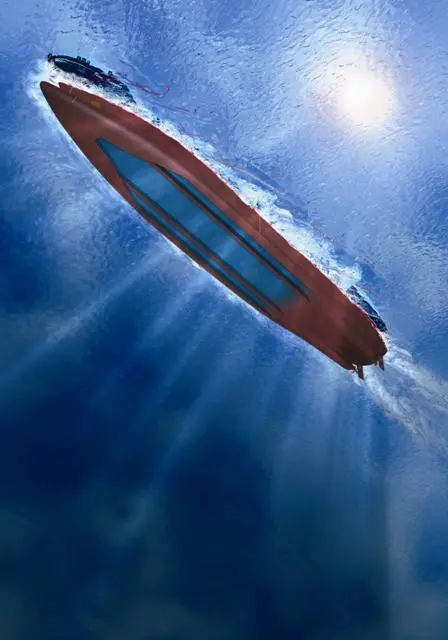
Aside from the SkySails technology, the tanker has an optimised hull design as well as a specially developed and patented hull construction based on an air pocket system under the vessel. In addition, the tanker is designed for operation with LNG, the cleanest and most effective fuel available for ships today.
With the help of engines running on LNG, the optimised hull design and slow-rotating propellers, Stena claims to have reached its goal. Fuel consumption is considerable reduced and emissions lowered, thus making Stena E-MAXair probably the greenest tanker in the world.
Although the E-MAXair is designed for LNG, the main engine as well as the auxiliary engines can also run on regular diesel fuel. With its engines running on LNG the vessel is said to produce 35-40% less CO2 than a conventional vessel of comparable size, 90% less NOx, no SOx and 99% fewer particles, and all this without using catalytic converters!
Fully bunkered with LNG, the Stena E-MAXair can sail non-stop for 22 days and, when trading in an area where LNG bunker is not available, the vessel can use regular fuel oil. Running on LNG has secondary economic effects as it reduces the need for maintenance of both the main and the auxiliary engines.
The hull is optimised for the water flow when cruising at 13 knots which, in combination with two large, slow rotating propellers, reduces fuel consumption. The hull construction allows the vessel to float or glide on a cushion of air. The air pocket under the vessel is extended forward with help of the newly developed bulbous bulb and air pressure is maintained by compressors. Since friction between water and air is lower than between water and hull, resistance is reduced.
Industry experts are convinced that this concept leads the way into the future as well since the ‘Green Shipping’ was the main topic of 2009’s NorShipping in Oslo and the E-MAXair concept won the ‘Clean Innovation Award’.
Stena E-MAXair tonnes of fuel /day
1. Optimal configuration of the hull saves 2.5
2. Air Mix saves 1 – 1.5
3. LNG energy density saves 2
4. Kite sail saves 0.5 –1
Sum of total savings: 7 tonnes fuel /day
Cruising at a speed of 13 knots the Stena E-MAXair consumes 15 tonnes of LNG fuel per day while a traditional tanker of the same size consumes 22 tons of fuel oil at normal service speed, a 32% reduction. Lower fuel consumption makes a great difference as it benefits the environment and improves transport economy.
Related Articles
 PROPULSION
 GENERAL NEWS
 HYDROGEN